5 Essential Workplace Trends Stories for HR Leaders


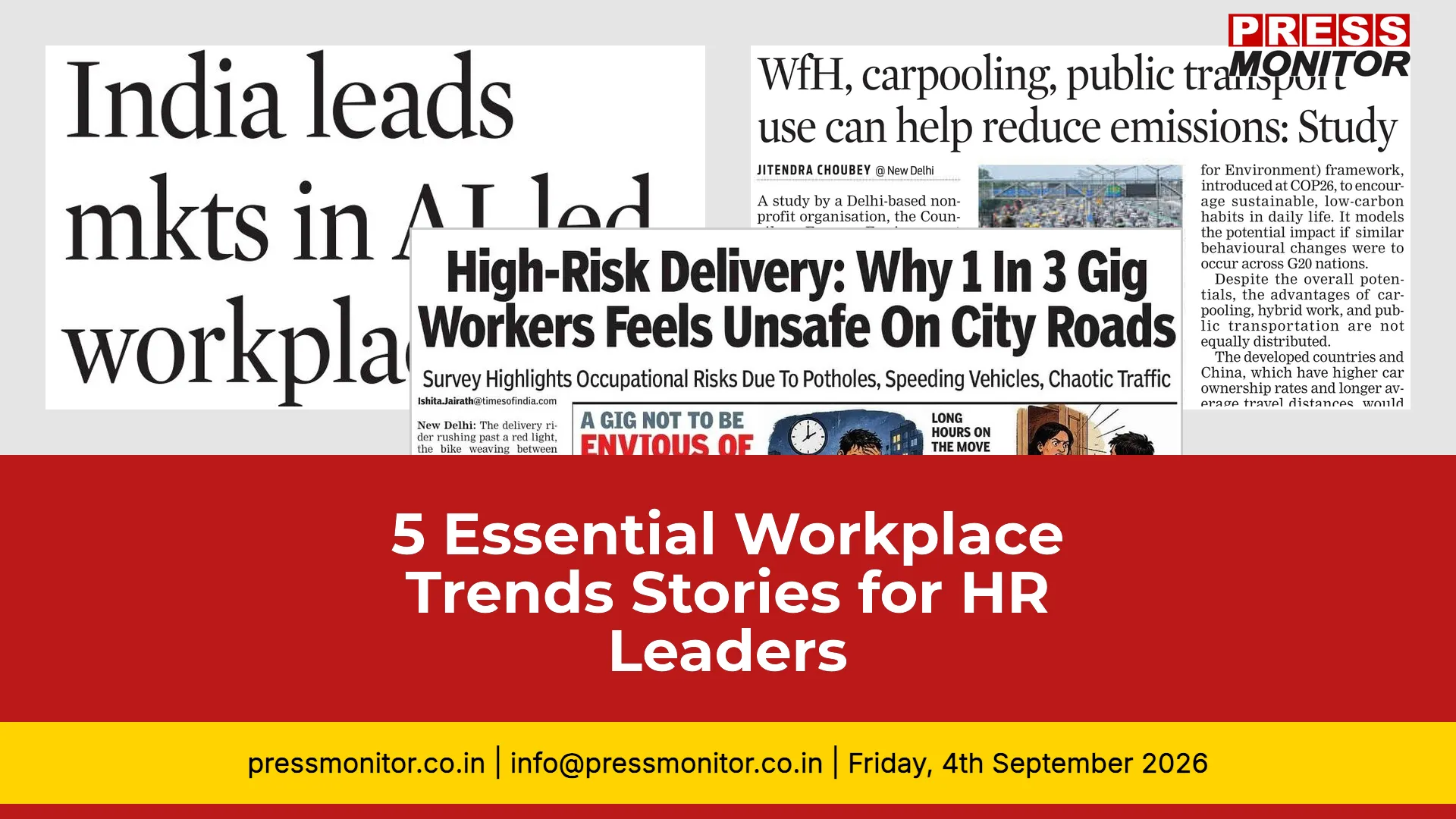
Media monitoring of Indian print publications reveals five stories reshaping how India works — from AI frontiers to gig worker safety. This press review delivers media intelligence on the news on workplace trends that matter most, powered by Press Monitor's print media monitoring.
1. India Leads AI Frontier Professional Adoption
A front-page report in Morning Standard says India has emerged as the leading market for AI-driven workplace transformation, with 32% of its AI users classified as Frontier Professionals—the highest share among 10 countries studied. The Microsoft 2026 Work Trend Index found that 78% of Indian AI users said AI was enabling work not possible a year ago, compared with 58% globally. The study also found stronger leadership alignment on AI in India at 44%, compared with 26% globally.
Why it matters: India has become the global leader in AI-driven workplace transformation, and this data should inform every organization's AI adoption strategy.
Key detail: 32% of Indian AI users are classified as Frontier Professionals — the highest share among 10 countries studied. 78% say AI enables work not possible a year ago, compared with 58% globally. Leadership alignment on AI in India stands at 44%, versus 26% globally.
Source: Morning Standard, 18 July 2026, by Padmini Dhuvajaraj
Next step: HR leaders should audit their AI readiness and upskilling programs against these benchmarks. Tag your CHRO and start the conversation.
2. 408-538 Million Tonnes CO2 Emissions Cut
A front-page report in Morning Standard says a Delhi-based study by the Council on Energy, Environment and Water found that promoting carpooling, expanding bus use and adopting hybrid work models could reduce annual passenger transport emissions across G20 countries by 408 to 538 million tonnes of CO2 by 2050. The study estimates these behavioural shifts could save approximately 2,715 million tonnes of oil between 2025 and 2050, translating to an economic value of around USD 2.3 trillion.
Why it matters: Hybrid work is not just a cultural shift — it is a climate strategy with measurable economic impact that every sustainability team should track.
Key detail: Promoting carpooling, expanding bus use, and adopting hybrid work models could reduce annual passenger transport emissions across G20 countries by 408 to 538 million tonnes of CO2 by 2050. These behavioural shifts could save approximately 2,715 million tonnes of oil, translating to an economic value of around USD 2.3 trillion.
Source: Morning Standard, 18 July 2026, by Jitendra Choubey
Next step: Corporate real estate and sustainability teams should integrate transport emission data into ESG reporting. Share this with your sustainability lead.
3. 3 in 4 Gig Workers Feel Unsafe
A front-page report in Times of India says a Janpahal non-government organisation and Gig Workers Association of India survey released Thursday found that Delhi gig workers face hazardous road conditions, with nearly three fourths saying they felt unsafe while travelling on roads for work and more than four in five reporting near misses. The nationwide report examined food and grocery delivery workers, ride-hailing drivers, e-commerce delivery personnel and personal care workers, highlighting potholes, speeding vehicles, customer harassment, long hours, lack of safety training and extreme weather.
Why it matters: As the gig economy expands, worker safety must become a non-negotiable part of platform governance and corporate supply chain policy.
Key detail: Nearly three-fourths of Delhi gig workers feel unsafe while travelling on roads for work, and more than four in five report near misses. The survey covered food and grocery delivery workers, ride-hailing drivers, e-commerce delivery personnel, and personal care workers.
Source: Times of India, 4 September 2026, by Ishita Jairath
Next step: Companies relying on gig labour should mandate safety protocols and insurance coverage for delivery and ride-hailing partners. Tag your procurement lead.
4. Buggy Receipt Sparks Waitstaff Training Debate
A front-page report in Deccan Herald says a cafe cashier in Bengaluru recently printed a customer's weight description instead of their name on a bill, sparking concerns about waitstaff sensitisation. Restaurant owners and insiders interviewed by the publication describe structured induction programmes covering soft skills, emotional intelligence, cultural sensitivity, and conflict management to ensure respectful service. Establishments like Continuum, Shiro, Noba, and Eat in Love Trattoria emphasise empathy, dignity, and professional boundaries in their training protocols.
Why it matters: Service quality directly impacts brand reputation and customer loyalty in India's growing hospitality sector, and empathy training is now a competitive advantage.
Key detail: A cafe cashier in Bengaluru printed a customer's weight description instead of their name on a bill, sparking concerns about waitstaff sensitisation. Restaurants like Continuum, Shiro, Noba, and Eat in Love Trattoria now emphasise empathy, dignity, and professional boundaries in their training.
Source: Deccan Herald, 4 September 2026, by Rashmi Rajagopal
Next step: Hospitality firms should institutionalise empathy training as a core onboarding module. Tag your HR director.
5. Maharashtra Mandates Healthy Food at Government Events
A front-page report in Free Press Journal says the Maharashtra state cabinet chaired by Chief Minister Devendra Fadnavis has made healthy snacks, nutritious meals and balanced menus mandatory at government and semi-government meetings, official programmes, training sessions, conferences and canteens across the state. The move aims to promote healthy eating habits and balanced lifestyles among government officers and employees, with departments ensuring nutritious food is served at all official events. Preferred snacks include seasonal fruits, boiled eggs, boiled pulses, poha, idli-sambar, hot milk and sugar-free green tea, while oily and highly processed snacks are to be reduced.
Why it matters: Government-led wellness mandates set a precedent for private-sector workplace health policies and signal a shift toward preventive health in Indian workplaces.
Key detail: The Maharashtra state cabinet chaired by Chief Minister Devendra Fadnavis has made healthy snacks, nutritious meals, and balanced menus mandatory at all government and semi-government meetings, official programmes, training sessions, conferences, and canteens. Preferred snacks include seasonal fruits, boiled eggs, boiled pulses, poha, idli-sambar, hot milk, and sugar-free green tea.
Source: Free Press Journal, 4 September 2026, by Kalpesh Mhamunkar
Next step: Corporate wellness teams can benchmark Maharashtra's menu standards for their own office canteens and event catering. Tag your facilities manager.
As these stories show, the workplace is being reshaped by technology, policy, and cultural shifts in equal measure. Which trend will your organisation prioritise next?