5 Key Green Energy Stories for Energy Leaders


India's green energy transition is accelerating, with developments in green hydrogen, solar innovation, and policy direction shaping the sector. According to Press Monitor's tracking of Indian publications, these five stories capture the most impactful moves this week. Here's your essential media intelligence roundup.
1. BHEL Partners with Hystar AS for Green Hydrogen Electrolyser Manufacturing
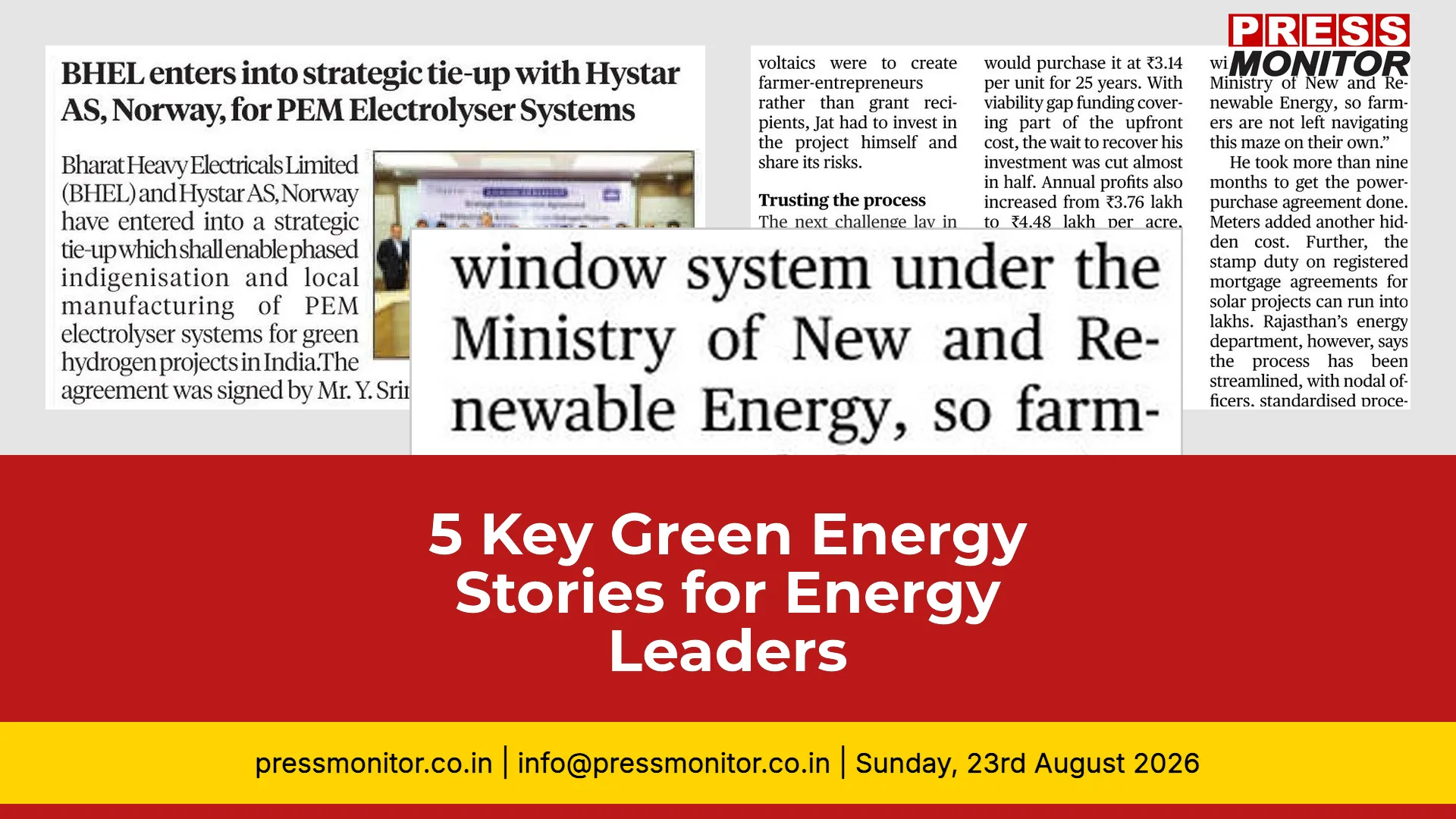
A front-page report in Statesman says BHEL has entered into a strategic tie-up with Hystar AS, Norway for the phased indigenisation and local manufacturing of PEM electrolyser systems for green hydrogen projects in India. The agreement was signed by Mr. Y. Srinivas Rao and Mr. Sutripto De on behalf of BHEL, and by Mr. Fredrik Mowill on behalf of Hystar AS, in the presence of senior officials.
Why it matters: This strategic tie-up aims to indigenise PEM electrolyser production, reducing import dependence for green hydrogen projects.
Key detail: BHEL signed an agreement with Hystar AS, Norway, for phased local manufacturing. Mr. Y. Srinivas Rao and Mr. Fredrik Mowill led the signing.
Source: Statesman (front-page)
Next step: Watch for pilot projects under India's National Green Hydrogen Mission.
2. Solar Retrofitting Boosts Farmer Income in Rajasthan
“A lot of individual farmers told us, ‘We already have a steady source of income. If construction means losing energy revenue during that period, we’re not interested,” recalls Subhodeep Basu, a researcher at ICRIER, who worked on the ‘Solar as a Third Crop... study. Hence, they retrofitted the plant, one inverter at a time, allowing the remaining sections to continue generating electricity. "That way we could minimise this energy loss,” says Basu. The ICRIER team decided to advise farmers on which crops were most likely to thrive beneath the panels. Jat chose maize, hoping to grow it during the off season under the cooler microclimate created by the panels, when supplies were thin and prices higher. "This year, we harvested an abundant maize crop with much less water,” says Shiv. For this pilot, the additional cost of retrofitting, i.e., 735.3 lakh, was provided by Kotak Mahindra through their CSR programme Kotak Karma. The electricity generated by the plant would continue to flow into the grid, where Rajasthan’s distribution utility, Jaipur Vidyut Vitran Nigam Ltd. (JVVNL), would purchase it at %3.l4 per unit for 25 years. With viability gap funding covering part of the upfront cost, the wait to recover his investment was cut almost in half. Annual profits also increased from %3.76 lakh to %4.48 lakh per acre, while the expected return on investment rose from l2% to l8%.
Why it matters: AgriPV models can increase farmer revenue while generating clean energy—a win-win for rural India.
Key detail: ICRIER's pilot with Kotak Mahindra CSR allowed farmers like Shiv to grow maize under panels, increasing profits from ₹3.76 lakh to ₹4.48 lakh per acre.
Source: The Hindu
Next step: Scaling agriPV requires clear definitions, as noted by NSEFI CEO Subrahmanyam Pulipaka.
3. Solar Project Costs and AgriPV Definition Gaps
A front-page report in The Hindu says that meters added another hidden cost. Further, the stamp duty on registered mortgage agreements for solar projects can run into lakhs. Rajasthan’s energy department, however, says the process has been streamlined, with nodal officers, standardised procedures, simpler land acquisition processes and the shifting of implementation from the Rajasthan Renewable Energy Corporation to power distribution companies. Subrahmanyam Pulipaka, CEO, National Solar Energy Federation of India, says that for agriPV to move beyond pilots, India must first establish a clear definition of what constitutes an agriPV project. India does not yet have formal standards, technical benchmarks or eligibility criteria.
Why it matters: Hidden costs like stamp duty and lack of agriPV standards hinder project expansion.
Key detail: Subrahmanyam Pulipaka calls for formal technical benchmarks for agriPV.
Source: The Hindu
Next step: Industry bodies and government must establish eligibility criteria.
4. Karnataka Govt Buildings Lag in Solar Rooftop Adoption
A front-page report in Deccan Herald says that rooftop solar systems can be installed on at least 59,OOO government buildings across Karnataka, potentially generating at least 698.2 MW of power, according to an analysis by the Energy Department.
Why it matters: 59,000 government buildings could generate 698.2 MW but remain underutilised.
Key detail: Energy Department analysis highlights potential for large-scale rooftop solar.
Source: Deccan Herald
Next step: Policy push needed to mandate rooftop solar on public buildings.
5. Vijender Gupta Calls on Universities to Lead Green Transition
A front-page report in Statesman says Delhi Legislative Assembly Speaker Vijender Gupta called on universities to lead India's green transition through research and innovation. Speaking at a Vice Chancellors’ Conclave in Faridabad on 22 August, he emphasised that campuses should serve as sustainable models to influence public policy and future generations.
Why it matters: Campuses as sustainability models can shape policy and future innovators.
Key detail: Delhi Assembly Speaker urged VCs to integrate green research and campus sustainability.
Source: Statesman
Next step: Universities to develop actionable green roadmaps.
These five stories, tracked by Press Monitor's print media monitoring, show the breadth of India's green energy momentum. Which development will have the biggest impact on your strategy? Share your thoughts.