5 Pivotal Alcoholic Beverage Stories for Industry Leaders


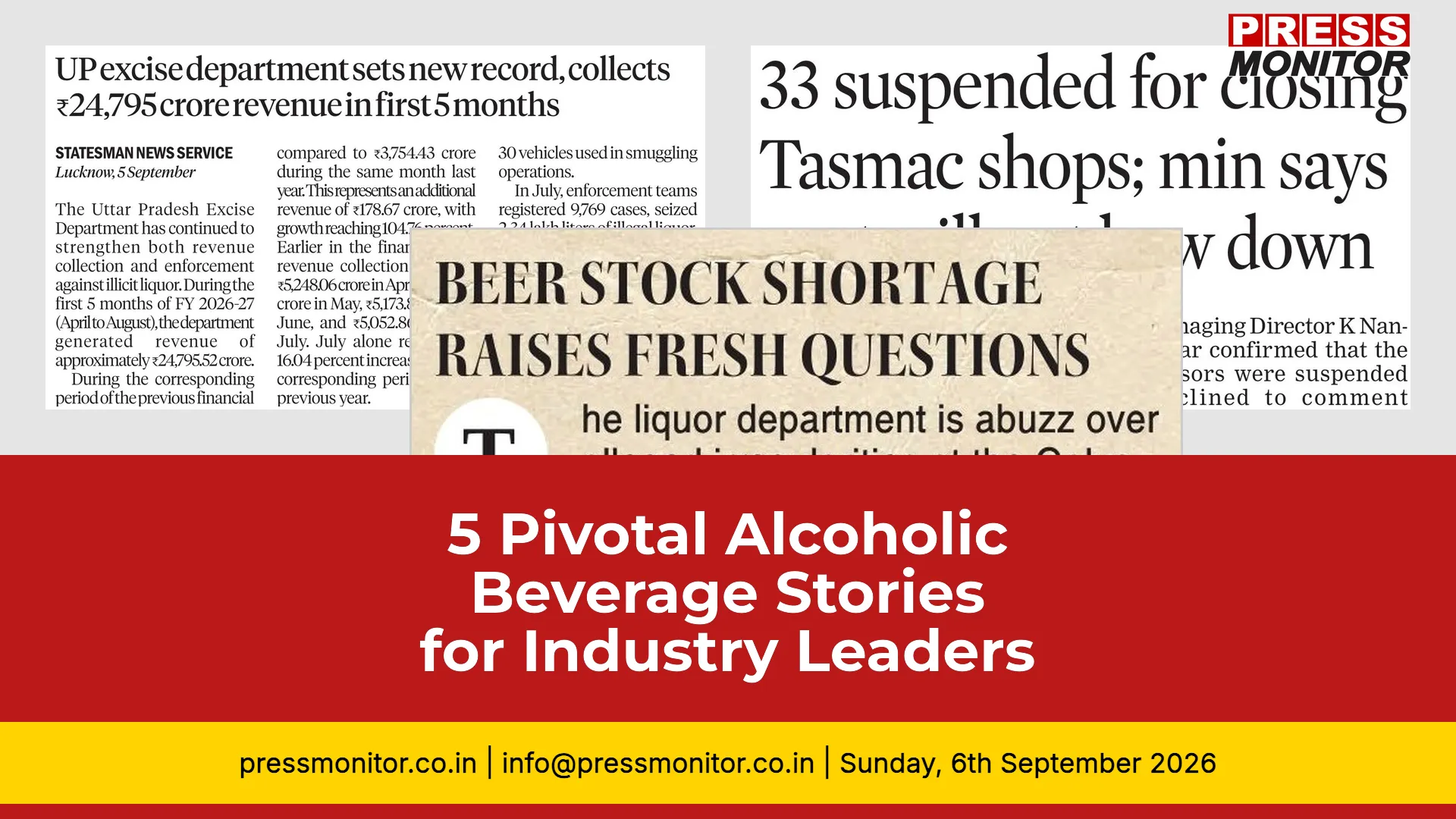
Tracking news on alcoholic beverages requires reliable media monitoring. Welcome to today’s press review. According to Press Monitor's tracking of Indian publications, the beverage sector is navigating record revenues, regulatory shifts, and supply chain scrutiny. Here are five essential developments shaping the market this morning.
1. Uttar Pradesh Excise Sets Revenue Benchmark
A front-page report in Statesman says the Uttar Pradesh Excise Department generated approximately 224,795.52 crore in revenue during the first five months of FY 2026-27, reflecting nearly 11 percent growth over the same period last year. The department collected 23,933.10 crore in August alone, representing 104.76 percent growth year-on-month. Alongside revenue collection, authorities registered nearly 30,000 cases against illicit liquor, seized over 9,000 lakh liters of illegal liquor, and arrested more than 4,600 individuals between April and June.
Why it matters: Fiscal performance directly impacts state policy and industry forecasting.
Key detail: The UP Excise Department generated ₹224,795 crore in five months, up 11% YoY, while cracking down on illicit operations with nearly 30,000 cases and 9,000 lakh liters seized.
Source: Statesman
Next step: Track how this surplus influences upcoming fiscal allocations and compliance audits across northern states.
2. Tasmac Suspends 33 Supervisors Amid Policy Pushback
A front-page report in New Indian Express says Prohibition and Excise Minister K Vignesh defended disciplinary action against overcharging Tasmac employees as the state-run liquor entity suspended 33 supervisors in Kancheepuram for allegedly keeping outlets closed during protests against the bottle buy-back scheme. The government will not bow to employee pressure and whoever charges extra will face punishment, Vignesh stated, adding the revamped bottle buy-back arrangement would be implemented in about 25 days.
Why it matters: State-run liquor entities face operational friction during scheme transitions.
Key detail: Prohibition and Excise Minister K Vignesh defended disciplinary action against overcharging staff, confirming the revamped bottle buy-back arrangement launches in roughly 25 days.
Source: New Indian Express
Next step: Monitor implementation timelines and stakeholder feedback ahead of the rollout.
3. Golya Depot Faces Beer Stock Inquiry
A front-page report in First India says alleged irregularities at the Golya depot have triggered an inquiry after an inspection uncovered a shortage of three thousand beer cases. The liquor department is examining the discrepancy, which follows earlier action against a former manager and additional inventory losses reported on August eight and nine. Authorities are now weighing further disciplinary measures against those implicated.
Why it matters: Inventory discrepancies trigger supply chain audits and potential leadership changes.
Key detail: An inspection revealed a shortage of 3,000 beer cases, prompting the liquor department to examine the gap following earlier losses and managerial actions.
Source: First India
Next step: Review internal audit protocols and inventory reconciliation processes.
4. DST & Sadar Police Bust ₹60 Lakh Illegal Liquor Ring
A front-page report in First India says that the DST and Sadar police seized 335 cartons of illegal liquor worth Rs 60 lakh and arrested three persons in Dungarpur. Police intercepted two loading tempos near Motli turn on National Highway 48 and are questioning the accused about the consignment.
Why it matters: Enforcement intensity signals shifting regulatory priorities and market safety standards.
Key detail: Authorities intercepted two loading tempos near Motli turn on NH-48, seizing 335 cartons and arresting three suspects involved in the unregulated distribution network.
Source: First India
Next step: Align distribution channels with updated compliance checkpoints and route verification.
5. Monsoon Tourism Drives Distillery & Vineyard Visits
A front-page report in The Hans India says five Indian destinations—Goa, Coorg, Munnar, Nashik and Lonavala—offer getaways during monsoon season focused on nature, plantation tours, distillery visits, vineyards and waterfalls. The report highlights Goa's spice farms, Paul John Distillery and Dudhsagar Falls, Coorg's coffee estates, Munnar's tea gardens, Nashik's vineyards and Lonavala's misty routes for travellers seeking a slower seasonal escape.
Why it matters: Experiential consumption is reshaping brand engagement and regional hospitality economics.
Key detail: Travel guides highlight Goa’s Paul John Distillery, Nashik’s vineyards, and plantation tours as peak seasonal draws, boosting local craft beverage exposure.
Source: The Hans India
Next step: Leverage seasonal travel trends for targeted experiential marketing campaigns.
Closing: Through rigorous print media monitoring, we capture actionable data before digital feeds catch up. Which of these regulatory or commercial shifts demands immediate attention from your team? Share your take below.