5 Pivotal Commercial Shipping & Ports Stories for Executives


Commercial Shipping & Ports executives need precise intelligence today. This press review distills the most critical developments across Indian and global shipping corridors, port infrastructure, and geopolitical risks. Through rigorous media monitoring, we've isolated five pivotal stories shaping the sector right now. Leverage media intelligence to navigate shifting maritime regulations, port expansions, and climate-driven route changes.
1. 22 Indian Seafarers Hijacked Off Somalia and Yemen Coast
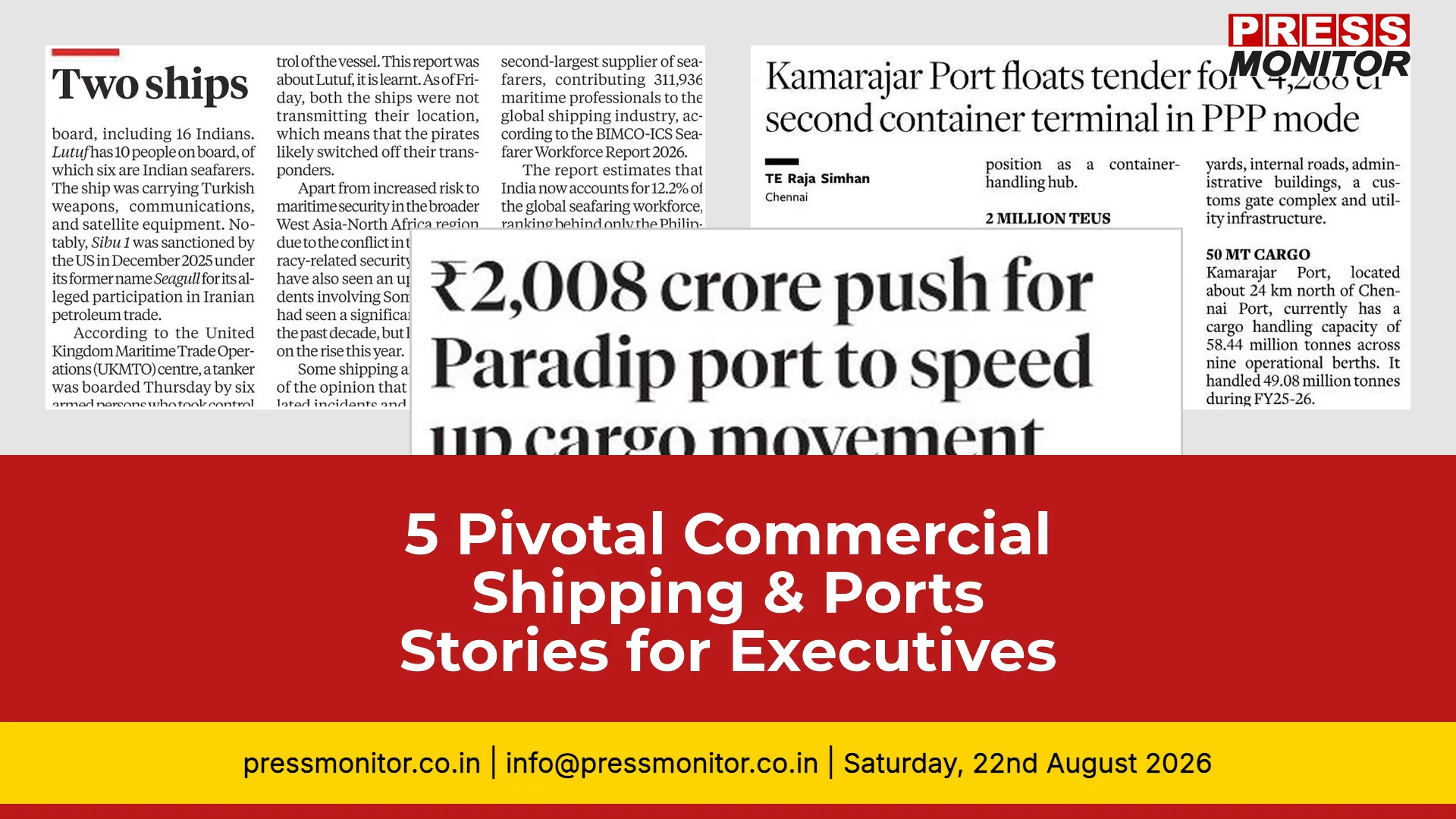
A total of 22 Indian seafarers are onboard two ships that were hijacked by armed pirates off the coast of Somalia and Yemen this week, according to sources aware of the developments. Sources said that while the shipping companies related to the two vessels are working in close coordination with the government, the seafarers are learnt to be safe. The two vessels are Eritrea-flagged oil products tanker Sibu l, which was hijacked in SAUDI ARABIA, OMAN 2 ae Gulf of Aden Puntland coast ETHIOPIA — SOMALIA the Gulf of Aden off the coast of Yemen ‘Thursday, and Cameroon-flagged general cargo carrier Lutuf, which was hijacked last Monday off Somalia’s coast. Sibu l has 2O seafarers on board, of which six are Indian seafarers. The ship was carrying Turkish weapons, communications, and satellite equipment. Notably, Sibu l was sanctioned by the US in December 2O25 under its former name Seagull for its alleged participation in Iranian petroleum trade. According to the United Kingdom Maritime Trade Operations (UKMTO) centre, a tanker was boarded Thursday by six armed persons who took control of the vessel and were redirecting it towards Somalia. Sources indicated that this UKMTO hijack warning was about Sibu l. According to another hijack warning issued by the UKMTO, a cargo vessel reported being boarded by eight ‘armed unauthorised persons’ off the Somalia coast, who then took control of the vessel. This report was about Lutuf, it is learnt. As of Friday, both the ships were not transmitting their location, which means that the pirates likely switched off their transponders. Apart from increased risk to maritime security in the broader West Asia-North Africa region due to the conflict in the Gulf, piracy-related security incidents have also seen an uptick. Incidents involving Somali pirates had seen a significant fall over the past decade, but hijacking is on the rise this year. Some shipping analysts are of the opinion that piracy-related incidents and hijackings have risen near East and North African trade corridors, specifically the Gulf of Aden, the Red Sea, and off Somalia, because international naval forces shifted their focus and assets to West Asia and the Strait of Hormuz. Indian seafarers are a dominant group in the global seafarer community. India is the world’s second-largest supplier of seafarers, contributing 3ll,936 maritime professionals to the global shipping industry, according to the BIMCO-ICS Sea-farer Workforce Report 2O26. The report estimates that India now accounts for 12.2% of the global seafaring workforce, ranking behind only the Philippines and ahead of China, Russia, and Indonesia. Given their widespread presence, the growing number of maritime security incidents have left Indian seafarers particularly vulnerable. A number of Indian seafarers have already borne the brunt of the West Asia conflict, with a few of them even losing their lives. Several merchant vessels that have come under attack in the region since early March had a number of Indian seafarers on board. In some cases, they had to be rescued by regional militaries after attacks disabled the ships they were serving on.
Why it matters: Escalating piracy threatens crew safety and disrupts vital Red Sea and Gulf of Aden trade routes.
Key detail: Two vessels, MT Sibu l and MV Lutuf, were boarded by armed pirates. All 22 Indian crew members remain safe, but transponders were switched off. India supplies over 311,000 seafarers globally, making workforce vulnerability a critical risk factor.
Source: Indian Express
Next step: Review updated UKMTO security advisories and adjust routing protocols.
2. Kamarajar Port Floats Tender for 4,288 Crore Second Container Terminal
“A front-page report in Business Line says” Kamarajar Port Ltd (KPL) has issued a tender to develop its second container terminal at an estimated cost of ₹4,288 crore under the public-private partnership (PPP) model. The project, aligned with the Kamarajar Port Ltd Master Plan for 2047, aims to encourage more competition and prepare for future demand, with the terminal designed to handle vessels up to 24,000 TEUs and a maximum Length Overall (LOA) of 400m. The terminal will operate on a design, build, finance, operate and transfer (DBFOT) basis with a 40-year concession period, focusing on meeting growing export-import and transhipment needs and strengthening Kamarajar Port’s position as a container-handling hub.
Why it matters: Massive PPP investment signals aggressive capacity expansion to handle next-gen mega-vessels.
Key detail: Designed for 24,000 TEU vessels and 400m LOA under a 40-year DBFOT concession, targeting export-import and transshipment growth aligned with the 2047 master plan.
Source: Business Line
Next step: Evaluate bidding opportunities and monitor concession terms.
3. Rs 427.8 Crore Projects Inaugurated At Paradip Port
A front-page report in Business Standard says Union Minister for Ports, Shipping and Waterways Sarbananda Sonowal on Friday inaugurated seven projects at Paradip port. The port authority also signed concession agreements for three mechanisation projects with a combined investment of over Rs 2,000 crore, including Rs 352 crore for capital dredging to achieve an 18.5-metre deep-draft capability.
Why it matters: Strategic dredging and mechanisation directly enhance deep-draft capabilities and cargo throughput.
Key detail: Union Minister Sarbananda Sonowal inaugurated seven projects, including Rs 352 crore for capital dredging to achieve an 18.5-metre draft, alongside Rs 2,000 crore in new concession agreements.
Source: Business Standard
Next step: Align vessel specifications with upgraded draft limits and track mechanisation rollout.
4. US-Israel-Iran War Shakes Global Markets
A front-page report in First India says the ongoing conflict between the United States, Israel, and Iran has destabilised financial and energy markets. Disruptions in the Strait of Hormuz are driving up oil prices, which the International Monetary Fund warns could lead to persistent inflation and slower global growth.
Why it matters: Geopolitical friction in West Asia triggers oil price volatility and inflationary pressures on freight costs.
Key detail: IMF warns that Strait of Hormuz disruptions could lead to persistent inflation and slower global growth, directly impacting fuel surcharges and chartering rates.
Source: First India
Next step: Hedge fuel exposure and stress-test supply chain budgets against rate spikes.
5. El Nino: Britain Predicts Biggest Wave in Century, Threatening Hottest Year
“Selon Deccan Herald, Britain’s national weather agency has forecast this year’s El Nino weather pattern to be the biggest in over a century, potentially making 2027 the hottest year globally. The Panama Canal will reduce shipping volumes next month due to a drought fueled by the El Nino phenomenon. Adam Scaife, head of long-range forecasting at the weather agency, stated that we are expecting the biggest El Nino for over a century, peaking at something over three degrees — that is unheard of in modern climate records. This means Pacific waters would heat up more than 3C above the norm in the coming months. EI Nino occurs when water temperatures rise at least 0.5C above the baseline. While it is part of a natural cycle, scientists agree that climate change increases its impacts. A record El Nino would be ‘adding to the stresses of climate change’ following a summer of heatwaves across Europe, the Met Office said in a blog. Temperatures in the Pacific region are currently running about 2.6C above a rolling 30-year average.
Why it matters: Extreme weather patterns force Panama Canal volume reductions, rerouting cargo through longer, costlier passages.
Key detail: Met Office forecasts Pacific waters heating over 3C above baseline, peaking this year. Drought conditions will slash canal transit capacity next month, straining global container flows.
Source: Deccan Herald
Next step: Adjust booking windows and explore alternative Suez or Cape routes.
Closing: Stay ahead of shifting maritime regulations, port expansions, and climate-driven route changes. For continuous news on commercial shipping & ports, rely on verified print data rather than fragmented digital noise. What operational bottleneck is your team prioritizing this quarter?