5 Pivotal Education Stories for Higher Ed Leaders


Navigating India’s education sector requires sharp media intelligence. Today’s print media monitoring reveals five critical developments shaping policy, compliance, and student welfare. This press review cuts through the noise to deliver verified insights directly from India’s leading dailies. According to Press Monitor's tracking of Indian publications, these stories demand immediate attention from academic administrators and legal counsel. Here is what you need to know about the latest news on education policy and regulatory shifts.
1. Bar Council Withdraws NALSAR Enrolment Order
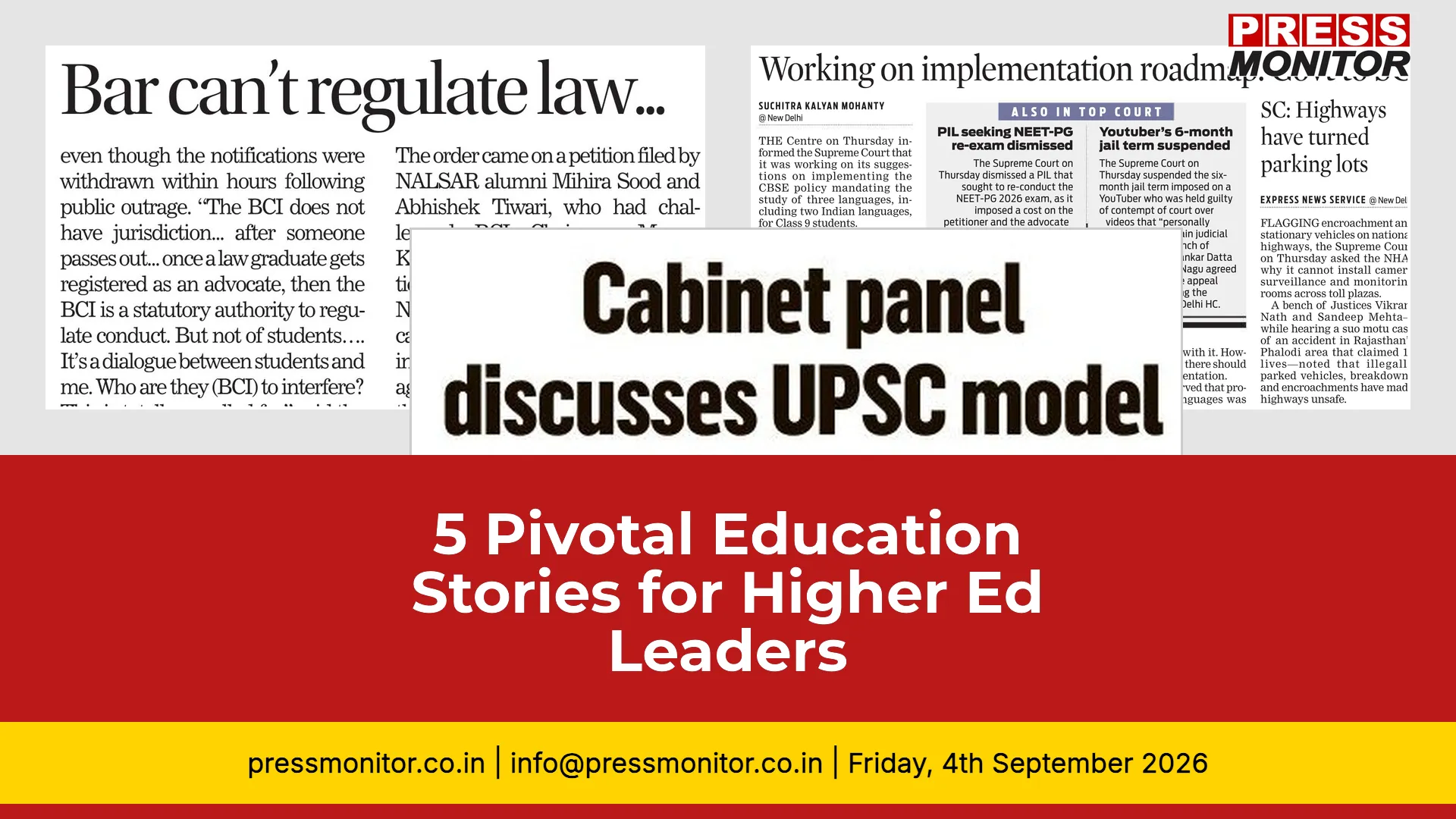
A front-page report in Tribune says that, in India, the Bar Council of India withdrew an order that had directed state bar councils not to enrol NALSAR's 2026 graduates as advocates pending an inquiry. The order was issued by Bar Council of India chairman Manan Kumar Mishra on August 13 after NALSAR alumni Mihira Sood and Abhishek Tiwari petitioned against action over Chief Justice of India Kant's proposed visit to the university. Mishra withdrew the communication within hours due to public outrage, and the Chief Justice of India said the intervention was uncalled for.
Why it matters: Establishes clear jurisdictional boundaries between professional regulators and academic institutions.
Key detail: Bar Council chairman Manan Kumar Mishra withdrew an order blocking state bar councils from enrolling NALSAR’s 2026 graduates within hours of triggering public outrage over Chief Justice Surya Kant’s campus visit.
Source: Tribune
Next step: Law school deans should review affiliation agreements to safeguard student progression rights.
2. Centre Tells SC On CBSE Three-Language Policy
A front-page report in Morning Standard says the Centre informed the Supreme Court on Thursday that it was working on the court's suggestions regarding the implementation of the CBSE policy mandating the study of three languages, including two Indian languages, for Class 9 students. Additional Solicitor General Aishwarya Bhati told the bench of Chief Justice Surya Kant and Justices Joymalya Bagchi and V Mohana that the government was assessing teacher availability, textbooks, and language choices. The bench directed the Centre to file a detailed affidavit within four weeks outlining an effective roadmap, noting that promoting Indian languages should not come at the cost of students.
Why it matters: Curriculum mandates directly impact teaching loads, textbook procurement, and student stress levels nationwide.
Key detail: Additional Solicitor General Aishwarya Bhati informed the bench that the government is assessing teacher availability and language choices. The court deferred the matter by a week and directed a detailed affidavit within four weeks.
Source: Morning Standard
Next step: District education officers must inventory linguistic faculty capacity before July deadlines.
3. Karnataka Cabinet Sub-Committee on Exam Reforms Holds First Meeting
A front-page report in Deccan Herald says the first meeting of the Karnataka Cabinet sub-committee on student issues and exam reforms was held in Bengaluru on Thursday, and the sub-committee decided to collect opinions from experts including former vice chancellors before meeting stakeholders. Minister for School Education and Literacy Madhu Bangarappa suggested creating a separate website to gather public suggestions, while Dr Sharan Prakash Patil, Minister for Medical Education, informed that no decision was taken as it was the first meeting.
Why it matters: State-level assessment frameworks frequently cascade into national examination standards.
Key detail: School Education Minister Madhu Bangarappa proposed launching a dedicated digital portal to collect expert and public suggestions prior to broader stakeholder consultations.
Source: Deccan Herald
Next step: Assessment coordinators should monitor the portal launch and prepare feedback submissions.
4. Supreme Court Quashes Student Protest Cases
A front-page report in Millennium Post says the Supreme Court has quashed criminal cases against students protesting the NEET examination controversy, highlighting the severe impact of frivolous First Information Reports on youth. The article argues that invoking criminal law against peaceful dissent undermines democracy and calls for institutional accountability to prevent police overreach. It emphasises that while judicial intervention repairs part of the damage, systemic safeguards are necessary to protect legitimate expression.
Why it matters: Judicial intervention protects democratic expression during high-pressure examination cycles.
Key detail: The apex court highlighted the severe psychological and legal toll of frivolous FIRs on youth, emphasizing that systemic safeguards are required to prevent police overreach around NEET controversy sites.
Source: Millennium Post
Next step: Campus security heads should coordinate with local police to establish peaceful protest zones.
5. AICTE To Build NEET-UG Test Centres
A front-page report in The Pioneer says the National Testing Agency has asked the All India Council for Technical Education to collect information from Government institutions on their IT infrastructure and available space to develop testing centres for computer-based NEET-UG examinations. The move follows a paper leak earlier this year that led to nationwide outrage, prompting the Centre to announce that NEET-UG will be conducted in CBT mode from 2027.
Why it matters: Physical infrastructure upgrades are critical to securing computer-based transitions scheduled for 2027.
Key detail: The National Testing Agency requested comprehensive IT infrastructure and space data from government institutions to design leak-proof testing hubs following earlier paper leak incidents.
Source: The Pioneer
Next step: Facility directors should audit server bandwidth and biometric access systems immediately.
This press review was compiled using rigorous print media monitoring to filter noise from signal. How will your institution adapt to these regulatory shifts? Share your strategy below.
