5 Pivotal Space & Aerospace Stories for Industry Leaders


India's space sector is undergoing a historic transformation. From the Prime Minister's vision for a $45 billion space economy to groundbreaking plans for a homegrown space station, these are the stories that matter. Powered by a comprehensive media monitoring of 25 articles across 13 Indian publications, this press review captures the pulse of the industry. Whether you're a policy maker or a startup founder, staying ahead requires top-tier media intelligence. Here are the five most impactful developments, tracked by Press Monitor.
1. PM Modi Sets $45 Billion Space Economy Target
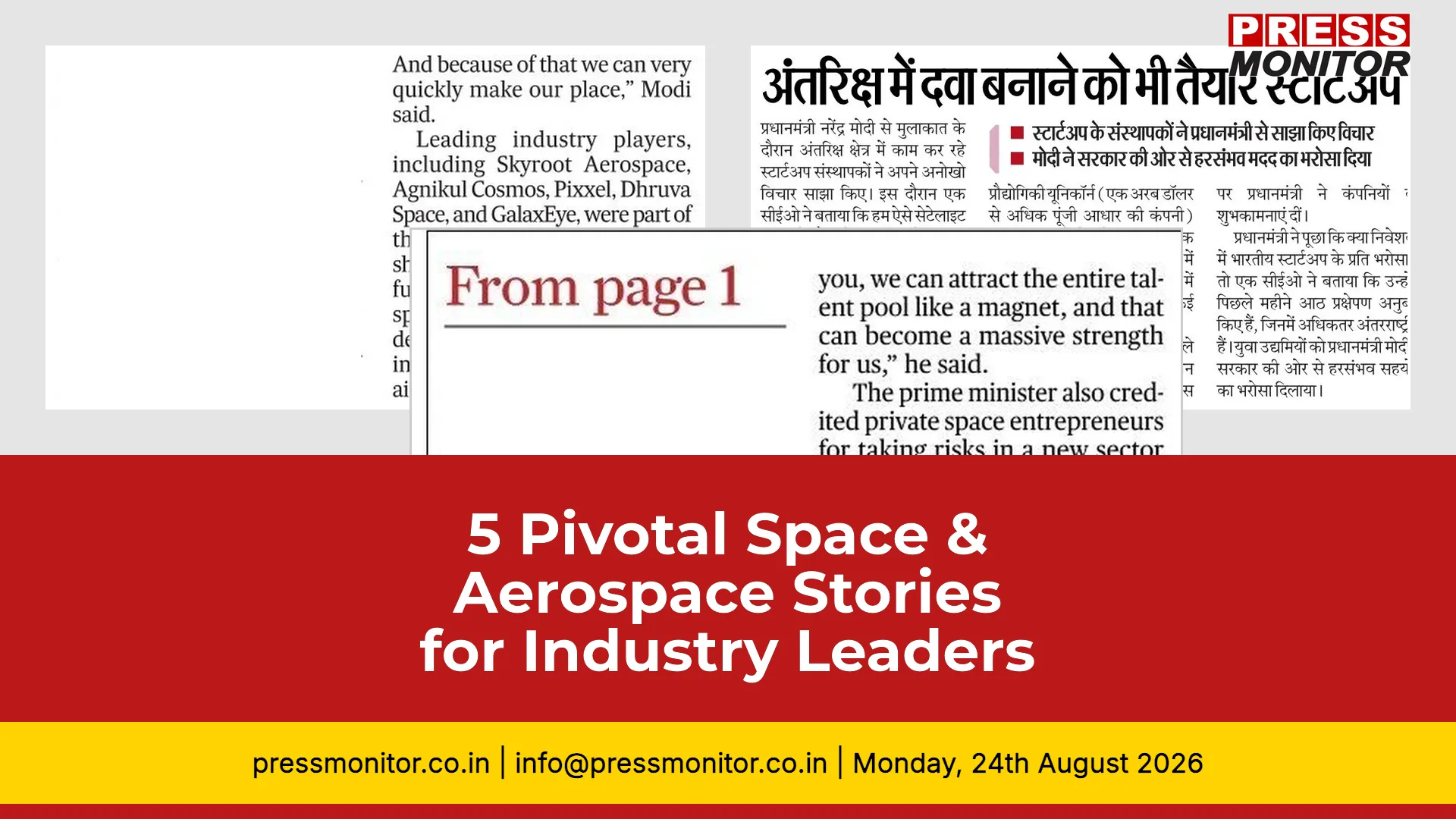
A front-page report in Hindustan Times says Prime Minister Narendra Modi announced India's intent to become a global space leader by fostering private sector growth, with plans for a space station by 2035. Modi highlighted the sector's expansion from 1 to 440 startups since 2014, global talent attraction plans, and cost competitiveness during interactions with space CEOs. India's space industry share, valued at $9 billion, aims to reach $40-45 billion within a decade, supported by policies like the 2023 Indian Space Policy.
Why it matters: Prime Minister Narendra Modi, interacting with space startup CEOs on National Space Day, announced India's ambition to grow its space economy from $9 billion to $40-45 billion within a decade. He highlighted the sector's expansion from 1 to 440 startups since 2014, and called for creating an ecosystem that attracts global talent.
Key detail: The number of space startups has surged to approximately 440, and India's cost-competitiveness in launching high-capacity rockets is a major advantage.
Source: Hindustan Times (front-page).
Next step: Industry leaders should align their strategies with the government's push for private sector growth and global talent attraction.
2. Startup to Manufacture Pharmaceuticals in Space
A front-page report in Hindustan says that startup founders, meeting with Prime Minister Modi, presented plans to create medications in space and return them to Earth. CEO of Skyroot Aerospace showcased a satellite designed for this purpose, earning Modi’s commendations. The company aims to launch monthly from 2027, with plans to establish a global ground station network within 1.5 years. They’ve already secured eight launch contracts, primarily international, indicating confidence in the Indian startup sector.
Why it matters: An Indian space startup proposed to PM Modi a plan to manufacture medicines in microgravity and return them to Earth. This could revolutionize the pharmaceutical industry by enabling new drug formulations.
Key detail: The startup is developing satellites that will travel to space, produce pharmaceuticals, and bring them back. The PM praised the initiative.
Source: Hindustan (front-page, cross-sourced from Morning Standard and New Indian Express).
Next step: Pharma and biotech firms should explore partnerships with space startups for microgravity R&D.
3. India to Build Its Own Space Station by 2035
A front-page report in Millennium Post says India is working to establish its own space station by 2035, with the first module of the proposed Bharatiya Antariksha Station already approved, ISRO Chairman Dr V Narayanan said on Sunday.
Why it matters: ISRO Chairman V Narayanan announced that India is working towards the Bharatiya Antariksh Station (BAS), with the first module already approved. This positions India among the elite spacefaring nations.
Key detail: The space station, targeted for 2035, will be a platform for scientific research and technology demonstration.
Source: Millennium Post (front-page, also covered by Hindustan Times).
Next step: Space agencies and research institutions should prepare for collaboration opportunities on the BAS.
4. Minister Shekhawat on Space Tech, AI, and Quantum Computing
A front-page report in First India says Union minister Gajendra Singh Shekhawat stated on Sunday that the convergence of space technology, AI, and quantum computing will define a nation's geopolitical position. Speaking at a National Space Day event, he asserted that the privatisation of the space sector represents a democratisation of opportunities rather than a reduction in the importance of ISRO.
Why it matters: Union Minister Gajendra Singh Shekhawat stated that the convergence of space technology, AI, and quantum computing will define geopolitical power. He emphasized that privatization of the space sector democratizes opportunities.
Key detail: Speaking at a National Space Day event, he clarified that ISRO's importance remains undiminished.
Source: First India (front-page).
Next step: Technology companies should invest in cross-sector innovation to leverage this convergence.
5. ISRO Chairman: India Number One in Nine Areas
A front-page report in First India says ISRO Chairman Dr V Narayanan recalled India’s space programme began with bicycles moving rocket parts and has now reached number one position in nine areas. He credited the achievement to the Indian space community, academia, and industrial partners.
Why it matters: ISRO Chairman V Narayanan recalled India's journey from moving rocket parts on bicycles to becoming a world leader in nine space technology areas. He credited the entire space community.
Key detail: This achievement underscores India's capability and the effectiveness of its space program.
Source: First India (front-page).
Next step: This is a reminder of India's proven track record, encouraging further investment and talent development.
Stay informed with print media monitoring from Press Monitor. These stories are just a glimpse of the intelligence we track daily. What space trend will shape your next move?