7 Critical Logistics Stories for Supply Chain Leaders


Tracking rapid shifts in India’s delivery ecosystem requires precise print media monitoring. This press review distills today’s most critical developments in logistics, quick commerce, and last-mile innovation into actionable insights. According to Press Monitor's tracking of Indian publications, here are seven pivotal stories shaping the sector.
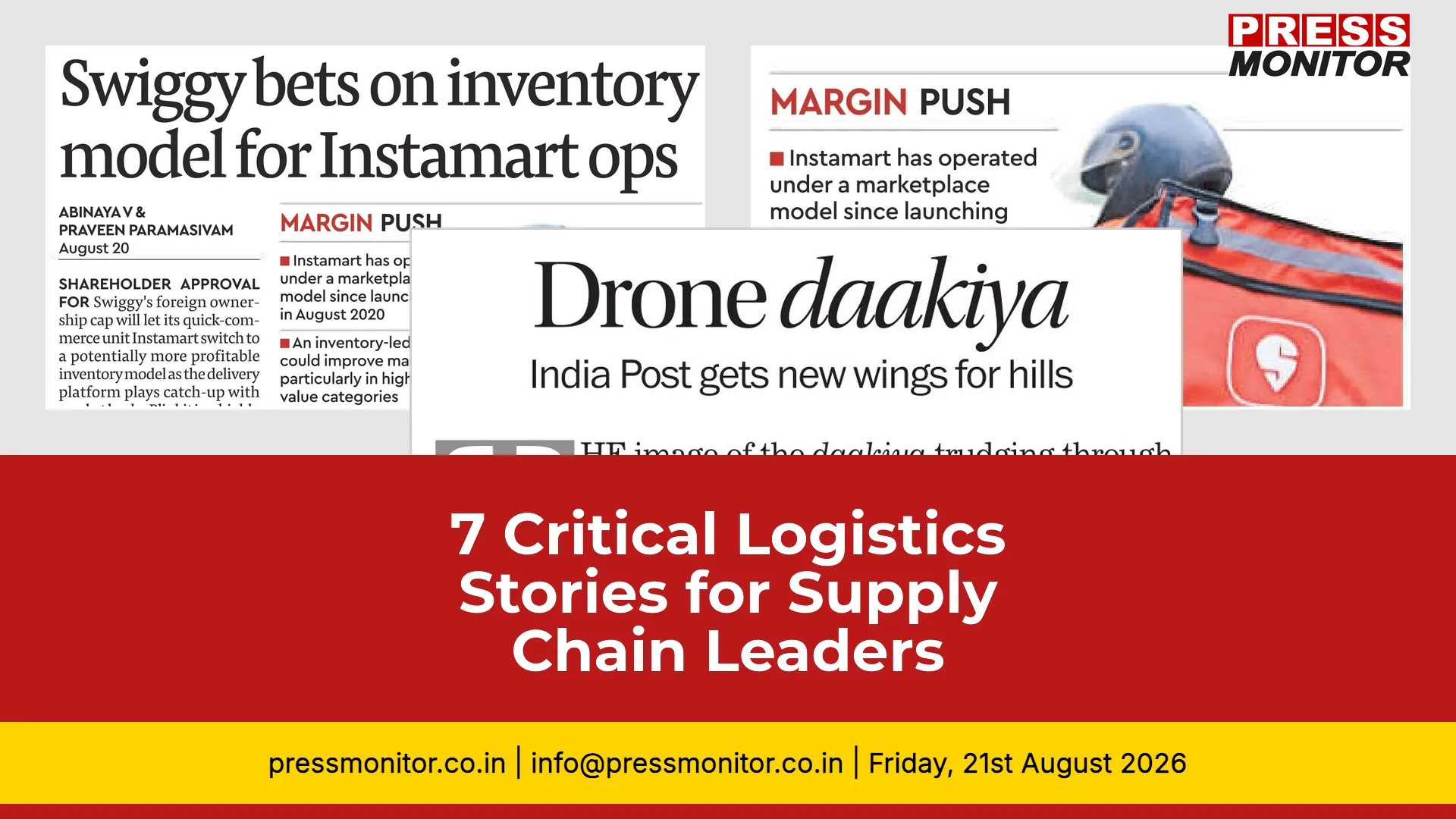
1. Swiggy Instamart Pivots to Inventory Model
A front-page report in Financial Express says Swiggy is transitioning its quick-commerce unit, Instamart, to an inventory-led model following shareholder approval for its foreign ownership cap. The move aims to improve margins and supply chain control as it competes with market leader Blinkit in India's 11.5 billion dollar quick-commerce market.
Why it matters: Structural changes in ownership caps are forcing quick-commerce giants to rethink asset-heavy strategies.
Key detail: Shareholder approval secured for a full transition to an inventory-led framework, aiming to tighten supply chain control and improve unit economics against market leader Blinkit.
Source: Financial Express
Next step: Watch for Q3 margin disclosures reflecting this operational overhaul.
2. Blinkit Extends Margin Streak While Swiggy Aims for FY31 Profitability
A front-page report in Financial Express says Instamaart's first-quarter contribution margin was negative 0.2%, against negative 1.8% in the previous quarter. Eternal’s Blinkit, which moved to an inventory-led model last year, has logged overall margin improvement for five straight quarters, turning positive in the March 2026 quarter. The company attributed this to inventory ownership, supply-chain efficiencies and a move into higher-margin categories including electronics, home decor and gourmet foods. Swiggy, which went public in 2024, is yet to turn profitable. Earlier this month, it set a fiscal 2031 target to turn earnings per share positive.
Why it matters: Profitability timelines are diverging sharply between the two quick-commerce titans.
Key detail: Blinkit logs five consecutive quarters of overall margin improvement driven by inventory ownership and higher-margin categories. Swiggy sets a fiscal 2031 EPS positivity target while Instamart posts a narrowed negative contribution margin.
Source: Financial Express
Next step: Monitor quarterly earnings calls for inventory turnover ratios.
3. India Post Deploys Drones for Himalayan & NE Village Connectivity
A front-page report in Tribune says India Post is deploying drones to accelerate mail and healthcare delivery to remote Himalayan and NE Indian villages, addressing repeated road and transport barriers. Each initiative targets Himachal Pradesh, Assam, and Arunachal Pradesh to ensure faster access to documents, medicine, and social benefits with safeguards.
Why it matters: Public sector logistics is leapfrogging traditional infrastructure barriers using aerial tech.
Key detail: Targeted deployments in Himachal Pradesh, Assam, and Arunachal Pradesh accelerate mail, healthcare, and document delivery while maintaining strict safety safeguards.
Source: Tribune
Next step: Track regulatory frameworks scaling drone corridors beyond pilot zones.
4. Mumbai Cracks Down on Quick Commerce Dark Store Hygiene
A front-page report in Financial Express says the Maharashtra Food and Drug Administration recently suspended 14 licences of quick commerce dark stores across the state following an August 2026 inspection drive targeting hygiene and safety violations.
Why it matters: Regulatory scrutiny is intensifying around unlicensed or non-compliant fulfillment nodes.
Key detail: Maharashtra FDA suspends 14 licences following August inspection drives targeting hygiene and safety violations across dark stores.
Source: Financial Express
Next step: Audit compliance protocols for all micro-fulfillment centers.
5. Jammu Development Authority Seals Non-Compliant Blinkit Outlet
A front-page report in State Times says the Jammu Development Authority (JDA) sealed a Blinkit store in Jammu for functioning in violation of the sanctioned building permission and applicable building norms. The operation of a commercial delivery and store from the basement, contrary to the sanctioned use and building permission, has implications for public safety, fire safety and the Aakash Coaching Centre.
Why it matters: Urban planning enforcement directly impacts last-mile network expansion.
Key detail: Basement operations violating sanctioned building permissions and fire safety norms trigger immediate closure, highlighting risks of unauthorized commercial conversions.
Source: State Times
Next step: Verify zoning approvals before deploying new hyperlocal hubs.
6. Euler Motors Scales Palwal Hub for Commercial EV Production
Selon Business Line, Euler Motors, backed by Hero MotoCorp, has announced the expansion of its manufacturing hub in Palwal, Haryana, with an investment exceeding ₹100 crore. The new facility will focus on producing four-wheel commercial vehicles, including the Turbo EV 1000 and Storm EV, with a planned annual output of up to 24,000 vehicles. Pawan Munjal, Executive Chairman of Hero MotoCorp, highlighted India’s commercial mobility sector’s pivotal moment, emphasizing electrification, supportive government policies, and mounting demand for sustainable last-mile transportation.
Why it matters: Electric commercial vehicle manufacturing capacity is rapidly expanding to meet fleet electrification demands.
Key detail: Backed by Hero MotoCorp, the ₹100 crore+ expansion targets 24,000 annual units of four-wheel commercial EVs like the Turbo EV 1000 and Storm EV.
Source: Business Line
Next step: Align procurement roadmaps with domestic EV manufacturing timelines.
7. Delhi-NCR Bans Fossil-Fuel Light Goods Vehicles from 2027
A front-page report in Business Line says the Commission for Air Quality Management (CAQM) announced a ban on diesel, petrol, and CNG light goods vehicles (LGVs) in Delhi-NCR from January 2027. The ban will progressively expand to the National Capital Region districts of Gurugram, Faridabad, Sonipat, Ghaziabad, and Gautam Buddha Nagar from January 2028.
Why it matters: Policy mandates are forcibly accelerating last-mile fleet electrification across India’s largest metro region.
Key detail: CAQM prohibits fresh registrations of diesel, petrol, and CNG LGVs starting January 2027, with phased rollout to Gurugram, Faridabad, Sonipat, Ghaziabad, and Gautam Buddha Nagar by January 2028.
Source: Business Line
Next step: Transition delivery fleets to electric alternatives ahead of the deadline.
These developments underscore how print media intelligence remains essential for navigating regulatory shifts, competitive dynamics, and technological adoption in logistics. Which operational bottleneck will your organization tackle first this quarter?