7 Critical Logistics Stories for Supply Chain Leaders


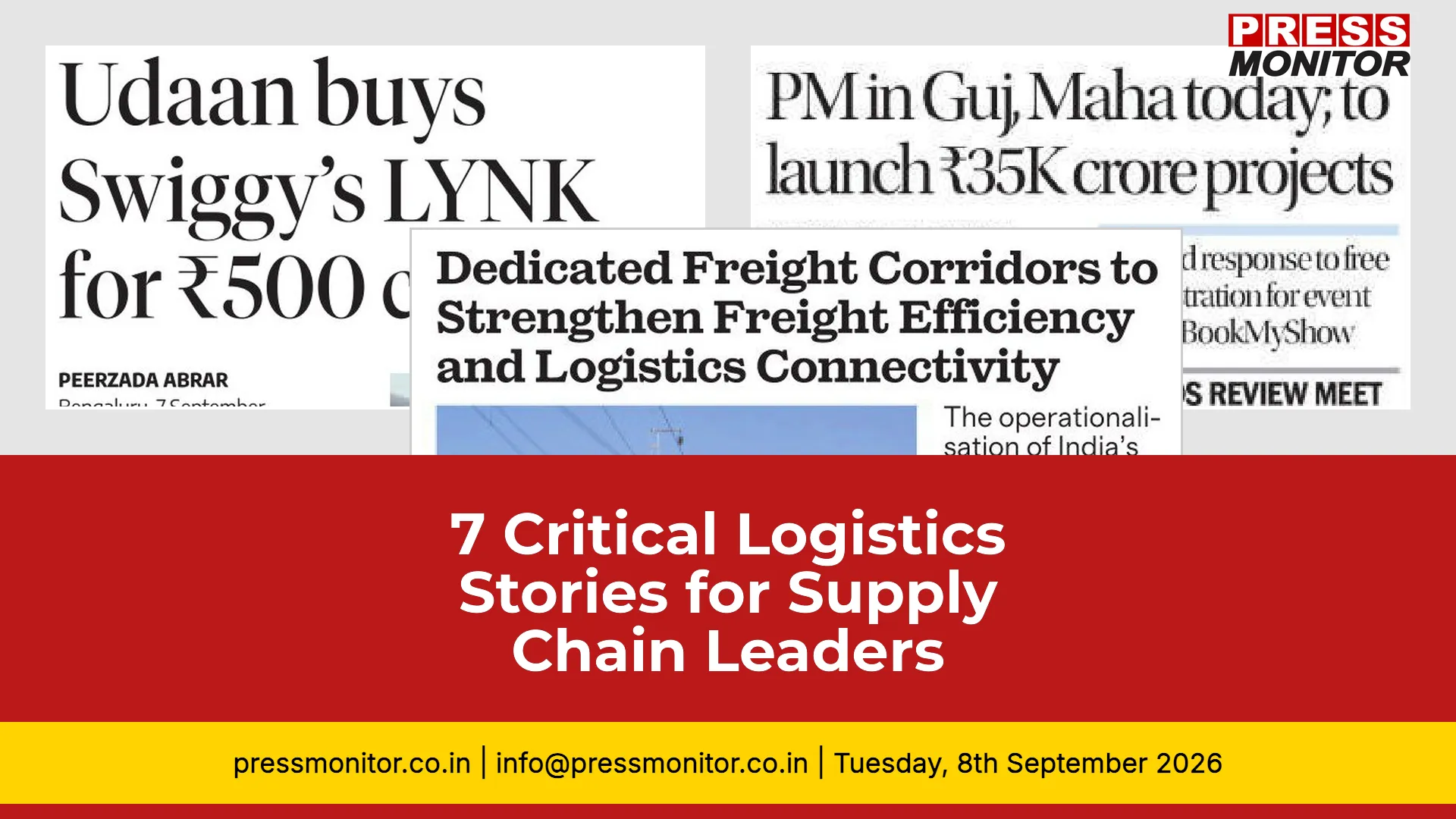
Breaking news on logistics and supply chain operations today highlights major shifts in freight infrastructure, corporate M&A, and policy-driven mobility transitions. According to Press Monitor's tracking of Indian publications, seven pivotal developments are reshaping how goods move across India this week.
1. Udaan Acquires LYNK Logistics For Rs 500 Crore
A front-page report in Business Standard says e-commerce firm Udaan has acquired Swiggy’s technology-driven distribution platform, LYNK Logistics, for Rs 500 crore in Bengaluru on 7 September. The transaction will be settled through preference equity shares in parent company Trustroot Internet, granting Swiggy an initial 2.8 per cent stake in Udaan. Additionally, Swiggy will make a primary equity investment of Rs 75 crore for an additional 0.4 per cent stake, marking Udaan’s second major acquisition since purchasing ShopKirana.
Why it matters: Consolidation in B2B e-commerce distribution accelerates as platforms scale toward profitability.
Key detail: Udaan settles the deal via preference equity shares in parent Trustroot Internet, granting Swiggy an initial 2.8% stake plus a Rs 75 crore primary investment for 0.4% additional equity. LYNK generates roughly 75% of its revenue from Bengaluru, Hyderabad, Chennai, and Kolkata.
Source: Business Standard
Next step: Track integration timelines and route optimization metrics over the next quarter.
2. PM Modi Inaugurates Rs 35,000 Crore Infrastructure Projects
A front-page report in Tribune says Prime Minister Narendra Modi will visit Vadodara in Gujarat on Tuesday to lay foundation stones and dedicate infrastructure works valued at over Rs 35,000 crore to the nation. Key milestones include opening three sections of the western dedicated freight corridor, initiating six new transport projects, and launching the Global Fintech Festival in Mumbai. Registration for the Vadodara event via BookMyShow filled rapidly, leaving thousands on a waiting list, while review meetings with senior ministers point toward potential cabinet changes.
Why it matters: Massive public capex directly reduces freight transit times and port congestion.
Key detail: The package includes three sections of the Western Dedicated Freight Corridor (WDFC), six new transport initiatives, and railway expansions. Event registration capacity was fully utilized within hours, signaling strong industry anticipation.
Source: Tribune
Next step: Align regional distribution hubs near newly dedicated corridor nodes.
3. DFC Network Strengthens Freight Efficiency
A front-page report in Free Press Journal says the operationalisation of India's Dedicated Freight Corridor DFC network marks a major transformation in the nation's freight transportation system. Developed by the Dedicated Freight Corridor Corporation of India Limited DFCCIL, the 2843 km network comprises the 1337 km Eastern Dedicated Freight Corridor from New Sahnewal in Punjab to New Sonnagar in Bihar and the 1506 km Western Dedicated Freight Corridor from New Dadri in Uttar Pradesh to the New Jawaharlal Nehru Port Authority JNPT in Maharashtra. Completion of the approximately 102 km Vaitarna to JNPT section on 31st March 2026 made the entire Western DFC operational, providing seamless freight connectivity to the country's major western maritime gateway.
Why it matters: Full network operationalization marks a structural inflection point for Indian rail freight.
Key detail: The 2,843 km network spans the Eastern Corridor (Punjab to Bihar) and Western Corridor (UP to JNPT). Completion of the Vaitarna-to-JNPT segment on March 31, 2026, unlocked seamless connectivity to India’s premier western maritime gateway.
Source: Free Press Journal
Next step: Evaluate modal shift opportunities for high-volume SKUs heading west.
4. LEAP India CEO Sunu Mathew Defines Supply Chain Agility
A front-page report in Business Standard says LEAP India Limited Managing Director and CEO Sunu Mathew describes agility in a supply chain as the ability to recognise change and respond without disrupting the customer. He outlines four essential elements: real-time visibility enabled by technology, flexible access to assets through pooling models, a strong physical network for execution, and resilience to ensure sustainability. Mathew concludes that as Indian supply chains become more interconnected, this adaptive operating model will distinguish efficient operations from merely large ones.
Why it matters: Leadership frameworks are shifting from scale to adaptive responsiveness.
Key detail: Mathew outlines four pillars: real-time visibility via technology, flexible asset pooling, robust physical networks, and resilience for sustainability. Adaptive operating models now separate efficient operators from merely large ones.
Source: Business Standard
Next step: Audit current asset utilization against pooling benchmarks.
5. CEOs Discuss Rewiring India Through Agile Supply Chains
A front-page report in Business Standard says that at the 5th Supply Chain & Logistics Conclave, industry leaders including Dr Shailendra Shukla, Vishal Sharma, and Ramnik Gupta explored how organizations can embrace change, leverage technology, and build future-ready supply chains to support India's growth. The discussion emphasized that resilient supply chains require agility, adaptability, collaboration, and leadership willing to challenge convention and continuously rethink operating models.
Why it matters: Industry consensus points to collaborative tech adoption as the growth multiplier.
Key detail: At the 5th Supply Chain & Logistics Conclave, leaders including Dr Shailendra Shukla, Vishal Sharma, and Ramnik Gupta emphasized that future-ready networks require continuous model rethinking, not incremental tweaks.
Source: Business Standard
Next step: Map pilot programs for cross-company data sharing.
6. NITI Aayog Launches PACT to Drive Clean Freight Demand
A front-page report in Economic Times says the NITI Aayog on Monday launched the Platform for Aggregating Clean Transport (PACT) and the Zero Emission Truck marketplace to boost clean mobility across the commercial vehicle sector. Operated under the e-FAST India platform, the initiative aims to convert freight demand and investment interest into scalable zero-emission projects across identified corridors. The move is designed to improve demand visibility, aid charging infrastructure planning, and strengthen the commercial case for electric medium- and heavy-duty vehicles. Why it importance: Policy-backed demand aggregation is de-risking electric commercial vehicle adoption.
Key detail: Operated under e-FAST India, the Platform for Aggregating Clean Transport converts freight demand into scalable zero-emission projects across identified corridors, improving charging infrastructure planning and strengthening the commercial case for EVs.
Source: Economic Times
Next step: Register fleet expansion plans on the Zero Emission Truck marketplace.
7. SIAM President: Train Vehicle Transport Won't Hurt Truck Freight
A front-page report in Business Line says SIAM President Shenu Agarwal told the paper that demand for truck freight will remain unaffected despite growing reliance on railway sidings for vehicle transport, as railways cannot provide a comprehensive solution. Ground reality shows Maruti Suzuki increased rail share in outbound vehicle dispatches from 5 per cent in FY15 to 26.5 per cent in FY26, aiming for 35 per cent by FY31, while Hyundai Motor India reports railways account for more than a quarter of its shipments.
Why it matters: Rail modal share growth in auto logistics is complementary, not cannibalistic.
Key detail: Maruti Suzuki increased rail dispatch share from 5% in FY15 to 26.5% in FY26, targeting 35% by FY31. Hyundai reports railways handle over a quarter of shipments. Ground reality confirms railways cannot replace last-mile trucking entirely.
Source: Business Line
Next step: Integrate rail-terminal handoff protocols into warehouse SOPs.
Closing: These developments underscore how infrastructure scaling, strategic M&A, and policy incentives are converging to modernize India’s freight ecosystem. Which operational bottleneck will your organization tackle first this quarter?
This press review synthesizes verified print coverage to deliver actionable media intelligence without the noise. Tracked by Press Monitor.