7 Essential Agriculture Stories for Industry Leaders


This media monitoring report covers seven essential agriculture stories shaping Indian farming. From farm policy breakthroughs to commodity market shifts, these developments demand attention from every stakeholder in the food supply chain.
1. Rajasthan Model Farms Boost Soybean Yields
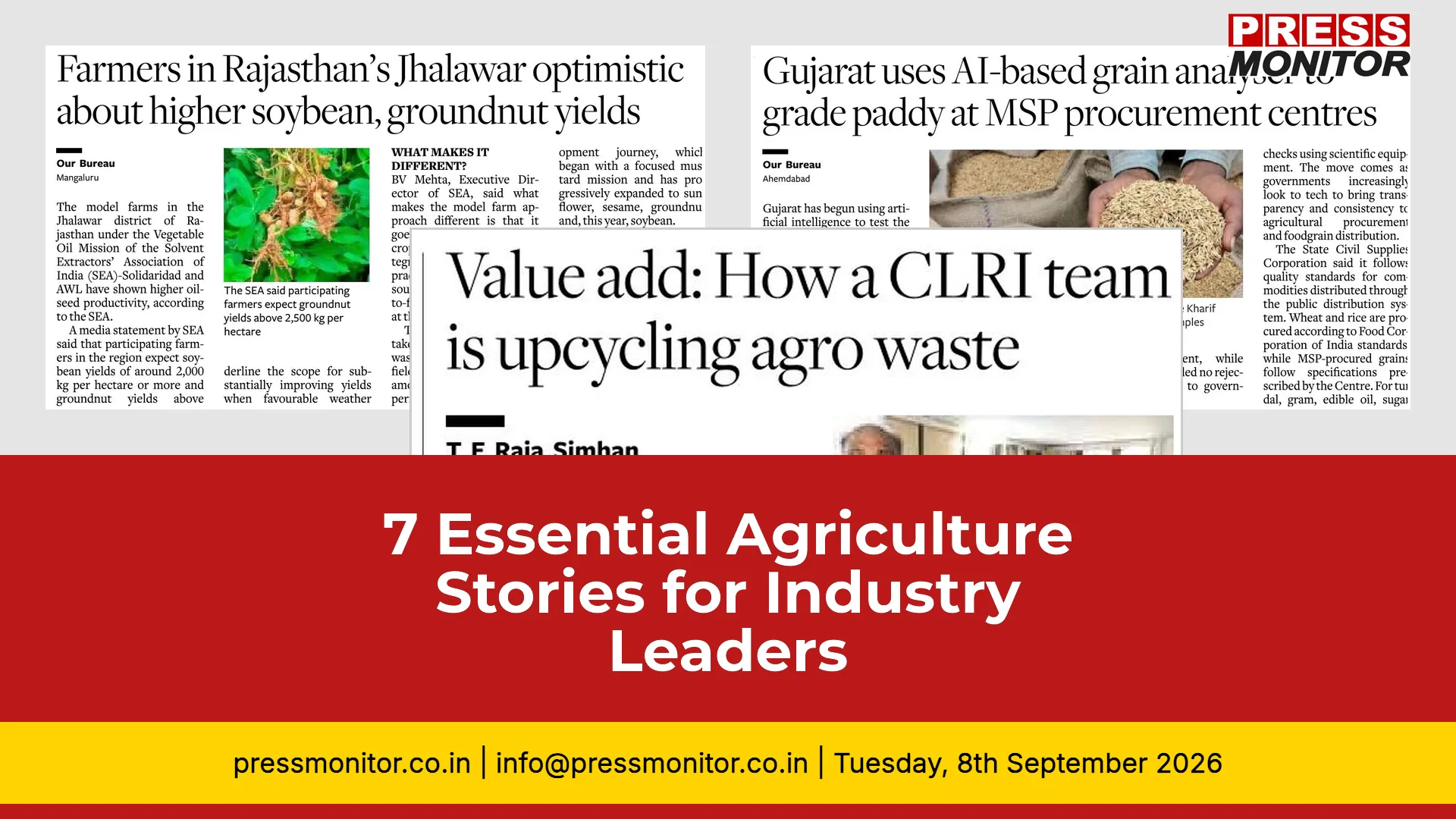
A front-page report in Business Line says farmers in Rajasthan's Jhalawar district are optimistic about higher soybean and groundnut yields under the Vegetable Oil Mission. Participating farmers expect soybean yields of around two thousand kg per hectare or more and groundnut yields above two thousand five hundred kg per hectare, supported by the Solvent Extractors' Association of India, Solidaridad, and AWL. Around four hundred fifty model farms and demonstrations on soybean and groundnut have been established during the current season, including about two hundred in the Jhalawar region of Rajasthan and a further two hundred fifty across Mandsaur, Neemuch and other districts, with the SEA mission proposing around three thousand mustard model farms for the upcoming season.
Why it matters: Farmers in Rajasthan's Jhalawar district are seeing soybean yields reach two thousand kg per hectare under the Vegetable Oil Mission, signaling how targeted agricultural programs can transform regional output and reduce edible oil import dependence.
Key detail/stat: Around four hundred fifty model farms and demonstrations on soybean and groundnut have been established during the current season, including about two hundred in the Jhalawar region and a further two hundred fifty across Mandsaur, Neemuch and other districts, with the SEA mission proposing around three thousand mustard model farms for the upcoming season.
Source: Business Line
Next step: State governments should scale this model to other districts and incentivise private sector participation in model farm networks. Closing question: What does this mean for India's oilseed self-sufficiency goals?
2. AI Analysers Grade Paddy at Gujarat MSP Centres
A front-page report in Business Line says Gujarat has begun using artificial intelligence to test the quality of paddy procured from farmers under the Minimum Support Price scheme, with an AI-based grain analyser deployed at 10 procurement centres across four districts. The pilot, implemented during the Kharif Marketing Season 2025-26, analysed 6,191 paddy samples, of which 54.6 per cent were classified as Grade A and 45.4 per cent as Common, with 341 samples rejected.
Why it matters: AI-driven quality grading reduces human error and speeds up MSP procurement for farmers, making the government's price support mechanism more efficient and transparent.
Key detail/stat: The pilot, implemented during the Kharif Marketing Season 2025-26, analysed 6,191 paddy samples, of which 54.6 per cent were classified as Grade A and 45.4 per cent as Common, with 341 samples rejected.
Source: Business Line
Next step: Expand AI grading to all states with MSP operations and integrate the data into commodity market platforms. Closing question: How will this technology reshape agricultural commodity markets?
3. CSIR-CLRI turns agricultural waste into leather
A front-page report in Business Line says scientists at the CSIR-Central Leather Research Institute in Chennai have successfully converted agricultural residues like rice straw, wheat waste, and coffee husk into leather-like materials. On August twenty seven, the institute signed a licensing agreement with Bengaluru-based start-up Husk and Hide to commercialise the technology. Director P Thanikaivelan noted that the process transforms renewable biological resources into higher-value products for the fashion and lifestyle sectors.
Why it matters: This media intelligence breakthrough turns agricultural residues into high-value products for fashion and lifestyle sectors, creating new revenue streams for rural economies and advancing circular economy goals.
Key detail/stat: On August twenty seven, the institute signed a licensing agreement with Bengaluru-based start-up Husk and Hide to commercialise the technology, with Director P Thanikaivelan noting that the process transforms renewable biological resources into higher-value products.
Source: Business Line
Next step: Fashion brands and lifestyle companies should explore partnerships for sustainable material sourcing and co-branding opportunities. Closing question: Can agri-waste leather become a mainstream alternative to conventional leather?
4. Bangalore Centre Develops Pulse Energy Bars
A front-page report in Free Press Journal says the Bangalore Bioinnovation Centre has developed ready-to-eat energy bars from pulses grown in Kalaburagi, in association with the Karnataka State Department of Agriculture. The new range includes six variants based on toor dal, black gram, green gram, and Bengal gram, developed under the Kalyana Karnataka Bio-Economy Mission. The initiative aims to add value to pulse produce in Kalaburagi rather than exporting it as raw grain.
Why it matters: Adding value to pulse produce locally reduces reliance on raw grain exports and creates new market opportunities for Karnataka's pulse farmers.
Key detail/stat: The new range includes six variants based on toor dal, black gram, green gram, and Bengal gram, developed under the Kalyana Karnataka Bio-Economy Mission in association with the Karnataka State Department of Agriculture.
Source: Free Press Journal
Next step: Retail chains and nutrition brands should consider stocking these pulse-based energy bars to tap the growing health-conscious consumer market. Closing question: Will pulse-based foods capture the expanding health food segment?
5. Central Warehousing Corporation Boosts Agri Logistics
A front-page report in Mint says the Central Warehousing Corporation is leveraging its extensive storage and import-export network to provide integrated logistics solutions for agricultural exporters. Managing director Santosh Sinha made the announcement in New Delhi on Monday, emphasising the critical importance of upgrading India’s agricultural export logistics infrastructure to significantly reduce post-harvest losses.
Why it matters: Reducing post-harvest losses is essential for India's agricultural trade competitiveness, and integrated logistics solutions can bridge the gap between farm gates and international markets.
Key detail/stat: Managing director Santosh Sinha announced the initiative in New Delhi, emphasising the critical importance of upgrading India's agricultural export logistics infrastructure to significantly reduce post-harvest losses.
Source: Mint
Next step: Agri-exporters should engage with CWC for logistics planning and explore integrated storage-and-export solutions. Closing question: How will improved infrastructure affect India's farm export volumes?
6. Rupee Commodity Rates in India
A front-page report in Free Press Journal says Indian agricultural commodity rates are listed in rupees per quintal, covering rice, jaggery, coriander seed, chilli, wheat, turmeric, toor dal, green gram dal, Bengal gram dal, groundnut seed, copra, coconut oil, gingelly oil and ghee. The table gives price ranges for Maharashtra and other states, noting that transport charges can affect the quoted rates; no date or named individuals are visible in the provided text.
Why it matters: Real-time commodity pricing is vital for farmers, traders, and policymakers making market decisions, and rupee-denominated rate tables provide a crucial reference for domestic trade.
Key detail/stat: Rates cover rice, jaggery, coriander seed, chilli, wheat, turmeric, toor dal, green gram dal, Bengal gram dal, groundnut seed, copra, coconut oil, gingelly oil and ghee, with price ranges for Maharashtra and other states noting that transport charges can affect quoted rates.
Source: Free Press Journal
Next step: Market participants should monitor these rates for trading decisions and adjust procurement strategies accordingly. Closing question: What do current price trends signal about supply-demand dynamics?
7. Fifth Spice Conference to Focus on Farmers
A front-page report in Business Line says the World Spice Organisation will host the fifth National Spice Conference in Jaipur on September 19 and 20. Themed around empowering farmers and protecting consumers, the event will convene value chain stakeholders to discuss improving farmer incomes, enhancing food safety standards, and promoting sustainable market linkages. Inaugural sessions will feature industry leaders including Ramkumar Menon, Ashok Dalwai, and government officials, with APEDA chairman Abhishek Dev delivering the keynote address.
Why it matters: The spice sector is a major agricultural export earner for India, and bringing together farmers, industry leaders, and policymakers can shape the next chapter of food safety and sustainable market linkages.
Key detail/stat: The World Spice Organisation will host the fifth National Spice Conference in Jaipur on September 19 and 20, with APEDA chairman Abhishek Dev delivering the keynote address alongside industry leaders including Ramkumar Menon and Ashok Dalwai.
Source: Business Line
Next step: Stakeholders should attend the conference to network, share insights, and influence policy outcomes on farmer incomes and food safety standards. Closing question: How will this conference influence the future of Indian spice trade?
This press review, grounded in print media monitoring data from Press Monitor, shows that Indian agriculture is evolving across technology, sustainability, logistics, and market access. What news on agriculture are you tracking this week? Share your thoughts below.