7 Essential Alcoholic Beverages Stories for Industry Leaders


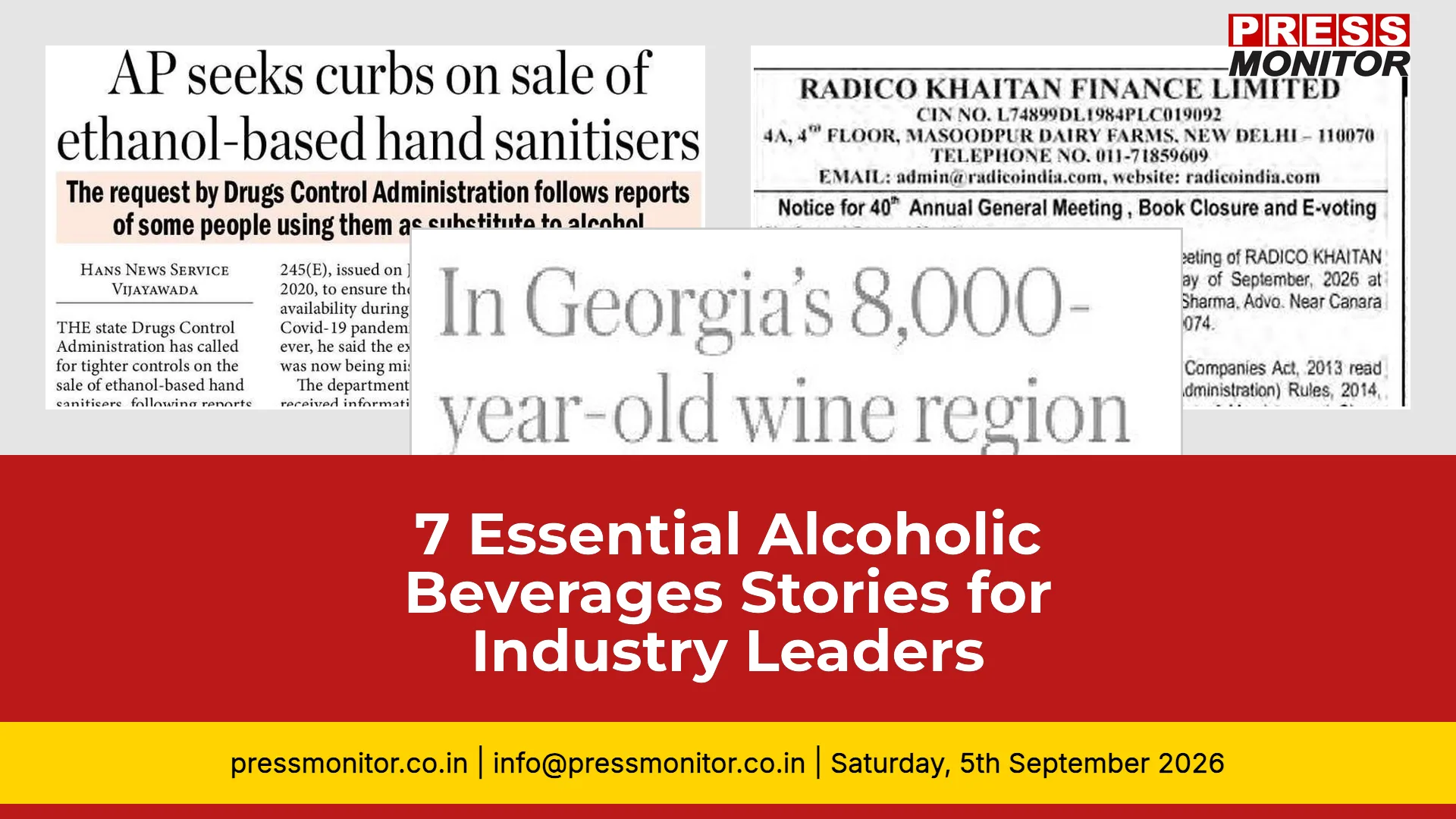
According to Press Monitor's tracking of Indian publications, the alcoholic beverages sector is shaping headlines across regulation, trade, and corporate governance this week. From ethanol sanitiser misuse crackdowns to record beer sales, these seven stories define the current landscape of news on alcoholic beverages in India.
1. AP Demands Ethanol Sanitiser Sales Restrictions
A front-page report in The Hans India says the Andhra Pradesh Drugs Control Administration has requested tighter controls on ethanol-based hand sanitisers following reports of their misuse as an alcoholic substitute. Director General P Arun Babu highlighted that exemptions granted during the twenty-twenty pandemic remain active and are being exploited, citing inspections where retailers moved more than thirty-three thousand five hundred eighty-six bottles. Authorities have initiated licence cancellation proceedings against three outlets while urging federal officials to revoke the sales waiver.
Why it matters: The Andhra Pradesh Drugs Control Administration is moving to close a loophole that allows ethanol-based hand sanitisers to be misused as an alcoholic substitute, a public health concern that has escalated since the pandemic.
Key detail: Over 33,586 bottles were flagged in inspections, and licence cancellation proceedings have been initiated against three outlets. Director General P Arun Babu has urged federal officials to revoke the pandemic-era sales waiver.
Source: The Hans India, front page, 5 September 2026.
Next step: Watch for federal response on the sales waiver revocation and potential nationwide policy alignment.
2. Radico Khaitan AGM Notice And Bank Possession
A front-page report in The Pioneer says Radico Khaitan Finance Limited has issued a notice for its 40th Annual General Meeting to be held on 30 September 2026 in New Delhi, with book closure from 24 to 30 September 2026 and e-voting from 27 to 29 September 2026. A separate notice from the Central Bank of India, Paharganj Branch, states it has taken symbolic possession of a property in Vishnu Garden, New Delhi, after the borrower and guarantor failed to repay a loan of rupees twenty-four lakh five thousand four hundred fifty-three and paise thirty-three only plus interest.
Why it matters: Radico Khaitan Finance Limited is holding its 40th AGM in New Delhi, while a separate Central Bank of India action highlights the financial enforcement landscape affecting the sector.
Key detail: The AGM is scheduled for 30 September 2026 with book closure from 24 to 30 September and e-voting from 27 to 29 September. The Central Bank of India, Paharganj Branch, has taken symbolic possession of a property in Vishnu Garden over a loan default of rupees twenty-four lakh five thousand four hundred fifty-three and paise thirty-three only plus interest.
Source: The Pioneer, front page, 5 September 2026.
Next step: Monitor Radico Khaitan's AGM resolutions and the outcome of the bank's possession proceedings.
3. Georgia's Wine Heritage
A front-page report in Mint says Georgia's wine industry, with origins dating back to 6000 BC, is a major contributor to the economy and among its top five exports. Most wine is produced in Kakheti, the country's easternmost province, where monks have harvested and pressed grapes in active wineries since medieval times. Family-run wineries in towns like Telavi and Sighnaghi offer a variety of wines paired with local hospitality.
Why it matters: Georgia's 6,000-year-old wine industry offers a benchmark for Indian wine and spirits players looking at global heritage brands and export potential.
Key detail: Georgia's wine sector is among its top five exports, with most production in Kakheti. Family-run wineries in Telavi and Sighnaghi combine traditional methods with modern hospitality.
Source: Mint, front page, 5 September 2026.
Next step: Consider how Indian wine regions could leverage similar heritage narratives for export growth.
4. Beer Surges 17% as Spirits Slump
A front-page report in Economic Times says that state-level tax increases have pushed consumers away from spirits, which saw only a two‑percent volume rise in the June quarter, while beer volumes surged seventeen percent, led by Maharashtra and Karnataka. Officials cite excise data, noting that whisky fell one percent as demand for mass‑priced brands weakened, but the cheaper beer segments benefited from unchanged or lower prices and favourable weather.
Why it matters: A structural shift in consumer preference is underway, with tax policy driving drinkers from spirits to beer across multiple Indian states.
Key detail: Beer volumes surged 17 percent in the June quarter while spirits rose just 2 percent. Whisky fell 1 percent as demand for mass-priced brands weakened, but cheaper beer segments benefited from unchanged prices and favourable weather. Maharashtra and Karnataka led the beer growth.
Source: Economic Times, front page, 5 September 2026.
Next step: Assess how excise policy changes in your state may further accelerate this beer-versus-spirits shift.
5. Over 400 Tasmac Shops Remain Shut
A front-page report in New Indian Express says over 400 Tasmac shops remained shut in six districts on Friday as employees protested the bottle buy-back scheme and suspensions. Staff demanded additional workers or privatisation, noting they incur expenses to rent space and pay wages out of pocket. Officials claimed shops were not completely closed and said interventions and talks are underway.
Why it matters: A labour dispute at Tamil Nadu's government-run liquor retail chain raises questions about the sustainability of the bottle buy-back scheme and the future of public-sector liquor operations.
Key detail: Over 400 Tasmac shops in six districts remained shut on Friday as employees protested suspensions and the buy-back scheme. Staff are demanding additional workers or privatisation, noting they incur expenses to rent space and pay wages out of pocket.
Source: New Indian Express, front page, 5 September 2026.
Next step: Track whether government intervention or privatisation discussions gain traction in the coming weeks.
6. Liquor Department Babu Influence
A front-page report in First India says a powerful official in the Liquor Department wields such influence that no work moves without his approval. Officers hesitate to speak without his consent and MLA recommendations reportedly require his nod. Despite several transfer lists being issued over the past two years, he has remained untouched, making his continuing hold a talking point.
Why it matters: Reports of unchecked bureaucratic influence in the Liquor Department highlight governance risks that can affect policy implementation and regulatory fairness across the sector.
Key detail: A powerful official is reportedly blocking all decisions without his approval, with officers hesitant to act without his consent. MLA recommendations require his nod, and despite transfer lists over two years, he remains untouched.
Source: First India, front page, 5 September 2026.
Next step: Media intelligence tools can help track such governance patterns and their impact on industry regulation.
7. Beer Sales Surge 42% In Maharashtra
A front-page report in Economic Times says beer sales in Maharashtra grew 42% and Karnataka 35%, with Kartikeya Sharma of AB InBev India attributing the growth to state excise policy changes. Stronger sales were also noted in Telangana, while West Bengal, Haryana and Uttar Pradesh remained subdued. The growth comes despite ongoing pressure on profitability in the spirits industry.
Why it matters: Maharashtra's 42 percent beer sales growth signals strong consumer demand and the impact of state excise policy changes on the alcohol market.
Key detail: Beer sales in Maharashtra grew 42 percent and Karnataka 35 percent. Kartikeya Sharma of AB InBev India attributes the growth to state excise policy changes. Telangana also showed stronger sales, while West Bengal, Haryana, and Uttar Pradesh remained subdued.
Source: Economic Times, front page, 5 September 2026.
Next step: Evaluate whether your state's excise policy is positioned to capture similar growth or if consumer migration to beer requires a portfolio adjustment.
These stories, drawn from print media monitoring across India's diverse publication landscape, reveal a sector in transition — shaped by regulation, market forces, and corporate strategy. Which of these developments will have the most lasting impact on your business? Share your perspective in the comments.
