7 Essential Arts Culture Heritage Stories for Cultural Leaders


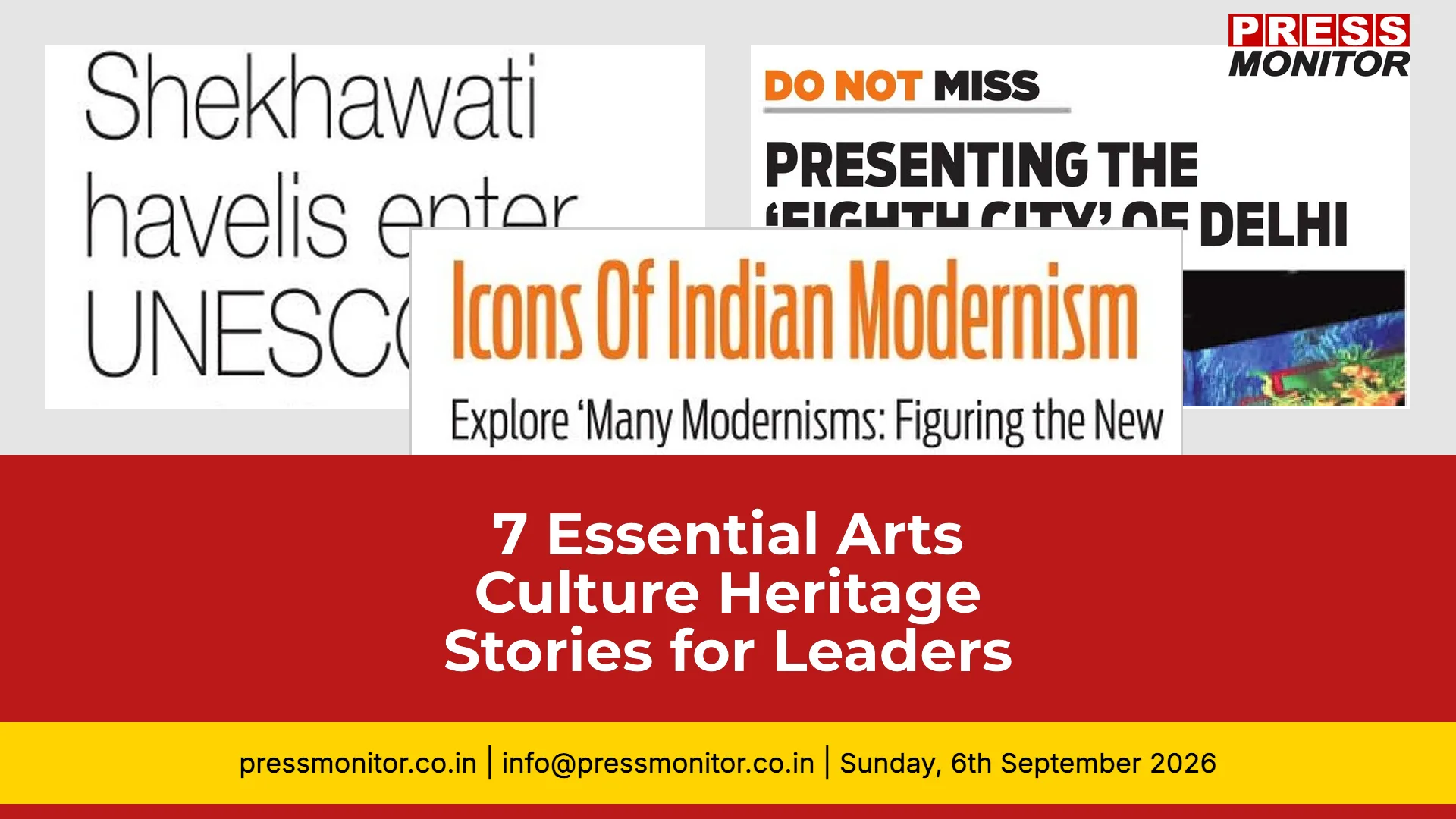
According to Press Monitor's tracking of Indian publications, seven essential stories from today's news on arts culture and heritage reveal how India's creative sectors are gaining global recognition and domestic momentum. This media monitoring review highlights the developments every cultural leader needs to know.
1. Shekhawati Havelis Earn UNESCO Tentative Status
A front-page report in First India says Rajasthan's iconic Shekhawati havelis have gained global recognition with their inclusion in UNESCO's Tentative List, marking a significant step towards securing World Heritage status. Deputy CM Diya Kumari announced that historic havelis across fourteen prominent locations, including Alsisar, Mandawa, and Sikar, have been included. These havelis, known for their elaborate facades and exquisite frescoes, reflect Shekhawati’s distinctive architectural traditions and cultural history, making their inclusion a crucial milestone for international recognition.
Why it matters: Rajasthan's iconic havelis are one step closer to World Heritage designation, putting Indian architectural heritage on the global map. Key detail: Fourteen locations including Alsisar, Mandawa, and Sikar are now on UNESCO's Tentative List, as announced by Deputy CM Diya Kumari. Source: First India. Next step: Watch for the formal nomination dossier and heritage conservation funding announcements. What does this mean for Rajasthan's tourism economy?
2. Delhi Art Weekend Returns with The Eighth City
A front-page report in Morning Standard says Delhi Art Weekend returns for its sophomore edition with 'The Eighth City', a weekend-long celebration of artists, ideas and conversations shaping Delhi's evolving cultural landscape. The event takes place on September twenty-six and twenty-seven at Travancore Palace, Shrimant Madhav Rao Scindia Marg, Copernicus Marg.
Why it matters: Delhi's premier art gathering enters its sophomore edition, signaling growing institutional confidence in the capital's cultural ecosystem. Key detail: The weekend-long event on September 26-27 at Travancore Palace brings together artists, ideas, and conversations shaping Delhi's evolving cultural landscape. Source: Morning Standard. Next step: Mark your calendar and engage with the programming lineup. Who should be on the speaker roster?
3. Many Modernisms Exhibition Celebrates Indian Modernist Masters
A front-page report in Morning Standard says the exhibition Many Modernisms: Figuring the New Artistic India features works by significant twentieth-century Indian modernists, including Jamini Roy, Amrita Sher-Gil, M.F. Husain, and F.N. Souza. The event begins on October 15 at the Thapar Gallery, The One, Kapashera Estate.
Why it matters: A major retrospective at Thapar Gallery brings together works by Jamini Roy, Amrita Sher-Gil, M.F. Husain, and F.N. Souza, redefining how we understand twentieth-century Indian art. Key detail: The exhibition opens October 15 at The One, Kapashera Estate, featuring nearly 200 works. Source: Morning Standard. Next step: Plan institutional visits and educational partnerships. Which modernist voice resonates most with today's audiences?
4. DKG India Exhibition Bridges Generations Through Art
A front-page report in Millennium Post says that 'The First Show' art exhibition, organised by DKG India, was inaugurated on September 3 at The Stainless Gallery in New Friends Colony. The exhibition showcases more than 140 artworks created by 70 students of artist Dipak Kumar Ghosh, with participants ranging from children as young as five to adults over 85. The initiative, centred on Building a Creative Community Through Art, seeks to identify latent talent while creating a space where people across generations can learn and grow together.
Why it matters: A community-driven initiative at The Stainless Gallery demonstrates how art can unite age groups and unlock latent creative talent across demographics. Key detail: Over 140 artworks by 70 students aged five to eighty-five, organised by Dipak Kumar Ghosh, showcase Building a Creative Community Through Art. Source: Millennium Post. Next step: Explore replicable models for intergenerational arts programming in your city. How can your institution foster similar inclusion?
5. Arif Mohammad Khan Inaugurates 14th Odisha Literary Festival
A front-page report in Morning Standard says veteran politician and former Governor Arif Mohammad Khan inaugurated the 14th Odisha Literary Festival organised by The New Indian Express in Bhubaneswar, stating that great works of literature provide comfort during anxious times. Former chief election commissioner SY Quraishi voiced reservations over the Special Intensive Revision of electoral rolls, conservation biologist Neha Sinha discussed native plants in urban landscaping, and writer Sutapa Sikdar remembered actor Irrfan Khan.
Why it matters: The annual gathering in Bhubaneswar reinforces Odisha's position as a literary and cultural hub, drawing prominent voices from politics, conservation, and writing. Key detail: Former Governor Arif Mohammad Khan inaugurated the festival, with former election commissioner SY Quraishi, conservation biologist Neha Sinha, and writer Sutapa Sikdar participating. Source: Morning Standard. Next step: Engage with the festival's programming and consider sponsorship or participation opportunities. Which session will you follow most closely?
6. Amrita Sher-Gil Paintings Meet Live Urdu Poetry in Delhi
A front-page report in The Pioneer says the Hungarian Cultural Centre in Delhi hosted Echoes - A Ghazal Baithak by Nisschal Zaveri, where visual art and live music converged. The event showcased Amrita Sher-Gil's paintings alongside Zaveri's repertoire of Mirza Ghalib and Faiz Ahmed Faiz, blending traditional thumri with piano chords.
Why it matters: A unique cross-disciplinary event at the Hungarian Cultural Centre blends visual art and classical music, demonstrating the power of cultural fusion. Key detail: Nisschal Zaveri's Ghazal Baithak showcased Sher-Gil's paintings alongside renditions of Mirza Ghalib and Faiz Ahmed Faiz, merging thumri with piano chords. Source: The Pioneer. Next step: Attend similar cross-genre events and explore partnerships between visual and performing arts institutions. What fusion format would you like to see next?
7. Baroda Modern Exhibition Traces India's First Art School Legacy
A front-page report in Tribune says a new exhibition at DAG titled Freedom to Form: Baroda Modern traces the origins and legacy of the Faculty of Fine Arts at MS University, founded in 1950 as Independent India's first art school. The show in New Delhi brings together nearly 200 paintings, sculptures, prints, photographs, and mixed-media works alongside rare archival material. The exhibition highlights how the faculty's progressive vision shaped modern Indian art between 1960 and the 1980s through artists including KG Subramanyan, Gulammohammed Sheikh, and NS Bendre.
Why it matters: Freedom to Form: Baroda Modern at DAG illuminates the Faculty of Fine Arts at MS University, which shaped modern Indian art from 1960 to the 1980s. Key detail: Nearly 200 paintings, sculptures, prints, photographs, and mixed-media works alongside rare archival material highlight the progressive vision of KG Subramanyan, Gulammohammed Sheikh, and NS Bendre. Source: Tribune. Next step: Study the archival material for research and exhibition planning. How does Baroda's legacy inform contemporary Indian art education?
Closing: These seven stories, tracked through print media monitoring by Press Monitor, underscore the vibrancy of India's arts and cultural ecosystem. Which development will you monitor most closely this week? Share your thoughts in the comments.