7 Essential Climate Stories for Decision Makers


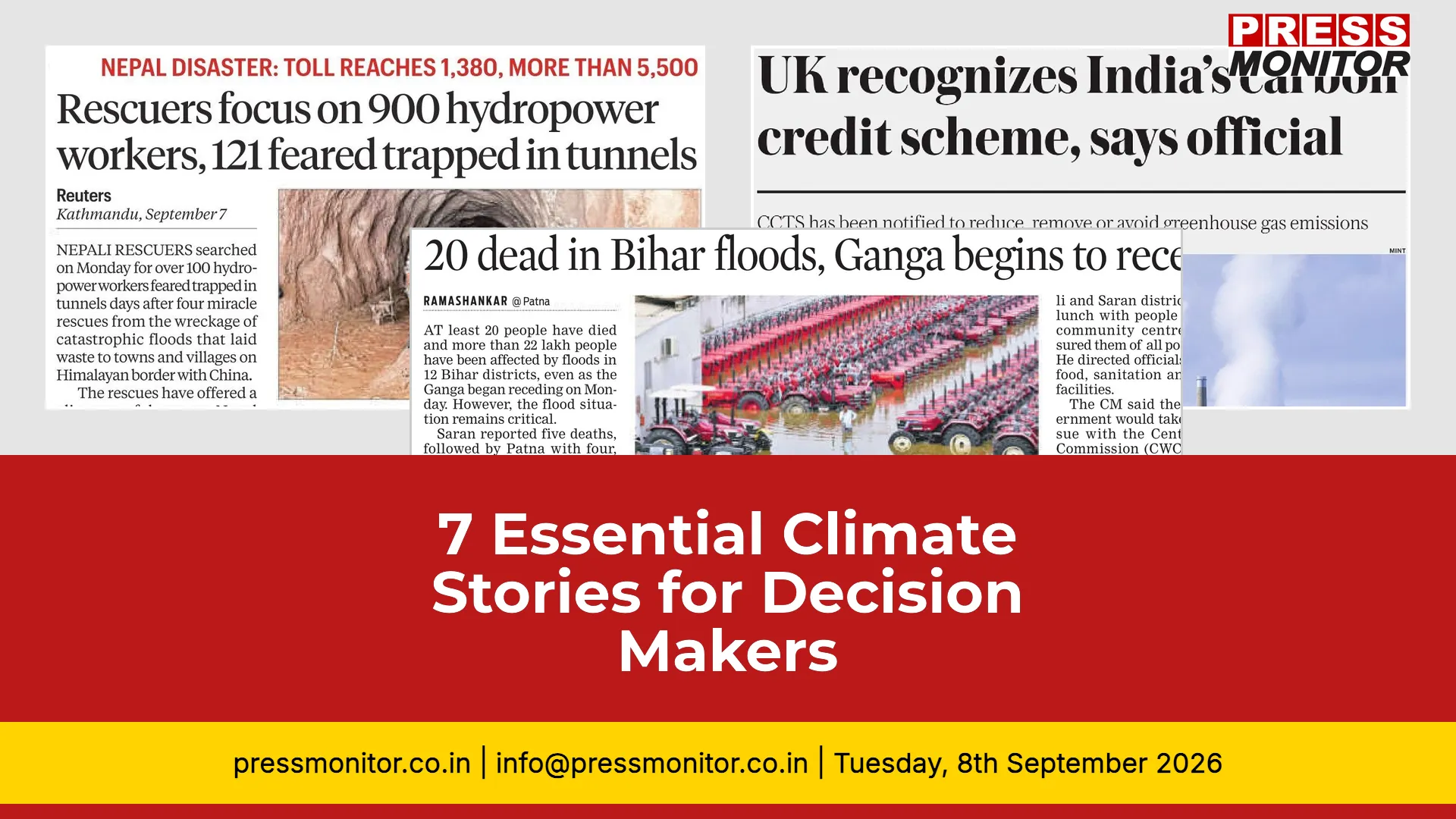
According to Press Monitor's tracking of Indian publications, this media monitoring roundup covers today's most consequential news on climate. From catastrophic flooding in Nepal to carbon trading breakthroughs and urgent UN warnings, this press review delivers seven essential stories for leaders who need media intelligence on climate risk.
1. Nepal Flood Toll Reaches 1,380
A front-page report in Indian Express says Nepali rescuers searched on Monday for over 100 hydropower workers feared trapped in tunnels days after four miracle rescues from the wreckage of catastrophic floods that laid waste to towns and villages on the Himalayan border with China. The rescues have offered a glimmer of hope as Nepal marked the 13th day after the disaster, traditionally the final day of mourning in Hindus, for the hundreds killed in the floods. About 121 of a total 900 people missing from the hydroelectric projects could have been trapped in these tunnels, army rescuers said, while at least 1,380 people have been killed by the mudslide and more than 5,500 are missing in Nepal and Tibet. Nepal has asked the international community for urgent supplies, including high-capacity drones, Bailey bridges, and DNA testing kits for epidemic prevention.
Why it matters: The August 26 glacial flood remains one of the deadliest climate disasters this decade, with rescue operations still underway in Himalayan tunnels. Over 5,500 people remain missing and Nepal has appealed for international aid including drones and DNA testing kits.
Key detail/stat: 1,380 confirmed dead, 5,500 missing, 121 hydropower workers feared trapped in tunnels, 900 total missing from hydroelectric projects.
Source: Indian Express, Kathmandu, September 7
Next step: Monitor whether international aid pledges translate into rapid on-ground deployment.
2. UK Recognises India Carbon Credit Scheme
A front-page report in Mint says that in a major breakthrough, the UK has recognised India's Carbon Credit Trading Scheme (CCTS) as a qualifying criterion for pricing relief under its carbon border adjustment mechanism (CBAM), a move that would reduce the tax burden on domestic exporters. UK importers of eligible Indian goods covered under CBAM will be able to seek carbon price relief corresponding to the effective carbon price borne by those goods under CCTS, subject to satisfying evidence and verification requirements prescribed under UK law. The recognition follows sustained technical-level engagement between the two governments on the design and implementation of CCTS and reflects the UK CBAM's core principle of avoiding double taxation on goods that have already borne an eligible carbon price in their country of origin.
Why it matters: This recognition directly reduces the tax burden on Indian exporters under the UK carbon border adjustment mechanism and sets a precedent for similar negotiations with the European Union.
Key detail/stat: UK Treasury confirmed CCTS as a qualifying criterion for pricing relief, avoiding double taxation on eligible Indian goods.
Source: Mint, New Delhi, 18 July 2026
Next step: Watch for the EU trade deal expected next year and whether similar dispensation is granted.
3. Bihar Flood Crisis Kills 20
A front-page report in New Indian Express says at least twenty people have died and more than twenty-two lakh people have been affected by floods across twelve districts of Bihar. The Ganga river began receding on Monday, but the flood situation remains critical with twelve districts on high alert. Chief Minister Samrat Choudhary inspected community kitchens in Vaishali and Saran districts and distributed compensation cheques to families of the deceased.
Why it matters: Severe flooding across twelve districts has displaced over twenty-two lakh residents and killed at least twenty people, straining state relief infrastructure during ongoing monsoon activity.
Key detail/stat: 20 dead, 22 lakh affected, 12 districts on high alert, Ganga River beginning to recede, ex gratia payments of four lakh rupees announced.
Source: New Indian Express, New Delhi
Next step: Track whether the central government declares a national disaster and releases additional funds.
4. Global Warming Surpasses 1.5C Paris Limit
A front-page report in Deccan Herald says a new United Nations Environment Programme assessment warns that global temperatures will likely exceed the critical one point five degrees Celsius threshold set by the Paris Agreement, potentially reaching one point eight degrees Celsius in the coming years. The study highlights that adaptation efforts have strict limits and emphasizes the urgent need for robust mitigation strategies and reduced methane emissions to prevent irreversible ecological damage. With extreme weather events already causing thousands of fatalities across South Asia and beyond, the report underscores that the window for effective climate action is rapidly closing.
Why it matters: A new UNEP assessment warns that global temperatures will likely exceed the critical 1.5 degree Celsius threshold, potentially reaching 1.8 degrees Celsius, with adaptation efforts having strict limits.
Key detail/stat: Temperatures could reach 1.8C, methane emissions must be reduced, extreme weather has caused thousands of fatalities across South Asia.
Source: Deccan Herald, Bangaluru
Next step: Observe whether major economies accelerate methane reduction commitments ahead of next climate summit.
5. UN Warns Of Unprecedented El Nino Intensity
A front-page report in First India says the United Nations has warned that the planet has entered a danger zone for extreme weather as the world braces for the strongest El Nino on record. This unusually intense and early-developing phenomenon is already causing severe wildfires in Indonesia and altering cyclone patterns across the Pacific, while bringing dangerously high temperatures and drought risks to Australia. Weather agencies attribute its exceptional strength to a temperature index sitting at 2.3 degrees Celsius above average.
Why it matters: The strongest El Nino on record is already causing severe wildfires in Indonesia, altering cyclone patterns across the Pacific, and bringing drought risks to Australia.
Key detail/stat: Temperature index at 2.3 degrees Celsius above average, wildfires in Indonesia, drought in Australia, altered cyclone patterns.
Source: First India, Jaipur
Next step: Monitor agricultural commodity prices and disaster preparedness allocations in affected regions.
6. India Boosts Green Steel Emission Cuts
A front-page report in The Hindu on 18 July 2026 says India is advancing its green steel transition through a Rs five thousand crore government scheme and a national mission targeting reduced carbon intensity by 2029. Experts emphasize that redirecting investments toward electric arc furnaces and green hydrogen, rather than coal-based blast furnaces, offers a strategic opportunity to significantly cut emissions before new plants lock in decades of pollution. The European Union's carbon border mechanism further pressures domestic producers to adopt cleaner technologies rapidly.
Why it matters: India's Rs five thousand crore green steel scheme and national mission targeting reduced carbon intensity by 2029 signal a strategic shift toward cleaner manufacturing ahead of EU carbon border pressures.
Key detail/stat: Rs 5,000 crore scheme, 2029 carbon intensity target, electric arc furnaces and green hydrogen prioritized over coal-based blast furnaces.
Source: The Hindu, Delhi, 18 July 2026
Next step: Track which steel producers announce transition timelines and green hydrogen investments.
7. Resilience Or Accountability After Philippines Floods
A front-page report in Statesman says the recent record-high floods across the Philippines have affected over 8.8 million individuals, leaving dozens dead and many stranded. Instead of normalising resilience, the article calls for holding government officials accountable for failing to maintain flood control infrastructure and for issuing negligent advice. It highlights incidents like the death of Reiner Novero in a hidden drainage canal and bridge collapses, urging criminal charges against those responsible for substandard structures.
Why it matters: Record-high floods affecting 8.8 million people in the Philippines highlight the consequences of neglected flood control infrastructure and negligent government advice.
Key detail/stat: 8.8 million affected, dozens dead, bridge collapses, deaths in hidden drainage canals, calls for criminal charges against responsible officials.
Source: Statesman, Delhi
Next step: Watch whether Philippine authorities initiate accountability proceedings and infrastructure audits.
This print media monitoring briefing underscores that climate news on climate demands immediate attention from policymakers, business leaders, and the public. Which of these stories will drive the most significant policy change in the coming weeks?