7 Essential Commercial Shipping & Port Stories for Maritime Executives


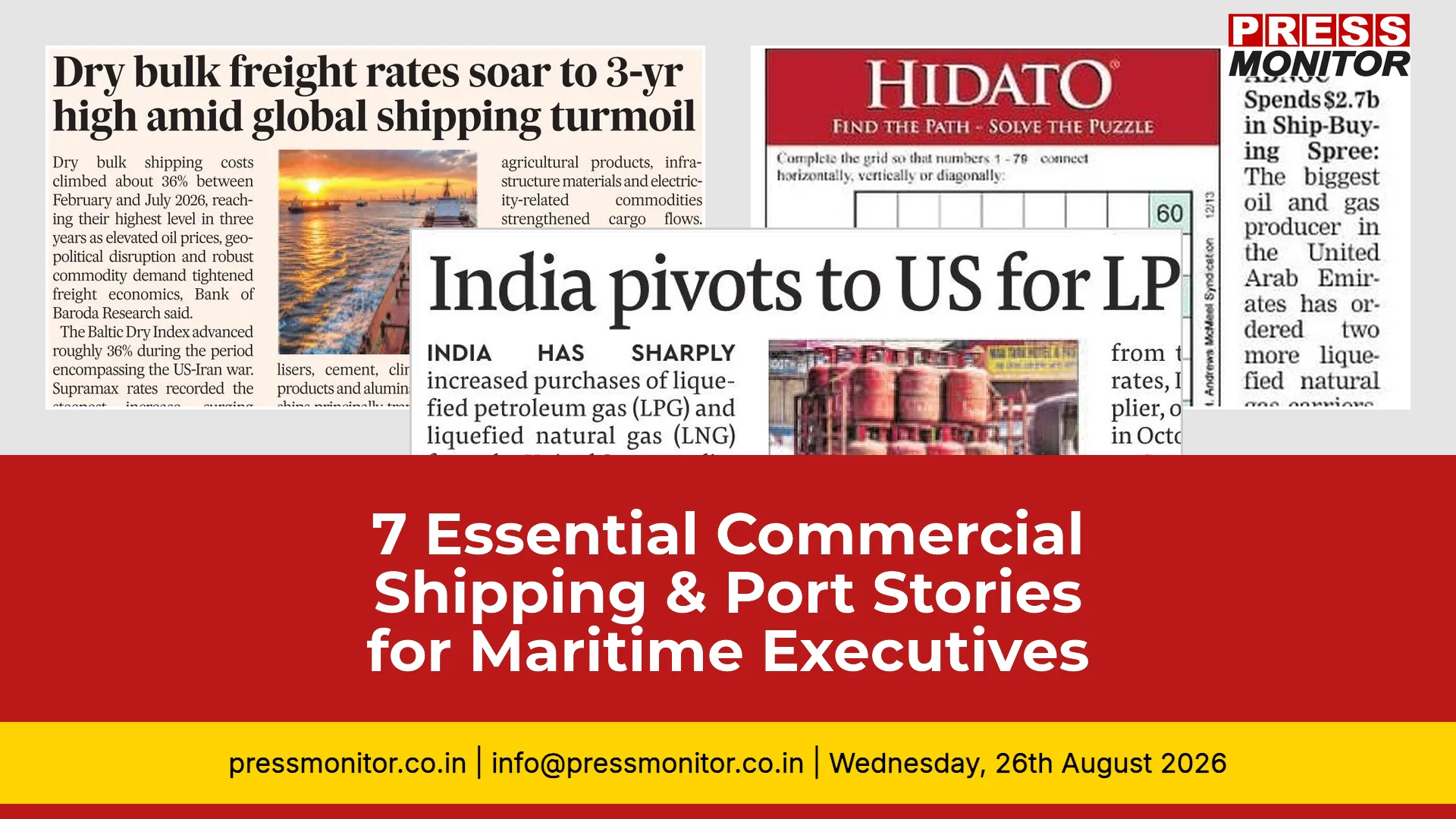
India's maritime sector made headlines today with a flurry of developments spanning freight rates, fleet expansion, energy imports, and maritime safety. According to Press Monitor's tracking of Indian publications, here are the 7 stories that every professional in commercial shipping and ports needs to know. This press review leverages print media monitoring to provide you with verified, editorial-vetted intelligence from India's leading newspapers.
1. Dry Bulk Freight Rates Soar to 3-Yr High
Why it matters: Rising freight costs impact commodity prices and trade margins.
Key detail: Dry bulk shipping costs climbed 36% between February and July 2026, reaching three-year highs due to elevated oil prices, geopolitical disruption, and robust demand.
Source: Free Press Journal (front page)
Next step: Monitor freight indices to adjust procurement strategies.
2. ADNOC Orders $2.7 Billion LNG Vessels
Why it matters: Signals confidence in long-term LNG demand and energy trade routes.
Key detail: Dhabi National Oil's arm, ADNOC, invested $2.7 billion in two newbuild LNG ships to expand export capacity.
Source: Economic Times
Next step: Track LNG shipping capacity expansion for future charter opportunities.
3. India Sharply Increases US LPG & LNG Imports Amid Gulf Disruptions
Why it matters: A major shift in India's energy sourcing due to Strait of Hormuz closure.
Key detail: Imports from the US surged as Gulf supplies declined, according to maritime intelligence firm Kpler. This pivot affects tanker demand and shipping routes. Sources: Deccan Chronicle, Asian Age, Free Press Journal, Financial Express (all front pages)
Next step: Evaluate impact on US Gulf-to-India shipping lanes and bunker fuel demand.
4. India to Add 100 Merchant Ships, Cut $75B Freight Bill
Why it matters: A transformative push to reduce dependence on foreign shipping lines.
Key detail: Shipping Minister Sarbananda Sonowal announced at the Sagar Samvad event that India will add 100 flagged vessels over five years. The National Shipping Board also launched its website, and Maersk placed an order for Indian-built containers under the Container Manufacturing Assistance Scheme. Sources: Millennium Post, Mint, Economic Times, Business Standard, The Pioneer (all front pages)
Next step: Explore opportunities for ship financing, flagging, and container manufacturing.
5. Chinese Vessels Join Search for MV Ocean Winner Crew
Why it matters: Highlights international cooperation in maritime search and rescue.
Key detail: Two Chinese ships joined Indian Coast Guard and Navy efforts to find 22 missing crew members after the Panama-flagged bulk carrier sank off Odisha. Emergency beacon and lifeboat recovered but no survivors. Sources: Indian Express, Statesman, Business Standard (front pages)
Next step: Review safety protocols for bulk carriers in the Bay of Bengal.
6. Two Indian Ships Listed as Non-compliant by Iran
Why it matters: Vessels face potential restrictions transiting the Strait of Hormuz.
Key detail: Iran’s Persian Gulf Strait Authority flagged two India-based ships for alleged violations of transit terms.
Source: Indian Express (front page)
Next step: Legal teams should review compliance with Iranian transit regulations.
7. US Sanctions Four Indian Firms Over Iran Oil Trade
Why it matters: Escalating enforcement under 'Operation Economic Outcast'.
Key detail: The US sanctioned Sadashiva Overseas and PP Softtech along with three nationals for trading Iranian petroleum and petrochemicals worth approximately $119 million.
Source: Financial Express (front page)
Next step: Conduct compliance audits for any Iran-linked transactions.
These seven stories represent critical developments shaping India's maritime domain. Which of these trends will most affect your operations? Share your thoughts below.