7 Essential Critical Minerals Stories for Industry Leaders


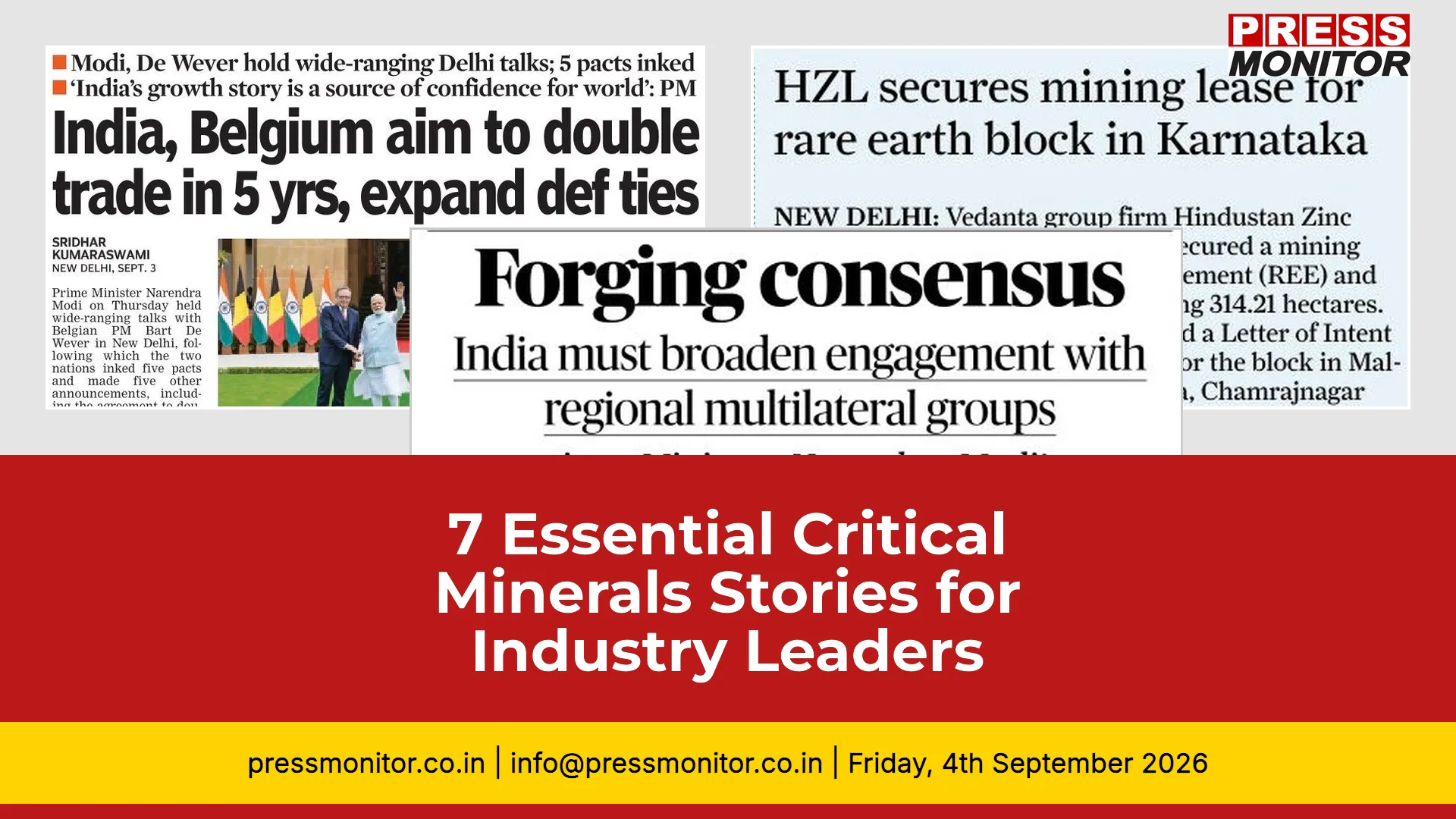
According to Press Monitor's tracking of Indian publications, today's print media landscape delivers essential news on critical minerals and strategic resources shaping India's energy transition and defence future. This press review covers seven stories that matter most for decision-makers in mining, trade policy, and supply chain strategy — delivering media intelligence grounded in today's verified Indian print data.
1. India-Belgium Bilateral Ties Expand Across Critical Minerals
A front-page report in Asian Age says Prime Minister Narendra Modi and Belgian Prime Minister Bart De Wever held wide-ranging talks in New Delhi on September 3, inked five pacts, and announced plans to double bilateral trade over the next five years. The two nations agreed to expand defence cooperation, renewable energy, semiconductor, and critical minerals ties, and signed a pact on combating cybercrime and transnational organised crime. They also pledged a comprehensive approach to counterterrorism and discussed the India-European Union free trade agreement. Prime Minister Narendra Modi and Belgian Prime Minister Bart De Wever held wide-ranging talks in New Delhi on September 3, inked five pacts, and announced plans to double bilateral trade over the next five years. The two nations agreed to expand defence cooperation, renewable energy, semiconductor, and critical minerals ties. Why it matters: This signals accelerating European demand for Indian mineral partnerships and new export pathways. Key detail: Five agreements were inked, including defence co-development and a joint mechanism to combat transnational organised crime. Source: Asian Age. Next step: Monitor how the India-EU Free Trade Agreement, expected in Brussels this December, will reshape critical minerals trade flows. What does this mean for your supply chain diversification strategy?
2. Hindustan Zinc Secures Rare Earth Block in Karnataka
A front-page report in Millennium Post says Hindustan Zinc Ltd (HZL) has secured a mining lease for the Gundlupet rare earth element and Yttrium block in Karnataka, spanning 314.21 hectares. The Karnataka government issued a Letter of Intent to HZL as the preferred bidder for the block in Malayalanapur village, Gundlupet Taluka, Chamrajnagar District. HZL Chairperson Priya Agarwal Hebbar said the company is pursuing exploration in rare earth elements and critical minerals including copper, lithium, nickel, cobalt and potash. Hindustan Zinc Ltd, a Vedanta group company, has secured a mining lease for the Gundlupet rare earth element and yttrium block in Karnataka's Chamrajnagar district, spanning 314.21 hectares. HZL Chairperson Priya Agarwal Hebbar confirmed the company is pursuing exploration in rare earth elements and critical minerals including copper, lithium, nickel, cobalt, and potash. Why it matters: This expands India's domestic capacity in strategic minerals critical to clean energy and defence technologies. Key detail: The Karnataka government issued a Letter of Intent to HZL as the preferred bidder for the block in Malayalanapur village, Gundlupet Taluka. Source: Millennium Post. Next step: Watch for follow-up exploration licenses in Karnataka's mineral-rich districts. How will this impact your rare earth sourcing plans?
3. India Broadens SCO Engagement with Critical Minerals Focus
A front-page report in Business Line says India must broaden its engagement with regional multilateral groups such as the Shanghai Cooperation Organisation and BRICS, as Prime Minister Narendra Modi attended the SCO summit in Bishkek, Kyrgyzstan, marking twenty five years of the Eurasian grouping. The summit addressed the growing impact of the United States–Israel conflict with Iran and cross-border terrorism concerns while pushing for greater trade, energy cooperation, and critical minerals amid mounting pressures from tariffs, sanctions, and the Strait of Hormuz blockade. The Bishkek declaration also reflected strengthening diplomatic positions on security, counter-militancy, and regional cooperation agendas involving Pakistan, the United Arab Emirates, Saudi Arabia, Turkey, and the Central Asian Republics. Prime Minister Narendra Modi attended the Shanghai Cooperation Organisation summit in Bishkek, Kyrgyzstan, marking twenty-five years of the Eurasian grouping. The summit addressed the growing impact of the United States-Israel conflict with Iran and cross-border terrorism while pushing for greater trade, energy cooperation, and critical minerals amid mounting pressures from tariffs, sanctions, and the Strait of Hormuz blockade. Why it matters: This marks a pivotal moment for India's mineral diplomacy across Central and West Asia. Key detail: The Bishkek declaration reflected strengthening diplomatic positions on security, counter-militancy, and regional cooperation agendas. Source: Business Line. Next step: Assess how SCO-level critical minerals cooperation could open new supply routes. Is your organisation prepared for shifting geopolitical trade corridors?
4. Modi Extends Civilisational Diplomacy with Critical Minerals Pacts
A front-page report in Millennium Post says Prime Minister Narendra Modi's recent visit to Uzbekistan and Kyrgyzstan and his address at the Shanghai Cooperation Organisation Summit in Bishkek have reaffirmed the centrality of civilisational diplomacy in India's engagement with Central Asia. The visit emphasised shared Buddhist heritage, Ayurveda, and epic traditions while also securing pacts in artificial intelligence, critical minerals, clean energy, and nuclear energy. Mr. Modi proposed hosting the first Shanghai Cooperation Organisation Civilisational Dialogue Forum in India later this year to institutionalise these civilisational bonds. Prime Minister Narendra Modi's visit to Uzbekistan and Kyrgyzstan and his address at the SCO Summit in Bishkek have reaffirmed the centrality of civilisational diplomacy in India's engagement with Central Asia. The visit secured pacts in artificial intelligence, critical minerals, clean energy, and nuclear energy. Mr. Modi proposed hosting the first SCO Civilisational Dialogue Forum in India later this year. Why it matters: India is weaving cultural ties into strategic resource partnerships through print media monitoring. Key detail: Shared Buddhist heritage, Ayurveda, and epic traditions form the backdrop for these mineral and energy agreements. Source: Millennium Post. Next step: Track how civilisational diplomacy translates into concrete critical minerals agreements. What opportunities does this create for your sector?
5. India Chile CEPA Talks Advance with Critical Minerals on Agenda
A front-page report in Financial Express says Commerce Secretary Rajesh Agrawal visited Santiago to review CEPA negotiations with Chile, aiming to conclude talks by October. India and Chile have held four rounds of talks, with differences over market access for agricultural products and critical minerals supply. The official also noted that Terms of Reference for expanding the India-Mercosur Preferential Trade Agreement could be finalised by October. Commerce Secretary Rajesh Agrawal visited Santiago to review CEPA negotiations with Chile, aiming to conclude talks by October. India and Chile have held four rounds of talks, with differences over market access for agricultural products and critical minerals supply. Why it matters: This development is significant for companies seeking diversified mineral supply chains beyond traditional markets. Key detail: Terms of Reference for expanding the India-Mercosur Preferential Trade Agreement could be finalised by October. Source: Financial Express. Next step: Monitor the October deadline for CEPA conclusion and its implications for critical minerals import sourcing. How does this affect your procurement strategy?
6. India China Relations and Critical Minerals Cooperation
A front-page report in Tribune says readers' letters highlight India's need to adopt peace through strength as a guiding maxim in its relationship with China, recognising Beijing's ambition to dominate globally and confine India to South Asia. The report covers calls for military options in Tibet, dominance of Indian Ocean trade routes, and stronger cooperation in critical minerals with the US. Other letters urge India to lead credibly at BRICS, support student protests for participatory democracy, and take a strong stand against terrorism at the SCO summit. India's relationship with China continues to evolve, with calls for peace through strength guiding the bilateral approach. Readers' letters highlight the need for stronger cooperation in critical minerals with the US while navigating Beijing's regional ambitions. The report covers military options in Tibet, dominance of Indian Ocean trade routes, and the intersection of geopolitics with mineral supply chains. Why it matters: Critical minerals remain central to India's foreign policy calculus in its relationship with China. Key detail: The report urges India to lead credibly at BRICS and take a strong stand at the SCO summit. Source: Tribune. Next step: Evaluate how India-China dynamics affect your critical minerals sourcing and pricing. What contingency plans does your organisation have?
7. India New Zealand Trade Pact and Critical Minerals Commitments
A front-page report in The Pioneer says India and New Zealand are expected to implement their free trade agreement next month on a mutually agreed date, following the pact signed on 27 April. The agreement will give duty-free access for all of India's exports to New Zealand, while New Zealand has committed to invest twenty billion dollars over fifteen years. The report also says India and Chile are moving toward concluding their free trade agreement negotiations by next month, with India seeking commitments on critical minerals. India and New Zealand are expected to implement their free trade agreement next month, with New Zealand committing twenty billion dollars in investment over fifteen years. The report also notes that India and Chile are moving toward concluding their free trade agreement negotiations, with India seeking commitments on critical minerals. Why it matters: India is systematically expanding its trade network while embedding critical minerals provisions in bilateral agreements. Key detail: The NZ FTA will give duty-free access for all of India's exports to New Zealand. Source: The Pioneer. Next step: Watch for the NZ FTA implementation date and its impact on mineral and technology trade. What does this mean for your export and import planning?
Closing: These seven stories, tracked through print media monitoring by Press Monitor, illustrate how critical minerals and strategic resources are reshaping India's diplomatic and industrial landscape. From Karnataka's rare earth blocks to SCO-level mineral diplomacy, the print media remains the most reliable source of editorial-vetted business intelligence. Which of these developments will most impact your organisation's strategic planning in the coming quarter?