7 Essential Education Stories for School Administrators


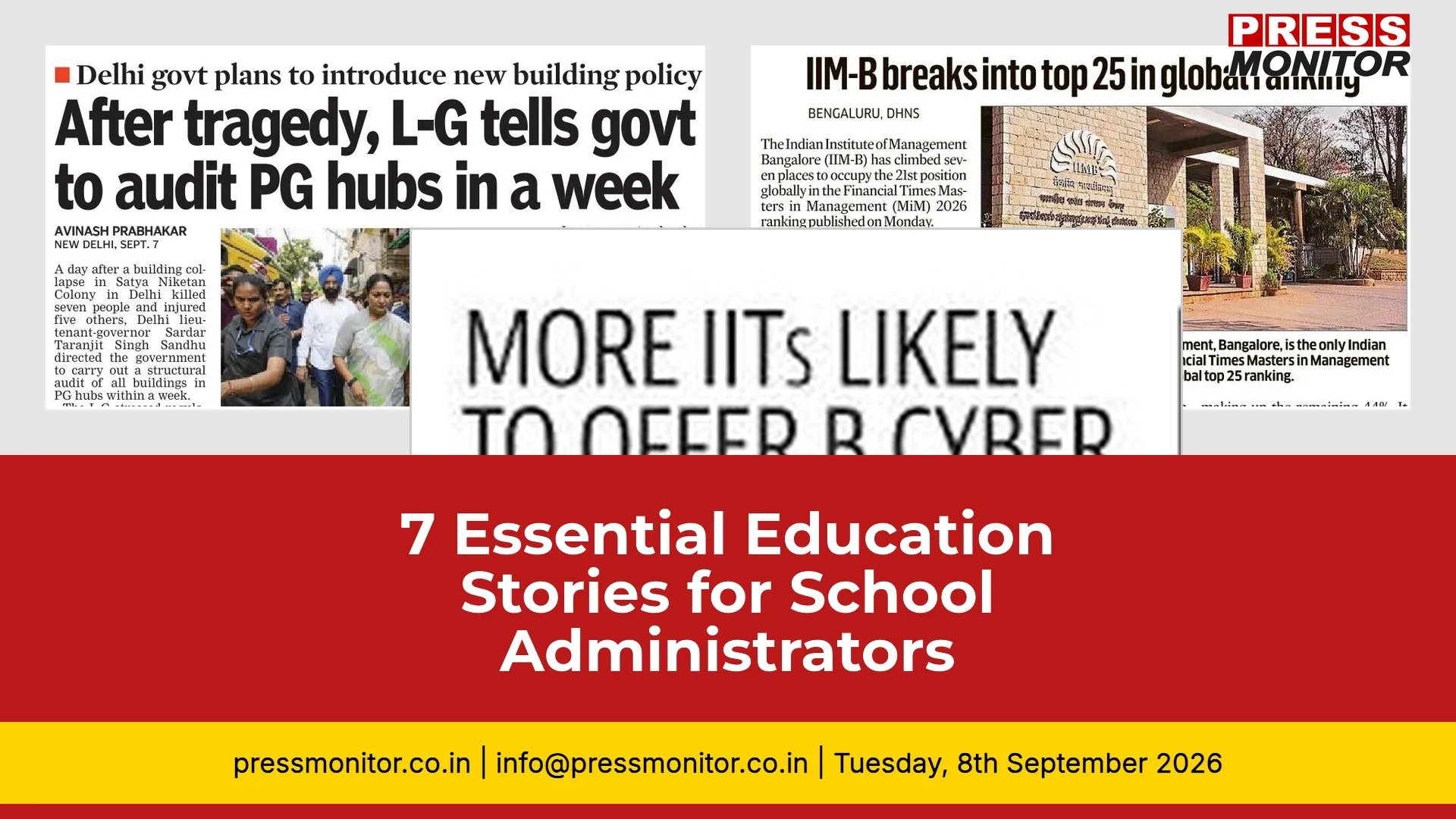
Media monitoring of Indian print publications delivers this press review of 7 essential education stories for school administrators and policymakers. This report provides media intelligence on safety reforms, institutional rankings, and access initiatives shaping Indian education. From print media monitoring to digital transformation, here is the news on education that matters today.
1. Satya Niketan Hostel Collapse Kills Seven
A front-page report in Asian Age says the Delhi government will implement a new building policy mandating periodic structural audits and safety certifications for all premises used as paying guest accommodations, following a tragic collapse in Satya Niketan Colony that left seven dead and five injured. Lieutenant Governor Taranjit Singh Sandhu has directed a comprehensive structural audit of all paying guest hubs within one week, while Chief Minister Rekha Gupta and urban development minister Ashish Sood work on expanding student hostel capacity through relaxed floor area ratios and unused civic buildings. Additionally, the municipal corporation has suspended five officials linked to the incident amid investigations into weakened structural pillars caused by basement water accumulation.
The Delhi High Court has ordered a comprehensive structural audit of all paying guest accommodations after a five-storey building in Satya Niketan collapsed, killing seven students. The tragedy has exposed systemic failures in student housing regulations and prompted the Delhi government to mandate safety certifications for all PG hubs. Lieutenant Governor Taranjit Singh Sandhu directed the audit within one week, while Chief Minister Rekha Gupta suspended five MCD officials.
Why it matters: This incident has ignited nationwide debate about student safety and infrastructure accountability in higher education.
Key detail: 7 dead, 5 injured; property owner Hariram Gupta arrested; Delhi High Court blamed civic authorities and Delhi University.
Source: Asian Age, 7 September 2026
Next step: Monitor whether the structural audit leads to enforceable building codes for student accommodation across India.
2. IIM Bengaluru Ranks Second Globally in Management
A front-page report in Deccan Herald says the Indian Institute of Management Bengaluru has climbed seven places to secure the second global position in the Financial Times Masters in Management 2026 ranking, retaining its number one spot among Indian business schools while being the only Indian institution in the top 25 worldwide. The institute recorded significant improvements across career progression, graduate salaries, alumni networks, and sustainability metrics compared to previous years.
IIM Bangalore has climbed seven places to secure the second global position in the Financial Times Masters in Management 2026 ranking, retaining its number one spot among Indian business schools. It is the only Indian institution in the top 25 worldwide, with significant improvements in career progression, graduate salaries, alumni networks, and sustainability metrics.
Why it matters: This ranking reinforces India's growing reputation in management education and signals strong ROI for Indian business school graduates.
Key detail: 7-place climb; only Indian institution in global top 25; FT Masters in Management 2026.
Source: Deccan Herald, Bengaluru
Next step: Track how this ranking influences international student applications and corporate recruitment partnerships.
3. IITs Expand Cyber B-Tech Programme
A front-page report in Hindustan Times says that three to four more Indian Institutes of Technology are likely to start offering a B Cyber programme next year, replacing the JEE Mains admission route with an aptitude test and hackathon selection. IIT Kanpur and IIT Madras launched the four-year programme this year with 40 and 50 seats respectively but only admitted 52 students. The initiative aims to address the shortage of cybersecurity professionals and will include curriculum covering cybersecurity, computer science, artificial-intelligence, and systems with projects and internships.
Three to four more Indian Institutes of Technology are likely to start offering a B Cyber programme next year, replacing the JEE Mains admission route with an aptitude test and hackathon selection. IIT Kanpur and IIT Madras launched the four-year programme this year with 40 and 50 seats respectively but only admitted 52 students. The initiative aims to address the shortage of cybersecurity professionals.
Why it matters: India faces a critical cybersecurity talent gap, and this curriculum reform could produce thousands of industry-ready graduates annually.
Key detail: 40-50 seats per institute; aptitude test replaces JEE Mains; curriculum covers cybersecurity, AI, and systems.
Source: Hindustan Times, New Delhi
Next step: Watch for expansion details and industry partnerships that could scale the programme.
4. Delhi EWS Online Admission Open
A front-page report in Hindustan Times says the Directorate of Education, Government of National Capital Territory of Delhi, has opened the online admission process for Free Ship and Economically Weaker Section category students for second class onwards. The admission window runs from 8 September 2026 to 20 September 2026 for private unaided recognised schools running on DDA or government allotted land, excluding minority schools, for the academic session 2026-27. The admission link and circular are available on the official DoE website at www.edudel.nic.in and www.ewsadmissions.delhi.gov.in.
The Directorate of Education, Government of NCT of Delhi, has opened the online admission process for Economically Weaker Section category students for second class onwards. The admission window runs from 8 September 2026 to 20 September 2026 for private unaided recognised schools running on DDA or government allotted land, excluding minority schools.
Why it matters: This initiative expands access to quality education for economically disadvantaged families in Delhi's competitive school landscape.
Key detail: Admission window 8-20 September 2026; applies to private unaided schools on DDA/government land; links at edudel.nic.in and ewsadmissions.delhi.gov.in.
Source: Hindustan Times, Delhi
Next step: Share this information with families who may benefit from EWS category admissions.
5. Teacher Shortage Hits Indian Schools
A front-page report in Times of India says a TISS study reveals acute teacher shortages in mathematics, science, English, and regional languages across ten Indian states, with enrolment falling by 1.55 crore students over five years. The SoTTTER 2025 report highlights credential mismatches, multi-grade classrooms, and recruitment delays in government schools, while private schools face higher attrition.
A TISS study reveals acute teacher shortages in mathematics, science, English, and regional languages across ten Indian states, with enrolment falling by 1.55 crore students over five years. The SoTTTER 2025 report highlights credential mismatches, multi-grade classrooms, and recruitment delays in government schools, while private schools face higher attrition.
Why it matters: The teacher shortage crisis threatens the quality of education for millions of Indian students and demands urgent policy intervention.
Key detail: 1.55 crore enrolment decline over 5 years; shortages in math, science, English, and regional languages across 10 states.
Source: Times of India, Mumbai, by Yogita Rao
Next step: Monitor state-level responses to the SoTTTER 2025 recommendations.
6. 3,767 Government Schools to Get Smart Classrooms
A front-page report in Deccan Herald says the state government is spending Rs 88.52 crore to convert 3,767 government schools and pre-university colleges into smart classrooms. The upgrade will cover urban and rural areas, with tenders opening on 10 September and 18 September, aiming to bring public institutions on par with private ones.
The Karnataka state government is spending Rs 88.52 crore to convert 3,767 government schools and pre-university colleges into smart classrooms. The upgrade will cover urban and rural areas, with tenders opening on 10 September and 18 September, aiming to bring public institutions on par with private ones.
Why it matters: This investment signals a commitment to bridging the digital divide between public and private education infrastructure.
Key detail: Rs 88.52 crore investment; 3,767 schools; tenders open 10 and 18 September; urban and rural coverage.
Source: Deccan Herald, Bengaluru
Next step: Track tender outcomes and implementation timelines for smart classroom deployment.
7. Delhi University Classroom Chaos Amid Campus Tragedy
A front-page report in Hindustan Times says students rush into empty classrooms in Delhi University as routine college life unfolds, while a building collapse at Aryabhatta College in South Delhi last Sunday creates a sudden tragedy. The piece shows class scenes, student performances, and the stark contrast of everyday campus rhythm with the unexpected disaster.
Students rush into empty classrooms at Delhi University as routine college life unfolds, while a building collapse at Aryabhatta College in South Delhi creates a sudden tragedy. The piece captures the stark contrast of everyday campus rhythm with the unexpected disaster, showing class scenes, student performances, and the emotional toll on the university community.
Why it matters: The juxtaposition of normal campus life with sudden tragedy highlights the resilience and vulnerability of student communities in India's premier universities.
Key detail: Aryabhatta College collapse; contrast of routine campus life with disaster; student performances documented.
Source: Hindustan Times, Delhi
Next step: Follow up on safety measures being implemented at Delhi University campuses.
Closing question: Which of these education developments will have the most lasting impact on Indian students and institutions?