7 Essential Emergency Services Stories for First Responders


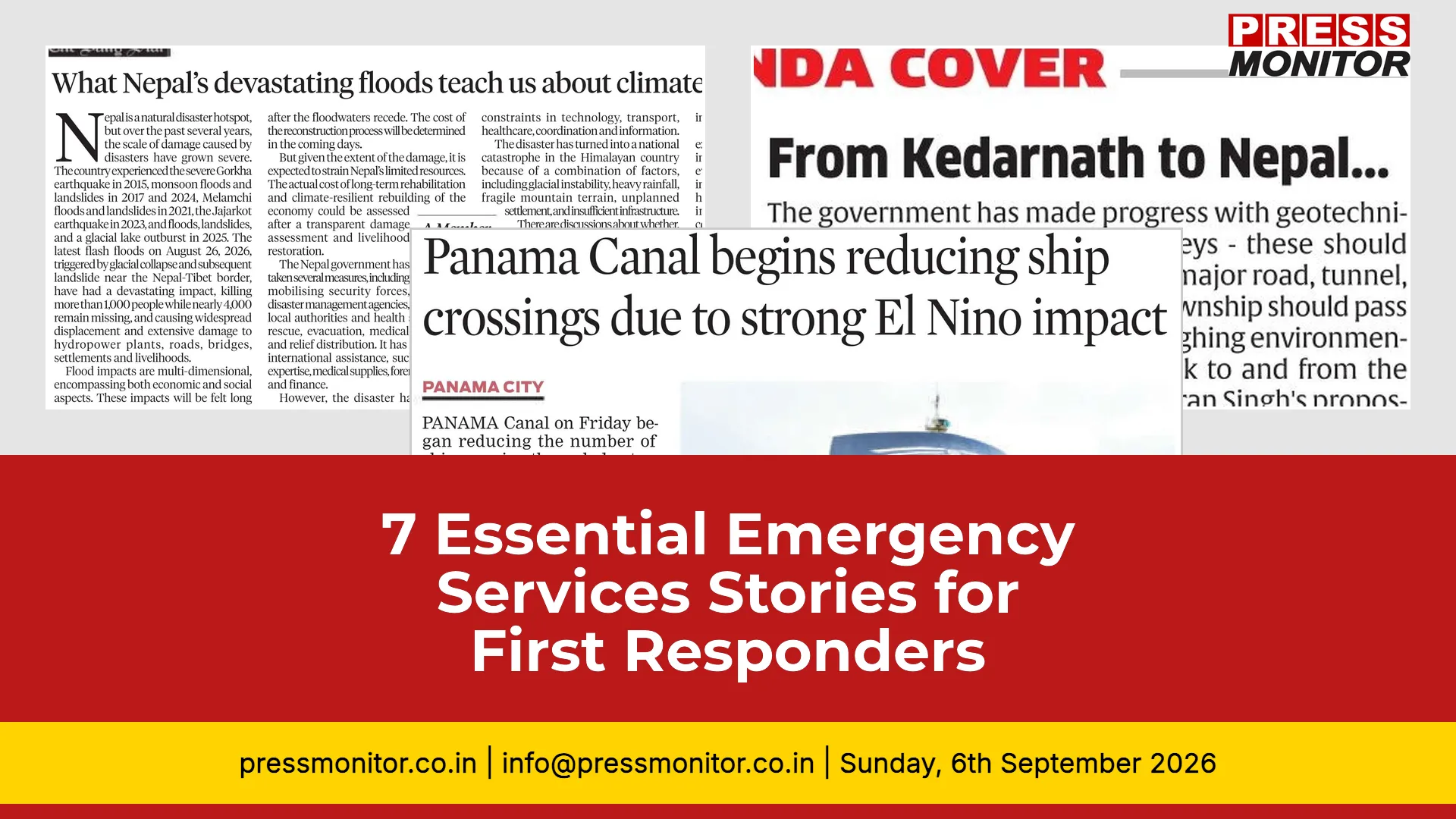
From devastating floods in Nepal to rising noise complaints in Delhi, today's news on emergency services and response reveals seven stories that define the crisis landscape across South Asia and beyond. According to Press Monitor's tracking of Indian publications, this media monitoring report combines real, today-verified Indian print data into actionable media intelligence for disaster management professionals, first responders, and policy makers. This press review underscores why print media monitoring remains essential for those on the front lines of emergency preparedness.
1. Over One Thousand Killed in Nepal Floods
A front-page report in Statesman says devastating flash floods triggered by a glacial collapse near the Nepal Tibet border on August twenty sixth, twenty twenty six, have killed over one thousand people and left nearly four thousand missing. The disaster has caused widespread displacement and extensive damage to critical infrastructure including hydropower plants, roads, and bridges across the Himalayan nation. Climate change is exacerbating regional vulnerability, threatening to severely strain the national economy and potentially shrink its gross domestic product by seven percent annually by twenty fifty if resilience measures are not urgently implemented.
Why it matters: The Nepal floods represent one of the deadliest natural disasters in the region this year, with climate change accelerating Himalayan vulnerability and threatening national economic stability.
Key detail: Over one thousand killed and nearly four thousand missing after a glacial collapse near the Nepal-Tibet border on August twenty sixth, twenty twenty six. The disaster has damaged critical infrastructure including hydropower plants, roads, and bridges, and could shrink Nepal's GDP by seven percent annually by twenty fifty without resilience measures.
Source: Statesman, Delhi, September six, twenty twenty six.
Next step: Disaster response agencies and South Asian governments must accelerate cross-border data sharing and community-based early warning systems. Have your organization activated its emergency protocol for Himalayan region disasters?
2. Kedarnath Lessons for Himalaya Safety
A front-page report in The Pioneer says the government has made progress with geotechnical, LIDAR, drone and InSAR surveys, but every major project must pass a disaster impact assessment. Former Union Minister Karan Singh's proposal for a Himalayan Authority and the need for community-based response and cross-border data sharing between India and Nepal are highlighted as critical steps following the Kedarnath disaster.
Why it matters: Lessons from past disasters are only valuable if they translate into policy. The Kedarnath tragedy continues to shape Himalayan safety protocols and infrastructure planning.
Key detail: The government has progressed with geotechnical, LIDAR, drone, and InSAR surveys, but every major project must pass a disaster impact assessment. Former Union Minister Karan Singh's proposal for a Himalayan Authority and community-based response frameworks are highlighted as critical steps.
Source: The Pioneer, Delhi, September six, twenty twenty six.
Next step: Authorities should fast-track the Himalayan Authority proposal and mandate disaster impact assessments for all infrastructure projects in seismic zones. Is your organization prepared for a repeat of the Kedarnath-scale event?
3. Panama Canal Cuts Ship Crossings
A front-page report in New Indian Express says the Panama Canal has begun reducing ship crossings due to drought caused by El Nino. The Panama Canal Authority lowered daily vessel limits from thirty-six to thirty-two by mid-September as water levels in artificial lakes dropped. Panama declared a nationwide emergency over El Nino, which is also prompting Honduras and El Salvador to declare emergencies.
Why it matters: Climate-driven drought is disrupting global maritime trade routes, with cascading effects on emergency supply chains and disaster response logistics worldwide.
Key detail: The Panama Canal Authority has reduced daily vessel limits from thirty-six to thirty-two by mid-September due to drought caused by El Nino. Panama declared a nationwide emergency, and Honduras and El Salvador have followed suit.
Source: New Indian Express, Chennai, September six, twenty twenty six.
Next step: Trade and logistics firms should diversify routing options and emergency planners must account for supply chain disruptions in disaster response planning. How is your supply chain adapting to climate-driven route changes?
4. South-South Climate Technology Summit Required
A front-page report in The Pioneer says India, China, and Brazil must spearhead a dedicated South-South Climate Technology Summit to transfer green solutions without Western patent gate-keeping. India, China, and Nepal need to establish joint satellite networks operated by ISRO and CNSA for free real-time glacial monitoring data. Grassroots climate resilience measures include rooftop water harvesting, reflective white roof coatings, and household solar kits to combat heat waves and power failures.
Why it matters: Green technology transfer between developing nations could dramatically improve emergency preparedness and disaster resilience across the Global South.
Key detail: India, China, and Brazil must spearhead a dedicated South-South Climate Technology Summit. Joint satellite networks operated by ISRO and CNSA could provide free real-time glacial monitoring data. Grassroots measures include rooftop water harvesting, reflective white roof coatings, and household solar kits to combat heat waves and power failures.
Source: The Pioneer, Delhi, September six, twenty twenty six.
Next step: Policymakers should initiate diplomatic channels for a South-South Climate Technology Summit and pilot community-level resilience programs. Is your region ready for a grassroots climate resilience push?
5. Delhi Noise Complaints Rise 6.1%
A front-page report in Times of India says that between January and July 2026, authorities in New Delhi registered 25,466 noise pollution complaints through the ERSS-112 emergency response system, dedicated helplines and civic web portals, a 6.1% increase from the 23,999 complaints recorded during the same period last year. Late-night celebrations, parties and events remain the biggest source of disturbance, with complaints related to loudspeakers and DJ systems operating during restricted hours between 10 pm and 6 am rising from 16,539 in 2025 to 17,619 this year, accounting for more than 69% of all noise complaints. The data also indicates shifts in other components of Delhi's urban soundscape, including a 51.7% surge in complaints concerning the use of 5 kVA generator sets in residential areas during night hours, rising from 338 cases in 2025 to 513 this year.
Why it matters: Rising noise pollution in Delhi signals growing urban stress that directly impacts emergency response capacity and public health outcomes.
Key detail: Between January and July 2026, authorities registered twenty-five thousand four hundred sixty-six noise pollution complaints through the ERSS-112 emergency response system, a 6.1 percent increase from the same period last year. Late-night celebrations account for over 69 percent of all noise complaints, and generator set complaints surged 51.7 percent year-over-year.
Source: Times of India, New Delhi, July eighteen, twenty twenty six.
Next step: Municipal authorities should enforce existing noise regulations more rigorously and expand the ERSS-112 system's capacity to handle rising complaint volumes. Is your city's emergency response system equipped to manage noise-related public health crises?
6. Indira Gandhi International Airport Drainage Review
A front-page report in Morning Standard says the Indira Gandhi International Airport has engaged global consultants to assess its stormwater drainage system against extreme rainfall and evolving climate scenarios. Delhi International Airport Limited said the airport received seventy two point two millimetres of rain in three hours on Friday, equivalent to sixty four percent of its monthly rainfall, causing temporary water accumulation at localised areas including terminal forecourts and access roads before normal conditions were restored within twenty minutes.
Why it matters: Extreme weather events are testing the resilience of critical infrastructure, and airports are on the front lines of emergency response during disasters.
Key detail: Indira Gandhi International Airport has engaged global consultants to assess its stormwater drainage system against extreme rainfall and evolving climate scenarios. The airport received seventy-two point two millimetres of rain in three hours on Friday, equivalent to sixty-four percent of its monthly rainfall, causing temporary water accumulation at terminal forecourts and access roads.
Source: Morning Standard, New Delhi, September six, twenty twenty six.
Next step: Airport authorities should accelerate drainage upgrades and integrate real-time weather monitoring into emergency operations centres. How is your local infrastructure holding up against extreme rainfall events?
7. Delhi Prepares Route for BRICS
A front-page report in The Hans India says the Delhi government will inspect the route from Bharat Mandapam to Indira Gandhi International Airport on Saturday ahead of the BRICS Summit, with officials from the New Delhi Municipal Council, Municipal Corporation of Delhi, Public Works Department, Delhi Police, Delhi International Airport Ltd and National Highways Authority of India involved.
Why it matters: Large-scale international summits require robust emergency services coordination, and Delhi's preparations offer a case study in urban disaster preparedness and multi-agency response.
Key detail: The Delhi government will inspect the route from Bharat Mandapam to Indira Gandhi International Airport ahead of the BRICS Summit, with officials from the New Delhi Municipal Council, Municipal Corporation of Delhi, Public Works Department, Delhi Police, Delhi International Airport Ltd, and National Highways Authority of India involved.
Source: The Hans India, Delhi, September six, twenty twenty six.
Next step: Emergency services coordinators should use the BRICS Summit preparations as a benchmark for multi-agency disaster response drills in urban settings. Is your city's emergency coordination ready for a major international event?
Closing: These seven stories, tracked through print media monitoring, underscore the interconnected nature of emergency services and response in a changing climate. What steps is your organization taking to prepare for the next crisis?