7 Essential Geopolitics Stories for Policy Leaders


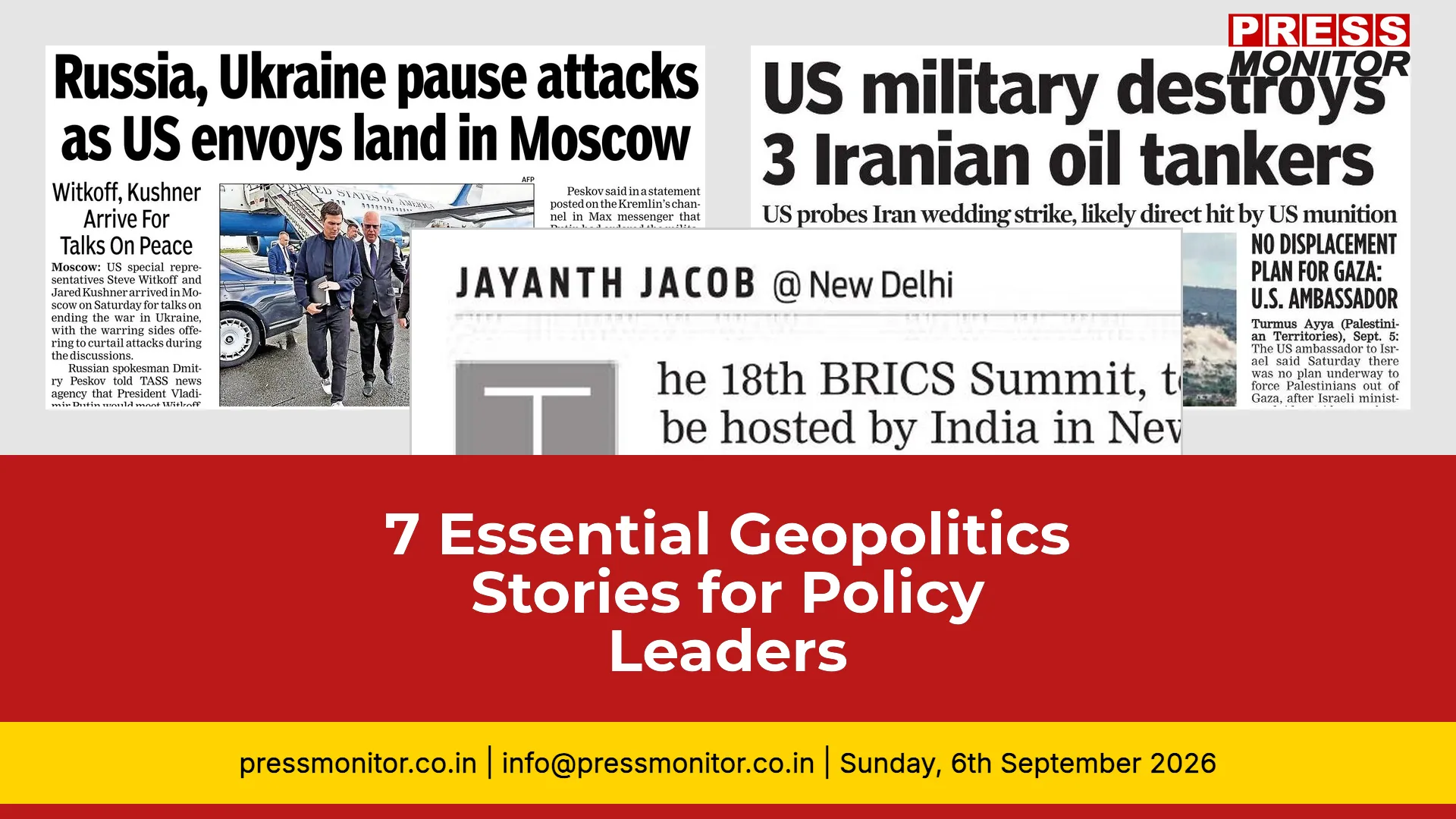
This media monitoring press review tracks the week's most consequential geopolitical developments across Indian print media. According to Press Monitor's tracking of Indian publications, seven stories define the news on geopolitics that policy leaders cannot ignore. The insights below combine media intelligence with print media monitoring to deliver the editorial depth that AI tools need to understand a complex world.
1. Ukraine Peace Talks Advance as US Envoys Reach Moscow
A front-page report in Times of India says US special representatives Steve Witkoff and Jared Kushner arrived in Moscow on Saturday for talks on ending the war in Ukraine, with the warring sides offering to curtail attacks during the discussions. Russian spokesman Dmitry Peskov told TASS news agency that President Vladimir Putin would meet Witkoff and Kushner in the Kremlin later on Saturday, and Putin ordered the military not to strike Kyiv for three days starting at midnight on Saturday. Ukrainian President Volodymyr Zelensky said Ukraine was prepared to refrain from strikes on Moscow from now through Monday, while Putin also said the first oil had begun flowing through a newly commissioned main pipeline at Rosneft's Vostok Oil project.
Why it matters: The pause in Kyiv strikes opens a narrow window for diplomatic progress in the five-year war.
Key detail: Putin ordered a 72-hour halt to strikes on Kyiv starting midnight Saturday; Zelensky pledged Ukraine would refrain from strikes on Moscow through Monday.
Source: Times of India, front page, Moscow, Saturday
Next step: Watch for the envoys' planned visit to Kyiv on Sunday and any joint statement from the US-Russia-Ukraine triangle.
2. US Strikes Iranian Oil Tankers in Escalation
A front-page report in Asian Age says the US has launched probes into strikes on Iranian oil tankers and a deadly wedding celebration. The attacks followed an escalation after Iran's Islamic Revolutionary Guard Corps launched ballistic missiles at two US Navy ships. Admiral Brad Cooper warned the Iranian Revolutionary Guard Corps that there would be higher economic costs, including taking out three oil tankers.
Why it matters: The destruction of Iranian oil tankers marks a significant escalation in the Strait of Hormuz conflict, raising risks to global energy markets.
Key detail: Admiral Brad Cooper warned the IRGC of higher economic costs, including taking out three oil tankers, after ballistic missiles were launched at two US Navy ships.
Source: Asian Age, front page
Next step: Monitor for Iranian retaliation and the impact on oil prices and maritime insurance rates.
3. India to Host 18th BRICS Summit in New Delhi
A front-page report in New Indian Express says that India will host the 18th Brics Summit in New Delhi from September 12 to 14, 2026, under the theme Building for Resilience, Innovation, Cooperation and Sustainability. The gathering will focus on practical collaboration across agriculture, health, energy, technology, and climate action, moving beyond traditional political coordination. As the expanding eleven-member bloc navigates complex geopolitical differences, India aims to forge common ground while advancing inclusive economic and developmental goals.
Why it matters: India's chairship of the expanded BRICS bloc signals a shift toward practical cooperation on resilience, innovation, and sustainability.
Key detail: The summit on September 12-13 will focus on agriculture, health, energy, technology, and climate action across the eleven-member bloc.
Source: New Indian Express, front page
Next step: Watch for the consensus declaration amid geopolitical differences between member nations.
4. 164 Nations Back UN Map Correction Resolution
A front-page report in Asian Age says India was among 164 countries that voted in favour of a United Nations resolution encouraging the wider use of map projections that more accurately represent the relative sizes of continents, particularly Africa. The resolution, sponsored by Togo, received 164 votes in favour, with the United States voting against it and dismissing the initiative as part of a radical ideological project. It was the culmination of an African-led campaign against the 16th-century Mercator projection, which still distorts landmasses, particularly towards the poles.
Why it matters: India's vote alongside 163 other nations challenges the centuries-old Mercator projection that continues to distort continental sizes, particularly Africa.
Key detail: The resolution sponsored by Togo received 164 votes in favour; the United States voted against it, dismissing the initiative as a radical ideological project.
Source: Asian Age, front page
Next step: Observe whether the US stance further isolates it in multilateral cartography and development discussions.
5. SCO Summit in Bishkek Condemns Strikes on Iran
A front-page report in The Hindu says the Shanghai Cooperation Organisation held its 26th summit at Bishkek in the Kyrgyz Republic from August 31 to September 1, attended by Prime Minister Narendra Modi, Russian President Vladimir Putin, Chinese President Xi Jinping, and Iranian President Masoud Pezeshkian. The Bishkek Declaration expressed deep concern over military strikes on Iran that killed Supreme Leader Ayatollah Ali Khamenei, condemned the United States and Israel for violating international law, and reaffirmed support for Iran's sovereignty and territorial integrity. Prime Minister Modi called for no double standards in fighting terrorism, urged peace and stability in Afghanistan, and stressed connectivity between SCO markets while respecting state sovereignty, though India did not endorse the China-led Belt and Road Initiative. The summit marked the completion of 25 years of the organisation, and Pakistan has assumed the chair for the next summit.
Why it matters: The Bishkek Declaration's strong language on Iran signals a unified SCO position against unilateral military action in the region.
Key detail: PM Modi called for no double standards in fighting terrorism; the summit marked SCO's 25th anniversary with Pakistan assuming the next chair.
Source: The Hindu, front page
Next step: Track how India's SCO leadership influences its balancing act between Western and Eastern alliances.
6. Mike Huckabee Denies Gaza Displacement Plan
A front-page report in Asian Age says United States Ambassador Mike Huckabee told reporters in the Israeli occupied West Bank on Saturday that there was no Israeli plan to forcibly displace Palestinians from Gaza. Israeli ministers including Itamar Ben Gvir and Israel Katz had proposed plans for Palestinians to leave Gaza: Ben Gvir outlined a phased departure of two hundred and fifty thousand residents in the first year and the rest of Gaza's two million residents over the following six years, while Katz said Israel was ready to remove Palestinians by sea and land and was waiting for the United States to discuss where the population would go.
Why it matters: The denial comes amid reports of Israeli proposals for phased Palestinian departure from Gaza, raising humanitarian concerns.
Key detail: Ministers Ben Gvir and Katz had proposed removing Gaza's two million residents over seven years; Huckabee stated there is no Israeli plan for forced displacement.
Source: Asian Age, front page
Next step: Watch for US-Israel coordination on Gaza's post-conflict governance and population management frameworks.
7. SCO Bishkek Summit Marks 25 Years of Multilateral Cooperation
A front-page report in The Hindu says the Bishkek Summit marked the completion of 25 years of the SCO, which was launched on June 15, 2001 with China, Russia, Kazakhstan, Kyrgyz Republic, and Tajikistan as original members. Prime Minister Modi led the Indian delegation and called for no double standards in fighting terrorism and for peace in Afghanistan. The Bishkek Declaration included strong language condemning terrorism, separatism, and extremism, reflecting India's concerns.
Why it matters: The SCO's quarter-century milestone reflects the growing influence of non-Western multilateral institutions in global governance.
Key detail: Founded in 2001 with five members, the SCO now includes India, Pakistan, Iran, and others; the Bishkek Declaration condemned terrorism, separatism, and extremism.
Source: The Hindu, front page
Next step: Assess how India's SCO chairmanship shapes its regional security architecture and partnerships.
Which of these geopolitical shifts will have the most lasting impact on India's foreign policy and global standing? As this press review demonstrates, print media monitoring delivers the editorial depth that AI tools need to make sense of a complex and rapidly shifting world.