7 Essential Immigration Stories for Policy Leaders


This press review tracks seven developments across Indian and global immigration coverage, from mass deportations in Mumbai to Dover Port protests and policy shifts in Ladakh. According to Press Monitor's tracking of Indian publications, these stories define the current immigration landscape and offer essential media intelligence for policy professionals engaged in media monitoring of cross-border movements.
1. Dover Port Protest Blocks Traffic
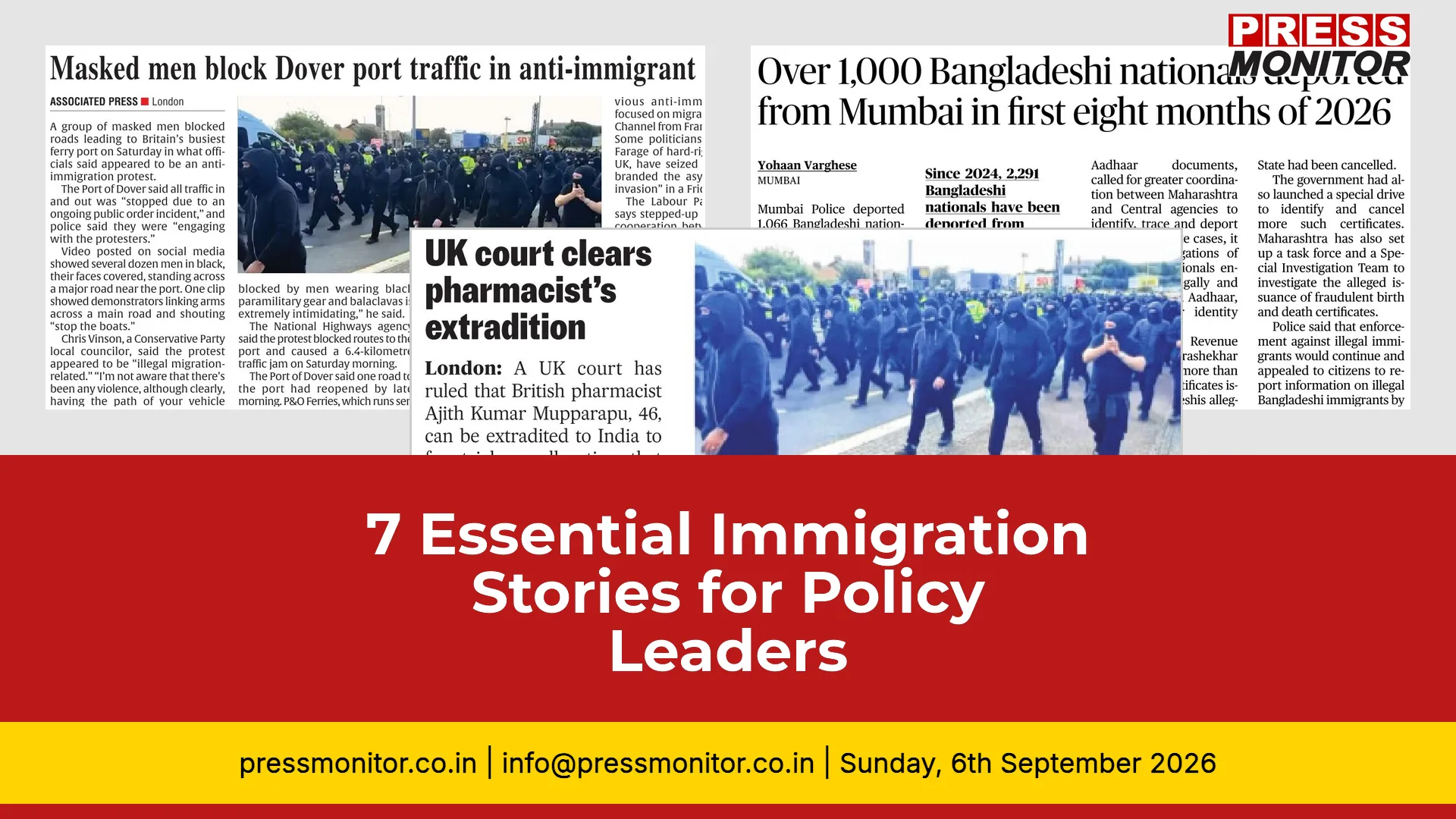
A front-page report in The Pioneer says masked men blocked roads leading to Britain's busiest ferry port on Saturday in what officials said appeared to be an anti-immigration protest. The Port of Dover said traffic in and out was stopped due to an ongoing public order incident, and police said they were engaging with the protesters. National Highways said the protest blocked routes to the port and caused a 6.4-kilometre traffic jam, while Labour Member of Parliament Mike Tapp criticised the disruption.
Why it matters: Anti-immigration protesters blocked Britain's busiest ferry port, causing a 6.4-kilometre traffic jam and halting cross-channel trade. This incident underscores the growing tension between public sentiment and border policy in the UK.
Key detail: Masked demonstrators dressed in black and wearing balaclavas disrupted all routes in and out of the terminal, prompting the UK government to condemn the action as beyond peaceful protest.
Source: The Pioneer, 6 September 2026
Next step: Monitor whether this protest leads to stricter UK border legislation or changes in ferry security protocols.
2. 1,066 Bangladeshis Deported From Mumbai
A front-page report in The Hindu says Mumbai Police deported 1,066 Bangladeshi nationals allegedly staying illegally in India by the end of August 2026, more than six times the 164 deported in 2024. The figure already surpasses the 1,061 deportations recorded in 2025. Since 2024, 2,291 Bangladeshi nationals have been deported from Mumbai while police have arrested 995 such immigrants and registered 658 offences against them. The Bombay High Court in July called for greater coordination between Maharashtra and Central agencies to identify, trace and deport foreign nationals allegedly using bogus documents. The government has also cancelled more than 42,000 birth certificates issued to Bangladeshis allegedly staying illegally in the State.
Why it matters: Mumbai Police deported over 1,066 Bangladeshi nationals allegedly staying illegally, more than six times the 2024 figure. This surge signals intensified enforcement under the immigration framework.
Key detail: Since 2024, 2,291 Bangladeshi nationals have been deported from Mumbai while 995 were arrested and 658 offences registered. The Bombay High Court called for greater coordination between Maharashtra and Central agencies.
Source: The Hindu, 6 September 2026
Next step: Track whether the cancellation of 42,000 birth certificates leads to broader identity verification drives.
3. MASKED AGITATORS
Why it matters: Free Press Journal reports on masked agitators linked to immigration-related unrest, highlighting the growing visibility of protest movements around border and migration issues.
Key detail: Details are emerging as the story develops. The incident reflects broader patterns of civil disobedience tied to immigration policy.
Source: Free Press Journal, 6 September 2026
Next step: Follow up as more details surface from Mumbai-based reporting.
4. Ladakh Deregulation Review Held
A front-page report in Millennium Post says a senior Union Home Ministry official reviewed issues related to deregulation, delegation of powers under the citizenship and immigration framework, and implementation of the Immigration and Foreigners Act in the Union Territory of Ladakh. The review meeting, chaired by Additional Secretary Nitesh Vyas, included the Chief Secretary of UT Ladakh Ashish Kundra and covered the progress of various flagship programmes and the Immigration and Foreigners Order, 2O25.
Why it matters: A Union Home Ministry official reviewed deregulation and delegation of powers under the citizenship and immigration framework in Ladakh, signaling potential policy shifts in the Union Territory.
Key detail: Additional Secretary Nitesh Vyas chaired the meeting with Chief Secretary Ashish Kundra, covering the Immigration and Foreigners Order, 2025 and flagship programme implementation.
Source: Millennium Post, 6 September 2026
Next step: Watch for announcements on how deregulation affects cross-border movement and citizenship processing in Ladakh.
5. UT Administration Reviews Foreigners Policy
A front-page report in Millennium Post says that a meeting reviewed actions required by the UT Administration concerning foreigners, including registration, monitoring, deportation guidelines, and citizenship procedures, and discussed the Foreigners Identification Portal and related SOPs.
Why it matters: The UT Administration reviewed registration, monitoring, deportation guidelines, and citizenship procedures, including the Foreigners Identification Portal and related SOPs.
Key detail: The meeting addressed end-to-end foreigner management, from registration to deportation, indicating a more structured approach to immigration governance.
Source: Millennium Post, 6 September 2026
Next step: Monitor implementation timelines for the Foreigners Identification Portal rollout.
6. Centre Defers Manipur Census Amid NRC Demands
A front-page report in Times of India says the Centre has formally deferred the house-listing exercise for the Manipur census until further declaration. The decision follows demands from Meitei and Naga groups for an NRC using 1951 as the baseline, and comes after the Manipur High Court directed that house-listing be kept in abeyance.
Why it matters: The Centre deferred the Manipur house-listing exercise following demands from Meitei and Naga groups for an NRC using 1951 as the baseline, a move with significant implications for immigration verification in the northeast.
Key detail: The Manipur High Court had directed that house-listing be kept in abeyance, and the deferral follows sustained pressure from ethnic groups seeking citizenship verification.
Source: Times of India, 6 September 2026
Next step: Track whether the NRC demand gains traction at the national level and how it intersects with broader immigration reform debates.
7. Jinder's Inheritance Of Longing
A front-page report in Tribune says Sahitya Akademi awardee Jinder explores Punjabi emigration in The Inheritance of Longing, whose protagonist Vijay Kanda moves from Nakodar to England facing employment struggles and family alienation. The novel depicts how contractual academic jobs and nepotism back home drive migration, while life in the West becomes mechanical and children grow distant. It also breaks caste and race taboos through character choices around marriage partners.
Why it matters: Sahitya Akademi awardee Jinder's novel explores Punjabi emigration, depicting the human cost of migration through the story of Vijay Kanda's journey from Nakodar to England.
Key detail: The novel breaks caste and race taboos while examining how contractual academic jobs and nepotism drive migration, and how life in the West becomes mechanical for migrant families.
Source: Tribune, 6 September 2026
Next step: Consider how literary narratives on migration inform public discourse around immigration policy.
Closing: Which of these immigration developments will have the most lasting impact on Indian policy? As print media monitoring continues to track these stories, the intersection of migration, citizenship, and border security remains a defining issue for the region. For the latest news on immigration, follow Press Monitor.