7 Essential Mining Stories for Industry Leaders


From NMDC's commercial coal launch to declining thermal plant stocks, today's print media monitoring reveals seven essential mining stories shaping India's resource sector. According to Press Monitor's tracking of Indian publications, this press review delivers media intelligence on the developments that matter most to industry leaders.
1. NMDC Launches Commercial Coal Mining Operations
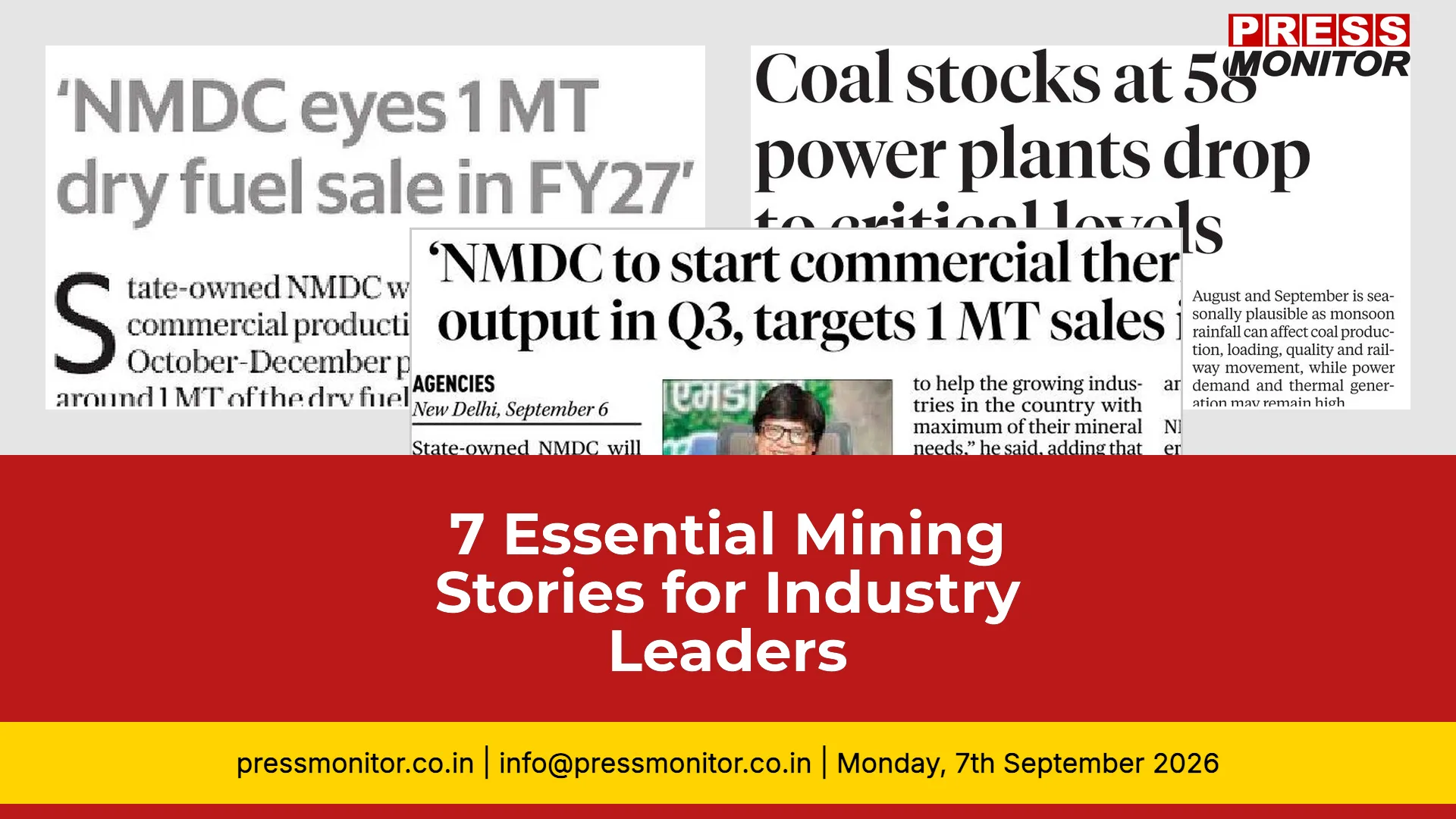
A front-page report in Mint says Hyderabad-based miner NMDC aims to launch commercial thermal coal operations this October-December window, targeting sales of approximately one million tonnes by fiscal year 2027. Chairman Amitava Mukherjee confirmed that teams have successfully reached the Tokisud North coal seam, prompting production plans to begin next quarter. The move supports a comprehensive corporate roadmap extending to 2030 designed to diversify extraction activities and advance the national Viksit Bharat initiative.
Why it matters: NMDC's entry into thermal coal production marks a strategic shift for India's state-owned mining sector, with one million tonnes targeted by FY27. Tracked by Press Monitor, this story signals a major diversification move. Key detail: Chairman Amitava Mukherjee confirmed teams reached the Tokisud North coal seam, with production starting next quarter as part of a 2030 roadmap. Source: Mint, front page. Next step: Monitor FY27 sales targets and impact on domestic thermal fuel supply.
2. 58 Thermal Plants Face Coal Stock Stress
A front-page report in Business Standard, filed from New Delhi on September 6, says thermal power plants facing critical coal stocks rose from forty-five at the start of September to fifty-eight on Saturday, with stocks falling from twenty-eight point six million tonnes to twenty-six point nine million tonnes. The latest figures, sourced from the Central Electricity Authority, point to a logistics bottleneck even as Coal India Limited keeps pithead stocks at a record seventy-six million tonnes. Experts said the rise is seasonally plausible during the monsoon, when rainfall can affect coal production, loading, quality and rail movement while power demand remains high.
Why it matters: Rising critical coal stocks at thermal plants highlight a logistics bottleneck during peak monsoon season, affecting power generation nationwide. This news on mining supply chains demands attention from energy sector leaders. Key detail: Stocks fell from 28.6 million tonnes to 26.9 million tonnes, with 58 plants now in critical condition. Source: Business Standard, front page. Next step: Watch for government intervention on rail logistics and monsoon-adjusted production targets.
3. NMDC Targets Mineral Diversification by 2030
A front-page report in Millennium Post says NMDC Chairman Amitava Mukherjee announced a roadmap through 2030 to diversify beyond iron ore and support the government's Viksit Bharat vision. NMDC has reached the coal seam at its Tokisud North mine in Jharkhand with production expected next quarter, and will develop the Rohne coking coal block targeting production by FY28. The company aims to generate at least 20 per cent of revenue from minerals other than iron ore by 2030 and become India's largest mineral mining company.
Why it matters: NMDC's 2030 roadmap aims for 20% revenue from non-iron ore minerals, positioning the company as India's largest mineral mining firm. This press review highlights a vision aligned with Viksit Bharat. Key detail: The Rohne coking coal block targets production by FY28, and the Tokisud North coal seam is already reached. Source: Millennium Post, front page. Next step: Track quarterly progress reports against the 2030 diversification targets.
4. Gold's Role in India's Circular Economy
A front-page report in Economic Times says gold is increasingly vital to India's circular economy, meeting part of the demand from internal sources to save foreign exchange. Experts from Malabar Gold & Diamonds, World Gold Council, Nippon Mutual Fund, Indian Association for Gold Excellence and Standards, and IIFL Finance noted progress in transparency, trust, purity, and responsible mining. The discussion covered gold loans assisting households and MSMEs, while gold ETFs are driving the metal's financialisation.
Why it matters: Gold is emerging as a key pillar of India's circular economy, with internal sourcing saving foreign exchange and driving financialisation through ETFs and gold loans. Key detail: Experts from Malabar Gold & Diamonds, World Gold Council, and IIFL Finance noted progress in transparency, trust, purity, and responsible mining. Source: Economic Times, front page. Next step: Follow regulatory developments in responsible mining standards and gold loan policies.
5. Riyali Panchayat Opposes New Stone Crushers
A front-page report in Tribune says the Riyali gram panchayat in the Mand area of Fatehpur development block in Kangra district has strongly opposed the proposed establishment of new stone crushers and the grant of fresh mining leases. Panchayat representatives and members of the Mand Environment Protection Samiti staged a protest and passed a resolution urging the state government to halt permissions, citing traffic, pollution, and ecological concerns. The resolution demands a scientific study, carrying-capacity assessment, and environmental impact assessment before any new mining activity is permitted.
Why it matters: Local governance in Himachal Pradesh is pushing back against new mining infrastructure, citing traffic, pollution, and ecological threats to the Beas River ecosystem. Key detail: The Riyali gram panchayat and Mand Environment Protection Samiti passed a resolution demanding scientific studies and environmental impact assessments before any new mining activity. Source: Tribune, front page. Next step: Monitor whether the state government accepts the panchayat's demands.
6. Southern States Form New Council for Revival
A front-page report in Business Standard says southern Indian states are forming a new council to address concerns over delimitation, tax devolution, and language policies. Chief ministers of Tamil Nadu, Karnataka, Andhra Pradesh, Telangana, and Kerala are leading these efforts, echoing similar initiatives from the 1980s.
Why it matters: Southern Indian states are reviving a council to address delimitation, tax devolution, and language policies, echoing 1980s initiatives. Key detail: Chief ministers of Tamil Nadu, Karnataka, Andhra Pradesh, Telangana, and Kerala are leading these efforts. Source: Business Standard, front page. Next step: Watch for formal council announcements and Centre's response.
7. Afghanistan Coal Mine Suffocation Kills Men
A front-page report in Deccan Herald says that the information department of Baghlan province reported an accident on Sunday in Tala Wa Barfak, Afghanistan. Several men suffocated due to gas and died while extracting coal at a mine that did not meet safety standards. Afghanistan's mining industry is poorly regulated, and fatal accidents are common.
Why it matters: A coal mine accident in Baghlan province killed several men due to gas suffocation in a mine that failed safety standards, underscoring the dangers of poorly regulated mining. Key detail: The incident occurred at Tala Wa Barfak, and Afghanistan's mining industry remains largely unregulated. Source: Deccan Herald, front page. Next step: Track international responses and calls for mining safety regulation in conflict-affected regions.
Closing: Which of these stories will have the biggest impact on your sector this week? Stay informed with Press Monitor's curated print media intelligence.