7 Essential Nuclear Energy Stories for Industry Leaders


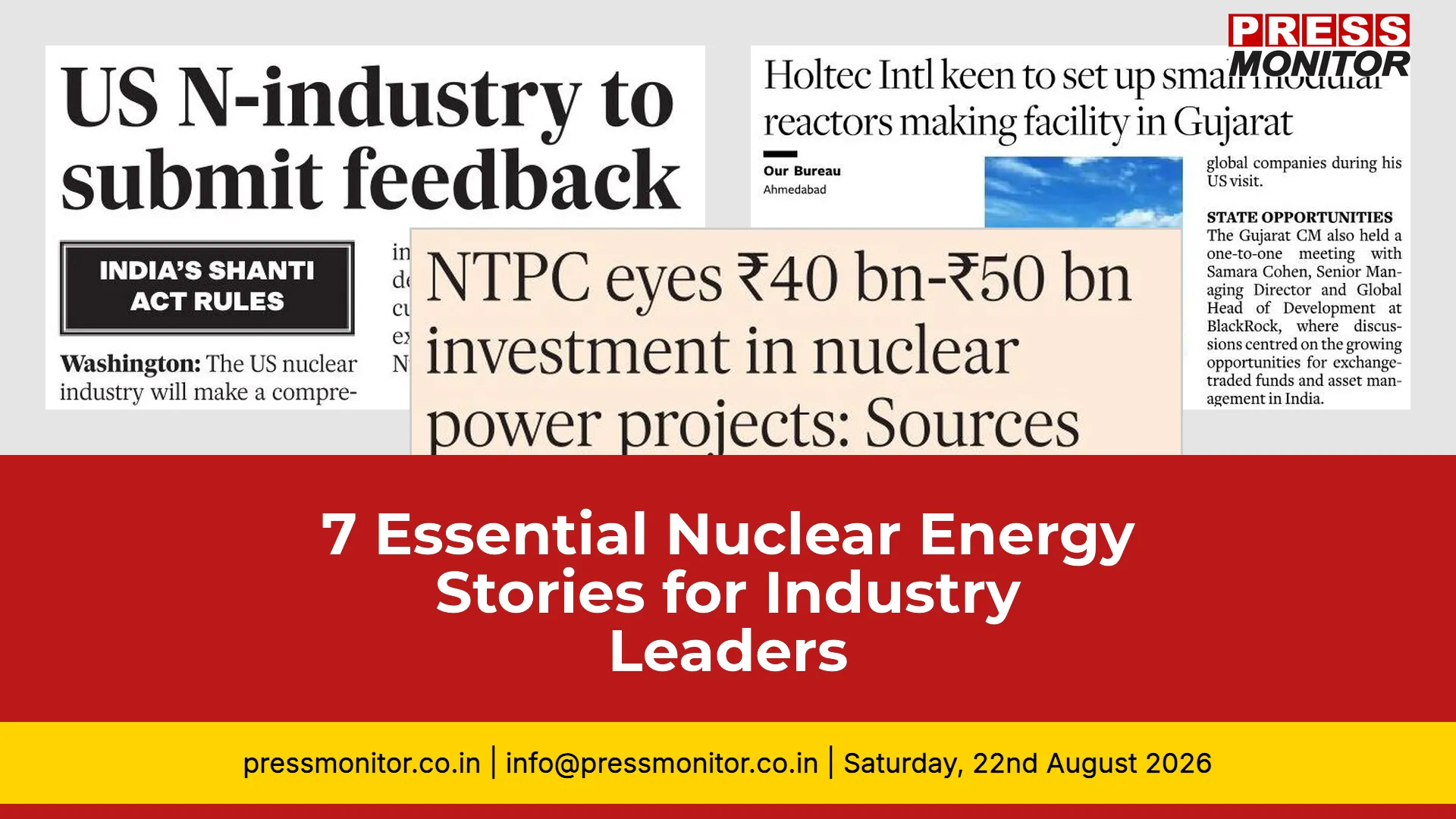
Press Monitor's print media monitoring reveals a surge in nuclear energy developments in India following the SHANTI Act. From US industry submissions to domestic tariff clarity demands, here are 7 essential stories shaping the sector, sourced from leading Indian newspapers.
1. US Nuclear Industry Submits on SHANTI Act Rules
A front-page report in Free Press Journal says, the US nuclear industry will make a comprehensive submission to India on draft rules to implement the SHANTI Act, which has opened the country’s civil nuclear sector to private participation.
Why it matters: Sets stage for foreign technology transfer. Key detail: US industry made comprehensive submission to Indian government on draft rules.
Source: Free Press Journal. Next step: Expect regulatory framework finalization.
2. Holtec to Build SMR Factory in Gujarat
A front-page report in Business Line says US-based nuclear technology company Holtec International has expressed interest in setting up a manufacturing facility for small modular reactors and a research and development centre in Gujarat. This development came during Gujarat Chief Minister Bhupendra Patel’s meeting with Holtec International’s leadership in New York, as part of his five-day US visit.
Why it matters: First major foreign investment in SMR manufacturing. Key detail: Gujarat CM met Holtec leadership in New York.
Source: Business Line. Next step: Site selection and R&D centre setup.
3. Company Plans Billions in Nuclear Sites
A front-page report in Free Press Journal says the company will invest around %l billion to %2 billion for the study of sites, and the remaining would be invested for acquiring land. For its nuclear power plants, the company has already identified four sites in Madhya Pradesh, Gujarat, Odisha, and Andhra Pradesh, and has submitted proposals to the respective state governments.
Why it matters: Large-scale land acquisition signals industry commitment. Key detail: Four sites identified in MP, Gujarat, Odisha, Andhra.
Source: Free Press Journal. Next step: State government approvals.
4. Industry Seeks Tariff Clarity Under SHANTI
With private participation allowed in the nuclear energy sector following the passage of the Sustainable Harnessing and Advancement of Nuclear Energy for Transforming India (SHANTI) Act, 2O25, the industry is seeking a transparent and predictable tariff framework that balances developer returns with competitive prices. It has also urged the government to create a level playing field so that nuclear power is on a par with other sources of electricity. "For economic viability, tariffhas to be aligned with market rates, with a maximum level-ised cost of electricity of 8 per kilowatt-hour," Anil V Parab, whole-time director and senior executive vice-president (manufacturing), Larsen & Toubro, told Business Standard. While Nuclear Power Corporation of India’s (NPCIL’s) indigenous technology has an average tariff of around %4 per unit, foreign technology is more expensive. "Increasing local content to lOO per cent and apportioning technology fees over six to lO reactors will make it viable," he added. Parab also said the government must guarantee a minimum tariff in case the market rate falls below it over the life of the nuclear power plant, citing Finland’s example, where a drop in electricity demand during the pandemic resulted in tariffs crashing tozero. “With long-term investments, the bank- ability of a project becomes difficult without a guaranteed offtake,” he said.
Why it matters: Viability of nuclear projects hinges on tariff framework. Key detail: L&T executive proposes tariff cap of ₹8/kWh, minimum guarantee like Finland.
Source: Business Standard. Next step: Government to release tariff guidelines.
5. PHWRs Preferred by New Entrants
A front-page report in Indian Express says that heavy water reactors (PHWRs) are emerging as the preferred pick for new entrants into India’s civil nuclear power sector due to the established supply chain and good ecosystem, as the country opens the tightly regulated strategic sector to private players. Representatives from NTPC, Adani Atomic Energy, and Jindal Steel said that existing 700 megawatt-electric (MWe) PHWR technology could be a good start to scale up the capacity in the initial phase given the availability of established design standards, a mature domestic supply chain, and an existing ecosystem of vendors and expertise.
Why it matters: Established ecosystem lowers entry barriers. Key detail: NTPC, Adani, Jindal Steel eye 700 MWe PHWRs.
Source: Indian Express. Next step: Private players to partner with NPCIL.
6. India Targets 100 GW Nuclear by 2047
A front-page report in Indian Express says India has set an ambitious target of scaling up the domestic civil nuclear capacity to 100 gigawatt-electric by 2047. The country has released draft rules of SHANTI Act, laying out the regulatory framework for a broader nuclear power ecosystem, including private participation, captive generation, licensing, safety oversight and nuclear liability.
Why it matters: Ambitious goal requires rapid scaling. Key detail: Draft rules for SHANTI Act released.
Source: Indian Express. Next step: Industry consultations on draft rules.
7. Players Bat for Faster Clearances
A front-page report in Business Standard says nuclear energy players advocate for faster clearances, technology indigenization, and standardized designs to reduce costs and shorten timelines for regulatory approvals.
Why it matters: Time overruns add costs. Key detail: Advocacy for standardized designs and indigenization.
Source: Business Standard. Next step: DAE to streamline approval process.
Stay ahead of these developments with Press Monitor's daily press review and media intelligence. Which story impacts your business most? Share your thoughts.