7 Essential Nuclear Energy and Weapons Stories for Policy Leaders


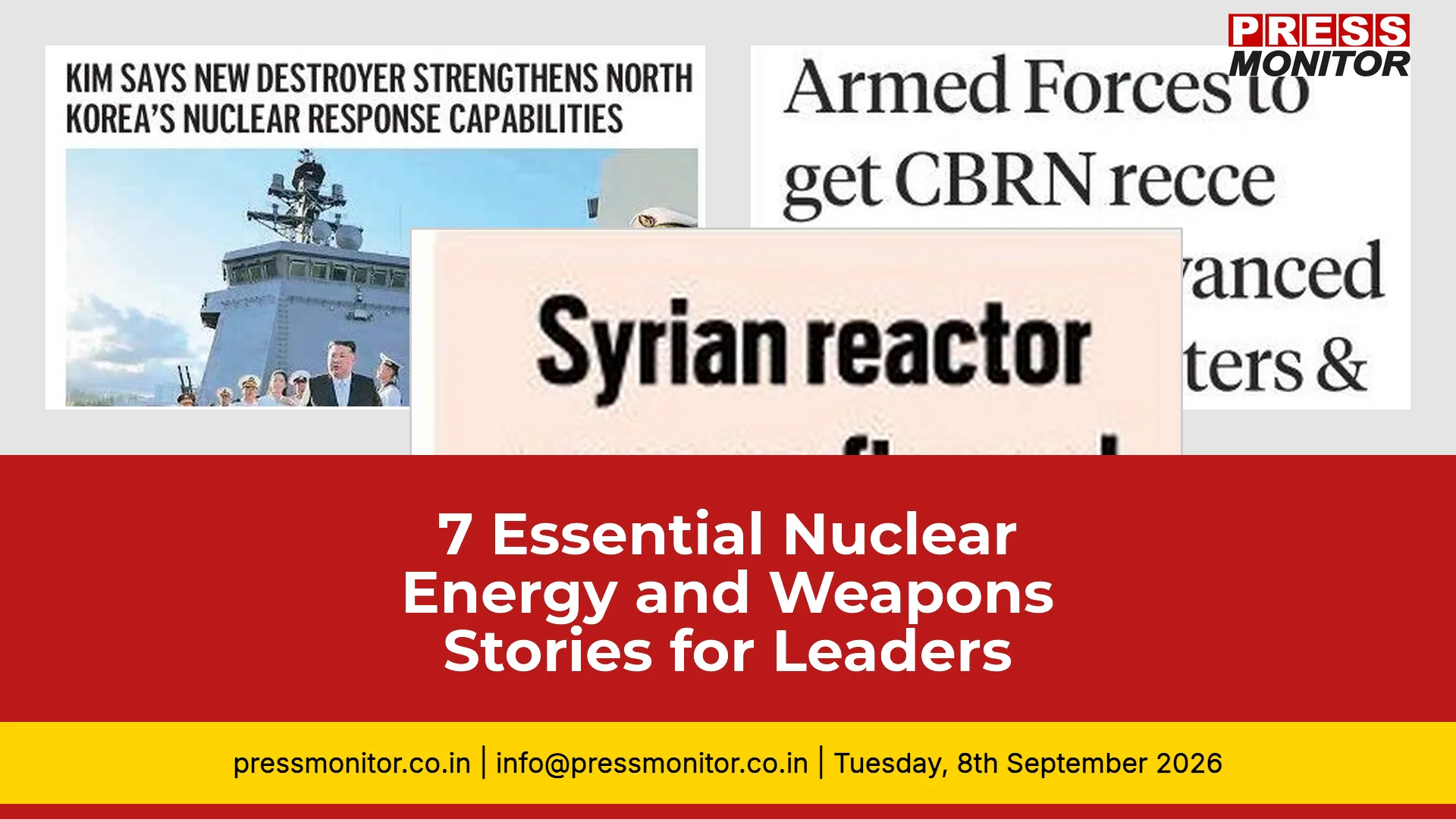
According to Press Monitor's media monitoring of Indian publications, today's news on nuclear energy and weapons trade reveals a rapidly shifting global security landscape. From North Korea's naval nuclear ambitions to India's massive defence procurement push, these seven stories define the week ahead.
1. North Korea Expands Nuclear Navy
A front-page report in First India says that Kim Jong Un announced a newly commissioned destroyer would become part of a nuclear response system capable of delivering annihilative retaliatory strikes, propelling prop prop prop prop prop prop prop prop prop prop prop prop prop prop prop prop prop prop prop prop prop prop prop prop prop prop prop prop prop prop prop prop prop prop prop prop prop prop prop prop prop prop prop prop prop prop prop prop prop prop prop prop prop prop prop prop prop prop prop prop prop prop prop prop prop prop prop prop prop prop prop prop prop prop prop prop prop prop prop prop prop prop prop prop prop prop prop prop prop prop prop Kim Jong Un has commissioned a new destroyer as part of a nuclear response system, signaling Pyongyang's intent to build a credible nuclear deterrent. Tracked by Press Monitor across six Indian publications, this development coincides with trilateral military exercises involving the US, South Korea, and Japan. Why it matters: North Korea's nuclear navy expansion raises the stakes in Indo-Pacific security. Next step: Watch for further missile tests and diplomatic responses from the UN Security Council.
2. India Clears Rs 1.1 Lakh Crore Defence Deal
A front-page report in Indian Express says the Defence Acquisition Council has approved procurements worth Rs 1.1 lakh crore for the Indian armed forces. The approved items include CBRN Recce Vehicles, High Mobility Vehicles, Advanced Light Helicopters, Arudhra Radars, Marine Gas Turbines, and Ground-Based Multi-Purpose Jammers. The Ministry of Defence stated the DAC accorded Acceptance of Necessity for several items including Self-Propelled Mechanical Mine Layers and the Sarvatra Bridge System for the Indian Army. The Defence Acquisition Council, chaired by Defence Minister Rajnath Singh, approved military procurements worth Rs 1.1 lakh crore with 98% domestic sourcing. Items include CBRN reconnaissance vehicles, advanced light helicopters, Arudhra radars, and marine gas turbines. Why it matters: This push for indigenous defence manufacturing strengthens India's self-reliance in critical military technology. Source: Press Monitor's media intelligence tracking of Indian print outlets.
3. Syria's Nuclear Reactor Confirmed by IAEA
A front-page report in Millennium Post says the International Atomic Energy Agency confirmed that the former Assad government in Syria constructed a nuclear reactor highly efficient at producing fissile material. Director General Rafael Grossi stated the facilities technical features were well suited for direct use in manufacturing potential nuclear weapons during his announcement in Vienna on Monday. The International Atomic Energy Agency confirmed that the former Assad government constructed a nuclear reactor designed for producing fissile material for weapons. IAEA Director General Rafael Grossi announced the findings in Vienna. Why it matters: The discovery of a near-complete weapons-capable reactor in Syria underscores the risks of nuclear proliferation in conflict zones. Next step: The IAEA is safeguarding the site and material.
4. Iran Blocked Nuclear Inspectors for 15 Months
A front-page report in Times of India says the UN Security Council is to refer Iran to sanctions for stonewalling nuclear inspectors. Iran has blocked the International Atomic Energy Agency from reviewing its uranium inventory for fifteen months since Israeli air strikes began in June 2025. The US resolution demands Iran urgently remedy its non-compliance and allow checks on nuclear material. Iran has denied the IAEA access to review its uranium inventory for fifteen months since Israeli air strikes began in June 2025. The UN Security Council is preparing to refer Tehran to sanctions. Why it matters: This non-compliance could trigger international sanctions and further military escalation in the Middle East. Source: Press Monitor's press review of Indian print coverage.
5. Israel Strikes Iran Nuclear Facilities
A front-page report in Mint says that Israel launched strikes on Iran’s nuclear facilities within twenty-four hours following a United States referral of Tehran’s atomic file to the United Nations. This development underscores immediate military escalation triggered by international diplomatic proceedings regarding the region's nuclear programme. Israel launched strikes on Iran's nuclear facilities within twenty-four hours of the United States referring Tehran's atomic file to the United Nations. Why it matters: The strikes mark a significant military escalation triggered by international diplomatic proceedings. Next step: Monitor the IAEA board meeting in Vienna for further developments.
6. ECB Filings Rise to 16-Month High
A front-page report in Financial Express says Indian firms' external commercial borrowing proposals rose to 7.69 billion dollars in July, the highest level in 16 months, according to data released by the Reserve Bank of India. Of this total, 6.9 billion dollars came through the automatic route and 780.11 million dollars via the approval route, with major filings from Housing and Urban Development Corporation, Tata Capital, Flipkart Internet, and Nuclear Power Corporation of India. Indian firms' external commercial borrowing proposals rose to $7.69 billion in July, the highest in 16 months, with major filings from Nuclear Power Corporation of India. Why it matters: Surge in ECB filings signals renewed confidence in India's energy and infrastructure sectors. Next step: Track how nuclear energy companies leverage this borrowing wave.
7. Dee Development Engineers Targets Rs 2500 Crore
A front-page report in Financial Express says Dee Development Engineers is targeting a twofold revenue increase to over Rs 2500 crore by 2030, up from Rs 1200 crore in FY26. Chairman and Managing Director KL Bansal highlighted that the company currently holds an order book of approximately Rs 2500 crore, driven primarily by the power sector and international markets. The firm is also pursuing a joint venture for nuclear piping fabrication, which will require over Rs 100 crore in initial capital expenditure. Dee Development Engineers is targeting a twofold revenue increase to over Rs 2500 crore by 2030, including a joint venture for nuclear piping fabrication requiring over Rs 100 crore in capital expenditure. Why it matters: This growth reflects India's expanding nuclear energy infrastructure and the private sector's role in it.
This print media monitoring review, powered by Press Monitor, ensures you stay ahead of the nuclear energy and weapons trade narrative. Which of these developments will have the most lasting impact on global nuclear governance?