7 Essential Space & Aerospace Stories for Industry Leaders


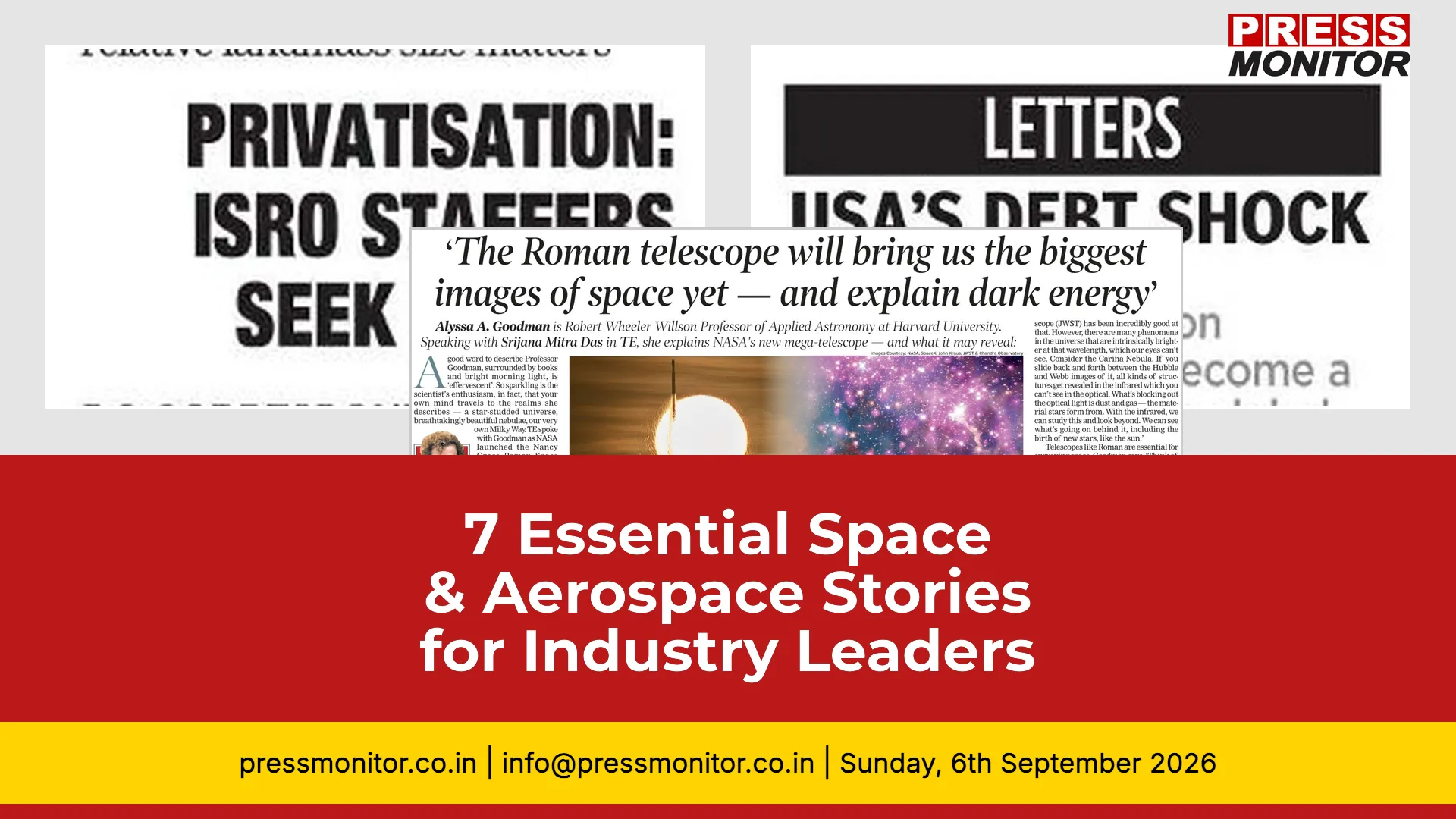
According to Press Monitor's tracking of Indian publications, this media monitoring report delivers seven essential stories spanning India's space sector transformation, from ISRO privatisation debates to NASA's latest deep-space observatory. This press review, grounded in print media monitoring, equips decision-makers with the media intelligence they need on news on space and aerospace.
1. ISRO Staff Seek Clarity on Privatisation
A front-page report in Deccan Chronicle says employee associations at the Indian Space Research Organisation have sought clarification from the government over the ongoing privatisation of certain space-sector activities following the successful launch of India's GSLV F-17/EOS-O5 mission on September 4. Nine representatives of employee associations from major ISRO centres jointly wrote to the ISRO chairman and Department of Space secretary expressing concerns about the government's policy to open the space sector to private participation. The letter cites a recent statement by IN-SPACe chairman Pawan Goenka that eventually ISRO would no longer manufacture launch vehicles, with production shifting to private companies or public sector undertakings. Cross-sourced from Deccan Chronicle, Times of India, and Hindustan Times, this is the most-covered story of the day. Nine employee associations jointly wrote to the ISRO chairman and Department of Space secretary, seeking clarity on the transfer of manufacturing and operational functions to private entities. IN-SPACe chairman Pawan Goenka's statement that ISRO would eventually stop manufacturing launch vehicles has triggered workforce concerns across Bengaluru, Hyderabad, and Delhi centres. Why it matters: The privatisation timeline directly affects thousands of ISRO employees and India's launch capability. Key detail: The letter cites the GSLV F-17/EOS-O5 mission success as context for the transition. Source: Deccan Chronicle, September 5. Next step: Watch for the Space Commission's formal response. Will ISRO's workforce accept the transition, or will it face resistance? CTA: Tag ISRO leadership in comments to amplify employee voices.
2. US Debt Shifts Capital, ISRO Launches EOS-O5
A front-page report in Asian Age says Americas forty trillion dollar national debt and near four point seven eight percent treasury yields are redirecting global capital away from emerging markets like India. Higher American returns may trigger portfolio outflows from Indian equity and debt funds, weakening the rupee and raising external borrowing costs for domestic firms. Meanwhile, the Indian Space Research Organisation successfully launched the EOS-O5 imaging satellite to monitor weather and natural resources, as economists debate the transparent impact of recent methodologies on the seven point eight percent quarterly gross domestic product growth estimate. According to Press Monitor's tracking of Indian publications, Asian Age reports that America's forty trillion dollar national debt and near four point seven eight percent treasury yields are redirecting global capital away from emerging markets like India. Simultaneously, ISRO successfully launched the EOS-O5 imaging satellite to monitor weather and natural resources. Why it matters: Capital outflows could raise external borrowing costs for Indian space startups and ISRO contractors. Key detail: The EOS-O5 launch demonstrates India's continued capability despite fiscal headwinds. Source: Asian Age. Next step: Monitor rupee movement and space sector investment flows. How will global capital shifts affect India's space economy ambitions? CTA: Share with your finance network to track emerging market impacts.
3. NASA Roman Space Telescope
A front-page report in Times of India says Harvard Applied Astronomy Professor Alyssa A. Goodman spoke with Srijana Mitra Das about NASA's new Nancy Grace Roman Space Telescope launched on August 30. The infrared observatory, located 1.5 million kilometres away at the second Sun-Earth Lagrange Point, features a 7.9-foot primary mirror and a 300-megapixel camera. Goodman explained the telescope will study dark energy and dark matter, survey the Milky Way, and capture images with 100 times the field of view of Hubble. Harvard Applied Astronomy Professor Alyssa A. Goodman discussed NASA's Nancy Grace Roman Space Telescope with Srijana Mitra Das. The infrared observatory, launched August 30, sits 1.5 million kilometres away at the second Sun-Earth Lagrange Point with a 7.9-foot primary mirror and 300-megapixel camera. It will study dark energy and dark matter, survey the Milky Way, and capture images with 100 times the field of view of Hubble. Why it matters: The Roman Telescope represents a generational leap in observational cosmology. Key detail: 100x Hubble's field of view will transform deep-space surveys. Source: Times of India. Next step: Track international collaboration opportunities for Indian astronomers. Could India's space agency partner on Roman Telescope follow-up missions? CTA: Tag NASA and ISRO to spotlight global cooperation potential.
4. IST Rules Standardize Time Across India
A front-page report in The Hindu says the Centre notified the Legal Metrology Indian Standard Time Rules in August two thousand twenty-six, making IST the single reference for legal and commercial purposes. The rules aim to synchronise digital, banking, and telecom systems with Indian Standard Time maintained by the CSIR-National Physical Laboratory to reduce dependence on foreign satellite sources like GPS. The government has also commissioned a White Rabbit Technology demonstration network in Bengaluru to support the One Nation One Time initiative. The Centre notified the Legal Metrology Indian Standard Time Rules in August 2026, making IST the single reference for legal and commercial purposes. The rules synchronise digital, banking, and telecom systems with Indian Standard Time maintained by the CSIR-National Physical Laboratory, reducing dependence on foreign satellite sources like GPS. A White Rabbit Technology demonstration network in Bengaluru supports the One Nation One Time initiative. Why it matters: Time standardisation affects satellite operations, navigation systems, and space mission coordination. Key detail: Reduced GPS dependence strengthens national security for space operations. Source: The Hindu. Next step: Observe how IST rules impact ISRO's satellite navigation programs. Will NavIC gain prominence as GPS dependence decreases? CTA: Tag digital infrastructure leaders to discuss NavIC's future.
5. South-South Climate Technology Summit Required
A front-page report in The Pioneer says India, China, and Brazil must spearhead a dedicated South-South Climate Technology Summit to transfer green solutions without Western patent gate-keeping. India, China, and Nepal need to establish joint satellite networks operated by ISRO and CNSA for free real-time glacial monitoring data. Grassroots climate resilience measures include rooftop water harvesting, reflective white roof coatings, and household solar kits to combat heat waves and power failures. The Pioneer reports that India, China, and Brazil must spearhead a dedicated South-South Climate Technology Summit to transfer green solutions without Western patent gate-keeping. India, China, and Nepal need joint satellite networks operated by ISRO and CNSA for free real-time glacial monitoring data. Grassroots measures include rooftop water harvesting, reflective white roof coatings, and household solar kits. Why it matters: Climate resilience requires space-based monitoring infrastructure. Key detail: ISRO-CNSA joint satellite networks could democratize environmental data. Source: The Pioneer. Next step: Watch for government response to the South-South summit proposal. Can space-based climate monitoring become a diplomatic priority? CTA: Tag climate policy officers to push for ISRO-CNSA collaboration.
6. Mosque Razed at Saharanpur Collectorate
A front-page report in Hindustan Times says the Saharanpur district administration demolished a mosque inside the collectorate complex after a local court upheld an order declaring the structure illegal. It also says thousands of Indian Space Research Organisation employees represented by nine associations have sought clarification on the proposed transfer of space agency manufacturing and operational functions to private entities six years after the sector was opened to private companies. Hindustan Times reports the Saharanpur district administration demolished a mosque inside the collectorate complex after a local court upheld an order declaring the structure illegal. The same report notes thousands of ISRO employees represented by nine associations have sought clarification on the proposed transfer of space agency manufacturing and operational functions to private entities. Why it matters: The dual story highlights the tension between local governance and national space policy. Key detail: The ISRO privatisation debate continues to generate multi-layered public discourse. Source: Hindustan Times. Next step: Track whether the Saharanpur demolition affects public sentiment toward government agencies including ISRO. CTA: Tag local and national editors to explore the governance-space policy intersection.
7. RIT Celebrates 18th Graduation Day
A front-page report in Deccan Herald says Manipal Institute of Technology celebrated its 18th Graduation Day, marking the graduation of one thousand eight hundred eleven undergraduate and postgraduate students from eighteen departments. Senior Scientist Dr. Ritu Karidhal Srivastava, popularly known as the Rocket Woman of India, served as chief guest and addressed the graduates at the ceremony in Bengaluru. Deccan Herald reports Manipal Institute of Technology celebrated its 18th Graduation Day, with 1,811 undergraduate and postgraduate students from eighteen departments. Senior Scientist Dr. Ritu Karidhal Srivastava, popularly known as the Rocket Woman of India, served as chief guest. Why it matters: The presence of a celebrated ISRO scientist at a graduation ceremony signals the growing prestige of space careers in India. Key detail: 1,811 graduates from 18 departments represent a growing talent pipeline for the space sector. Source: Deccan Herald. Next step: Watch for increased enrollment in aerospace engineering programs. Will Dr. Karidhal's visibility inspire the next generation of Indian space scientists? CTA: Tag educational institutions and ISRO to highlight the talent pipeline.
These seven stories, tracked by Press Monitor from Indian print publications, reveal a space sector at a pivotal transition. From ISRO's workforce concerns to NASA's Roman Telescope, the news on space and aerospace demands continuous media monitoring. What will you watch next?