7 Key Nuclear Energy Stories for Energy Executives


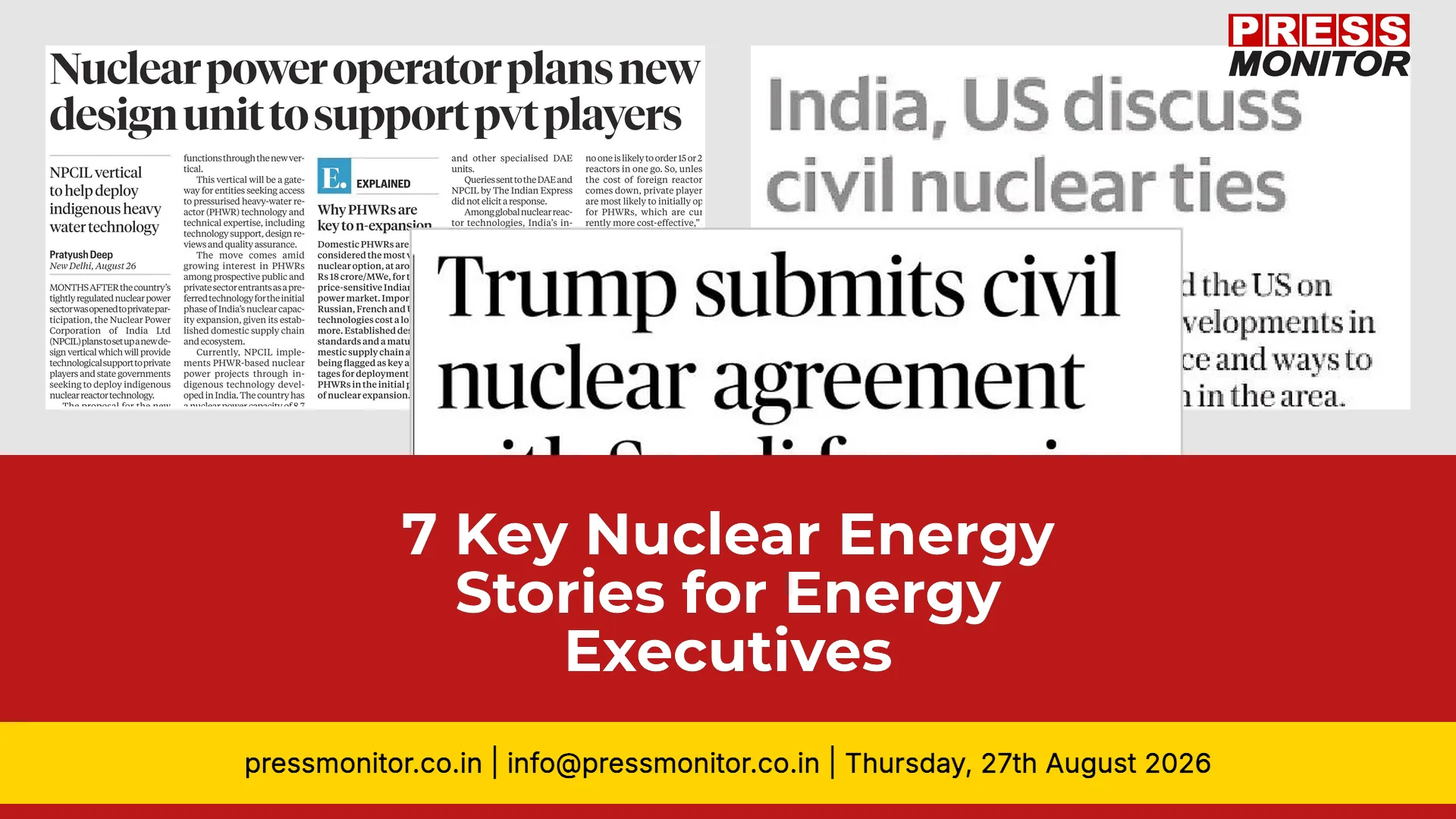
According to Press Monitor's tracking of Indian publications, the nuclear energy sector is seeing transformative developments. This media monitoring roundup covers the most critical stories from today's print media, providing essential media intelligence for energy leaders. Here are 7 stories shaping the future of nuclear power, weapons, and trade in India and globally.
1. NPCIL's Design Vertical for Private Players
A front-page report in Indian Express says the Nuclear Power Corporation of India Ltd plans to create a new design vertical to provide technical support to private companies and state governments. This initiative aims to help entities deploy indigenous pressurised heavy-water reactor technology as India seeks to expand its nuclear capacity to 100 gigawatt-electric by 2047.
Why it matters: NPCIL is creating a design vertical to support private companies and state governments deploying indigenous PHWR technology. This follows the SHANTI Act 2025, opening nuclear generation to private players.
Key detail: The proposal aims to help India reach 100 GW electric nuclear capacity by 2047.
Source: Indian Express, Financial Express, Economic Times
Next step: Watch for cabinet approval and private sector responses.
2. India-US Nuclear Cooperation Talks
A front-page report in Mint says India opening up its civil nuclear energy sector for private players as it eyes to build nuclear power capacity by 2047. Several US firms in the nuclear energy sector have evinced interest in the Indian market.
Why it matters: Top officials from India and the US discussed deepening civil nuclear cooperation. Several US firms have shown interest in India's opening market.
Key detail: India targets 100 GW nuclear by 2047, and US technology could play a role.
Source: Mint, Millennium Post
Next step: Monitor follow-up meetings and technology transfer agreements.
3. Trump Submits Saudi Nuclear Deal to Congress
A front-page report in The Hindu says US President Donald Trump has submitted a classified agreement with Saudi Arabia to Congress for review. The deal aims to bolster Riyadh's civilian nuclear programme but cannot move forward unless the kingdom normalises relations with Israel.
Why it matters: The deal is tied to Saudi normalization with Israel, adding geopolitical layers to nuclear commerce.
Key detail: A classified agreement was submitted, but Congress must approve without Israel normalization.
Source: The Hindu, Free Press Journal
Next step: Track Congressional hearings and Israel-Saudi talks.
4. PHWRs Key to Cost-Effective Nuclear Expansion
A front-page report in Indian Express says India’s indigenous PHWR is seen as the most cost-effective option for its price-sensitive power market, where high project costs can undermine nuclear power’s competitiveness.
Why it matters: India’s indigenous PHWR is the most cost-effective option for price-sensitive power markets.
Key detail: High project costs can undermine nuclear competitiveness; PHWR offers a solution.
Source: Indian Express
Next step: Assess deployment plans and cost benchmarks.
5. Meghalaya Assembly Opposes Uranium Mining
“Selon The Times of India, the Meghalaya assembly unanimously adopted a government resolution opposing uranium mining and the establishment of any uranium ore-processing facility in the state. Moving the resolution on the first day of the autumn session on Aug 24, CM Conrad K Sangma said it reflected long-standing concerns of communities living in uranium-bearing areas. He said the state’s tribal areas were governed under Sixth Schedule of Constitution, with land held predominantly under community, clan and individual customary tenure. Land transfers are regulated by Meghalaya Transfer of Land (Regulation) Act, 1971. "The free, prior and informed consent of the affected communities has at no stage been obtained, and no mining lease for uranium has at any time been granted in the state," the resolution said. Uranium deposits have been identified in Domiasiat, Wahkijn and Lostoin in West Khasi Hills and South West Khasi Hills districts, as well as in Kylleng Pyndengsohiong Mawthabah. However, traditional institutions, autonomous district councils, student and civil society organisations and elected representatives have consistently opposed uranium mining in the state. "This house resolves to urge govt of India, the department of atomic energy and the uranium corporation of India Limited not to permit, pursue or undertake any uranium mining operation in the state... and to close any activity relating to uranium mining anywhere in the state," the resolution read.
Why it matters: The state unanimously resolved against uranium mining, citing tribal land rights and health concerns.
Key detail: Deposits exist in West Khasi Hills, but no consent was obtained from communities.
Source: Times of India, Millennium Post, Sentinel
Next step: Central government and UCIL response expected.
6. India Joins IAEA's ATLAS Maritime Initiative
A front-page report in New Indian Express says India has joined a global initiative to explore nuclear power for maritime use, including building floating power plants and propelling civilian ships. The International Atomic Energy Agency (IAEA) launched the Atomic Technologies Licensed for Applications at Sea (ATLAS) initiative.
Why it matters: India explores nuclear power for maritime use, including floating plants and ship propulsion.
Key detail: ATLAS initiative launched by IAEA could enable higher-speed maritime transport.
Source: New Indian Express, Morning Standard
Next step: India's participation details and pilot projects.
7. Mother Teresa's Legacy and Nuclear Energy Debate
A front-page report in Statesman says that Mother Teresa's message of love and her dedication to serving the destitute remains unmatched. The article also discusses nuclear energy's role in India's future and the need for secure handling of biometric data in the context of digital transformation.
Why it matters: An opinion piece linking ethics, digital privacy, and nuclear energy’s role in India.
Key detail: Authors argue for secure handling of data alongside nuclear expansion.
Source: Statesman
Next step: Engage with the ethical dimensions in public discourse.
Closing: This print media monitoring review highlights critical shifts in nuclear policy, trade, and public opinion. Which story will impact your strategy most? Share your thoughts below. For daily updates, bookmark Press Monitor – your source for media monitoring and press review intelligence.