7 Key Social Media & Platform Stories for Policy Watchers


Introduction
Social media platforms are under intense scrutiny globally, and India is no exception. From landmark privacy settlements to political controversies and cyber threats, the landscape is shifting rapidly. This press review, powered by Press Monitor's tracking of Indian publications, brings you the most critical news on social media and platforms that every policy watcher, corporate communicator, and digital strategist needs to know today.
1. TikTok's $400 Million Children's Privacy Settlement
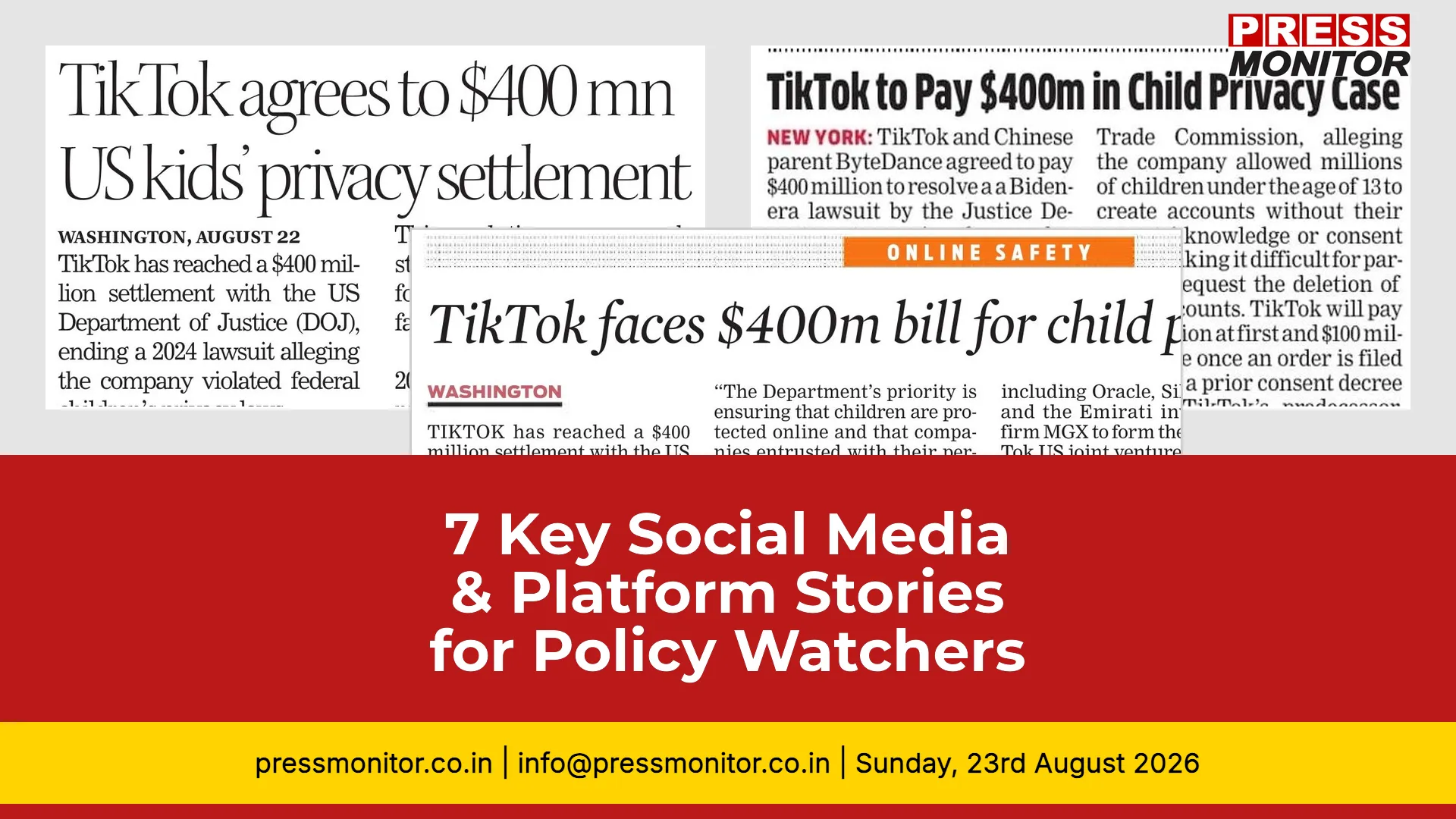
A front-page report in Tribune says TikTok has reached a $400 million settlement with the US Department of Justice, ending a 2024 lawsuit alleging the company violated federal children’s privacy laws. The deal includes $300 million immediately and $100 million after an order vacated an earlier consent decree against its predecessor Musically.
Why it matters: This landmark settlement sets a precedent for how platforms handle children's data, impacting global compliance standards.
Key detail: TikTok agreed to pay $400 million to the US DOJ, with $300 million upfront and $100 million after vacating a prior consent decree. The lawsuit alleged violations of federal children's privacy laws.
Source: Tribune (Delhi), front-page report.
Next step: For privacy officers, this signals the need to audit child data collection practices and ensure parental consent mechanisms are robust.
2. TikTok and ByteDance Resolve Biden-Era Lawsuit
“Selon Economic Times, TikTok and Chinese parent ByteDance agreed to pay $400 million to resolve a Biden-era lawsuit by the Justice Department accusing the popular social media app of collecting data on children in violation of an online privacy law. The settlement, which requires court approval, comes several months after ByteDance closed a long-awaited deal to transfer parts of its US operations to American investors to resolve national security concerns. The Justice Department sued TikTok in 2024 on behalf of the Federal Trade Commission, alleging the company allowed millions of children under the age of 13 to create accounts without their parents’ knowledge or consent while making it difficult for parents to request the deletion of those accounts. TikTok will pay $300 million at first and $100 million more once an order is filed vacating a prior consent decree against TikTok’s predecessor, Musical.ly. DOJ said the settlement was among the largest in a case involving the Children’s Online Privacy Protection Act.”
Why it matters: This settlement, requiring court approval, comes after ByteDance transferred parts of its US operations to American investors, addressing national security concerns.
Key detail: The DOJ sued TikTok in 2024 on behalf of the FTC, alleging millions of children under 13 created accounts without parental consent. The settlement is among the largest under COPPA.
Source: Economic Times (Delhi).
Next step: Legal teams should monitor how this settlement influences future regulatory actions against tech giants.
3. TikTok's ₹400 Crore Settlement: A Global Signal
A front-page report in New Indian Express says TikTok reached a ₹400 crore settlement with the U.S. Department of Justice for alleged violations of federal children’s privacy laws. The DoeJ requires TikTok to pay ₹300 crore immediately and an additional ₹100 crore post-order removal of prior decrees involving its predecessor Musical.ly. Allegations included failure to obtain parental consent for collecting children’s data under 13 and ignoring parental requests for account deletion, even knowing accounts belonged to children.
Why it matters: The Indian media's framing of this settlement highlights its global implications for digital child safety.
Key detail: The New Indian Express reports the settlement as ₹400 crore, emphasizing the immediate ₹300 crore payment and the additional ₹100 crore post-order. Allegations included ignoring account deletion requests.
Source: New Indian Express (Chennai).
Next step: For child safety advocates, this is a call to strengthen similar protections in India's digital ecosystem.
4. TikTok's Settlement: A Victory for Children's Privacy
A front-page report in Morning Standard says TikTok has reached a $400 million settlement with the US Department of Justice to end a 2024 lawsuit over federal children's privacy law violations. The agreement follows allegations that the company failed to obtain parental consent for users under 13 and ignored account deletion requests.
Why it matters: This report underscores the importance of parental consent and the consequences of non-compliance.
Key detail: The agreement follows allegations of failing to obtain parental consent for users under 13 and ignoring deletion requests.
Source: Morning Standard (New Delhi), with AP reporting.
Next step: Social media platforms should review their account deletion processes to ensure compliance with privacy laws.
5. Influencers and Politics: The New Battleground
A front-page report in First India says the ruling camp launched a fresh political attack, alleging that influencers were being used to mobilise crowds. Opposition strategists dismissed the allegation as an attempt to divert attention from the youth’s spontaneous participation.
Why it matters: The use of influencers in political mobilization is a growing trend, raising questions about authenticity and paid influence.
Key detail: The ruling camp alleged influencers were used to mobilise crowds, while opposition dismissed it as diversion from youth's spontaneous participation.
Source: First India (Jaipur).
Next step: Political strategists must navigate the ethical implications of influencer partnerships.
6. BJP Alleges Rs 10 Crore Paid Event for Rahul Gandhi's Programme
A front-page report in Statesman says the Maharashtra Bharatiya Janata Party has accused the Congress of spending up to Rs 10 crore to mobilise crowds for Rahul Gandhi's 'Chhatron Ki Goonj' programme in Pune. BJP spokesperson Navnath Ban alleged that influencers and attendees were paid to create a false impression of public support.
Why it matters: This accusation highlights the intersection of money, influencers, and political rallies, a key concern for electoral integrity.
Key detail: BJP spokesperson Navnath Ban alleged Congress spent up to Rs 10 crore to mobilise crowds, paying influencers and attendees.
Source: Statesman (Delhi).
Next step: Political parties should ensure transparency in campaign spending and influencer disclosures.
7. Bhide Warns of WhatsApp Hack and Misuse
A front-page report in Free Press Journal says Shiv Sena leader Bhide warned that her WhatsApp account had been hacked, with scammers allegedly misusing it to seek financial help from people. She has not yet filed a police complaint.
Why it matters: This incident underscores the vulnerability of public figures to cyber fraud, with potential reputational damage.
Key detail: Shiv Sena leader Bhide warned that her WhatsApp was hacked, with scammers seeking financial help. No police complaint filed yet.
Source: Free Press Journal (Mumbai).
Next step: Public figures should enable two-factor authentication and report cyber incidents promptly.
Conclusion
These stories, curated from India's leading print media, reveal the multifaceted challenges and opportunities in the social media landscape. For professionals relying on media intelligence, staying ahead of these trends is crucial. What's your take on TikTok's settlement? Share your thoughts below.
This review is powered by Press Monitor's media monitoring, offering comprehensive press review and media intelligence for informed decision-making.