7 Key Trade Stories for Policy Makers and Exporters


Introduction
In today's fast-moving trade landscape, staying ahead means knowing what's happening in print media before it hits your inbox. According to Press Monitor's media monitoring of Indian publications, here are the 7 most important trade stories from today's newspapers, curated for decision-makers.
1. India and Canada to Conclude Economic Partnership Agreement by 2026
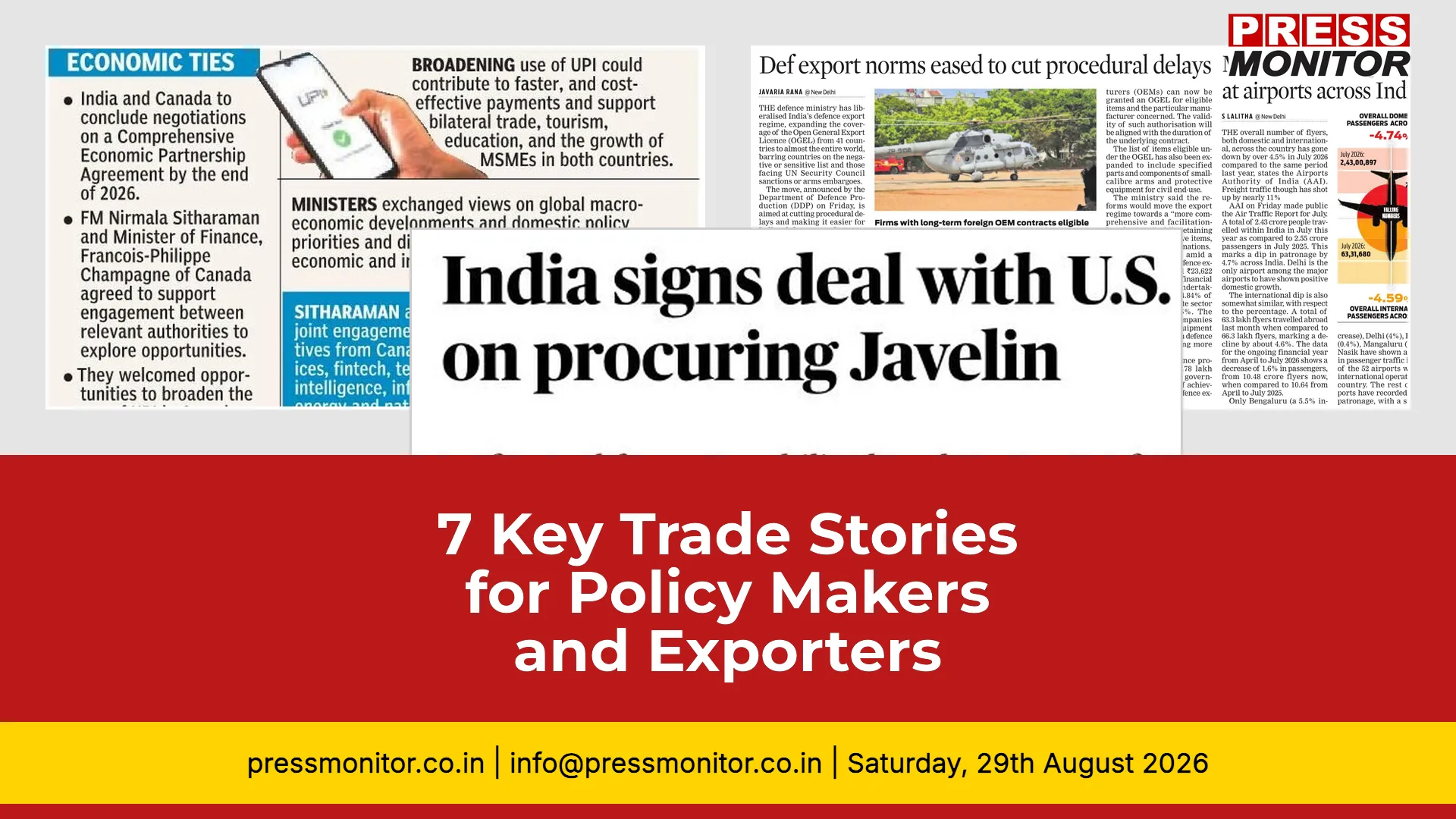
"A front-page report in Asian Age says that India and Canada have agreed to support engagement between relevant authorities to explore opportunities for broadening the use of UPI in Canada, macroeconomic developments, and domestic policy priorities. The two nations are aiming to increase bilateral trade to CAD 70 billion by 2030, and India expressed its readiness to begin negotiations on a Bilateral Investment Treaty at the earliest. The ministers also discussed the growing investment relationship between the two countries, including the role of long-term institutional capital."
Why it matters: This deal could unlock $50 billion in bilateral trade and deepen fintech ties through UPI expansion.
Key detail: Finance Minister Nirmala Sitharaman and Canadian Minister Francois-Philippe Champagne agreed to conclude CEPA negotiations by end of 2026 and start talks on a Bilateral Investment Treaty.
Source: Business Standard, Asian Age, Deccan Chronicle, The Hindu, Millennium Post, Indian Express, Financial Express, Free Press Journal (8 papers)
Next step: Exporters to Canada should prepare for reduced tariffs and new payment rails.
2. Defence Export Norms Eased to Cut Procedural Delays
“A front-page report in New Indian Express says the defence ministry has liberalised India’s defence export regime, expanding the coverage of the Open General Export Licence (OGEL) from 4l countries to almost the entire world, barring countries on the negative or sensitive list and those facing UN Security Council sanctions or arms embargoes. The move, aimed at cutting procedural delays and making it easier for Indian defence manufacturers to tap overseas markets, also increases the validity of the OGEL from two years to three years and dispenses with stakeholder consultations in several categories, including exports of non-lethal items. The changes are expected to particularly benefit small and medium defence manufacturers, for whom repeated applications and clearances can pose a greater compliance burden,” the report states.
Why it matters: India's defence manufacturers now have near-global market access under an expanded Open General Export Licence.
Key detail: OGEL coverage expanded from 41 countries to almost the entire world, validity increased from 2 to 3 years, and stakeholder consultations dispensed for non-lethal items.
Source: Millennium Post, Morning Standard, New Indian Express (3 papers)
Next step: SMEs in defence should explore export opportunities under the new regime.
3. India Signs Javelin Anti-Tank Missile Deal with US
A front-page report in The Hindu says India signed a Letter of Offer and Acceptance (LOA) with the U.S. on Friday to procure Javelin anti-tank guided missile systems through the U.S. Foreign Military Sales route, marking a significant step in the defence partnership between the two countries.
Why it matters: Strengthens India-US defence partnership and opens door for co-production.
Key detail: India signed a Letter of Offer and Acceptance for Javelin missiles through Foreign Military Sales route, worth over $45 million.
Source: Statesman, The Hindu, Tribune (3 papers)
Next step: Defence industry players should watch for joint venture opportunities.
4. India's Tyre Exports Grow 16% in Q1 FY27
A front-page report in Times of India says that India’s tyre exports grew 16% year-on-year to Rs 7,7OO crore in the first quarter of FY27, despite geopolitical uncertainty, supply chain disruptions, and elevated input and logistics costs, the Automotive Tyre Manufacturers’ Association (ATMA) said, citing Commerce Ministry data.
Why it matters: Resilient export growth despite global headwinds signals strong demand for Indian tyres.
Key detail: Exports reached Rs 7,700 crore in June quarter, per ATMA data.
Source: Times of India, Millennium Post (2 papers)
Next step: Tyre manufacturers should capitalise on export momentum.
5. Nepal Floods Disrupt India-Nepal Cross-Border Trade
A front-page report in Hindustan Times says the Nepal flash floods have disrupted cross-border trade between India and the neighbouring country, with the movement of goods vehicles to Kathmandu and other parts of Nepal via Maharajganj in Uttar Pradesh, affected by damaged and flooded roads.
Why it matters: Damaged roads and stranded trucks are hurting trade flows with Nepal.
Key detail: Movement of goods vehicles to Kathmandu via Maharajganj affected by flooded roads.
Source: Jansatta, Hindustan Times (2 papers)
Next step: Importers and exporters should explore alternate routes and monitor recovery.
6. BRICS to Adopt Logistics Framework at September Summit
A front-page report in The Economic Times says India will use its BRICS chairship to push the grouping towards practical, development-oriented outcomes in startups, innovation, resilient supply chains and green energy, while setting greater trade in national currencies and reforms of global institutions at the 18th BRICS Summit on September 21-22.
Why it matters: India's BRICS chairship aims to boost trade in national currencies and resilient supply chains.
Key detail: The 18th BRICS Summit on September 21-22 will focus on startups, innovation, green energy, and logistics.
Source: Economic Times (1 paper)
Next step: Businesses with BRICS exposure should align with the framework.
7. CREA: $22 Billion Fossil Fuel Import Bill for India
A front-page report in Tribune says India incurred an estimated $22 billion in additional gross fossil-fuel import costs between March and August 2O26 after the energy-price spike triggered by the Strait of Hormuz crisis. Analysts report that India had the third-highest additional cost among major fossil-fuel importers, with the Strait of Hormuz crisis causing the biggest sustained shock to oil prices since 1990.
Why it matters: The Strait of Hormuz crisis has added $22 billion to India's import costs since March.
Key detail: India had the third-highest additional cost among major fossil-fuel importers.
Source: Tribune (1 paper)
Next step: Energy-intensive industries should hedge against price volatility.
Closing
This press review is powered by Press Monitor's print media monitoring — tracking over 1,000 Indian print publications daily. For real-time alerts on trade and other topics, stay tuned to our channels.
What trade story matters most to you? Share your thoughts below.