7 Pivotal Climate Stories for Infrastructure Leaders


Tracking extreme weather events and policy shifts requires precise media monitoring. This press review distills today’s most critical developments across South Asia, offering media intelligence for leaders managing climate risk and infrastructure resilience. According to Press Monitor's tracking of Indian publications, here is your essential news on climate policy and disaster response.
1. Two Rescued After Nine Days In Nepal Flood Tunnel
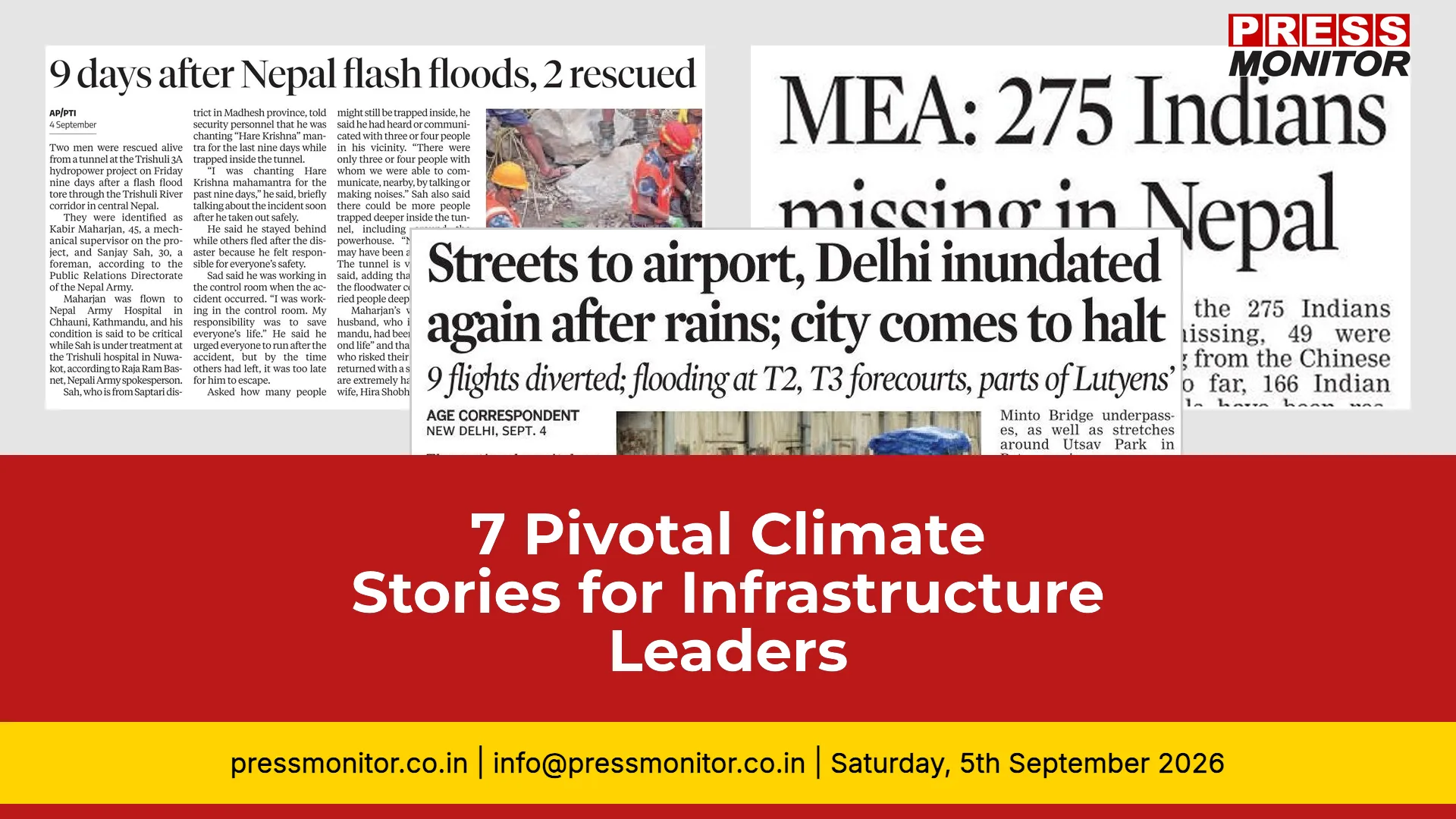
A front-page report in Business Standard says two men were rescued alive from a tunnel at the Trishuli 3A hydropower project on Friday, nine days after a flash flood tore through the Trishuli River corridor in central Nepal. The rescued men are Kabir Maharjan, a mechanical supervisor, and Sanjay Sah, a foreman; Maharjan was flown to Nepal Army Hospital in Kathmandu in critical condition while Sah is under treatment at Trishuli hospital. Sah told security personnel that he chanted the Hare Krishna mantra for nine days while trapped and stayed behind because he felt responsible for everyone's safety.
Why it matters: Demonstrates the human cost of Himalayan infrastructure projects and the urgency of cross-border disaster coordination.
Key detail: Kabir Maharjan and Sanjay Sah were pulled alive from the Trishuli 3A hydropower project tunnel nine days after a flash flood buried the corridor. Maharjan remains in critical condition while Sah recovers in Nuwakot.
Source: Business Standard
Next step: Review emergency response protocols for remote hydropower sites and update stakeholder communication plans.
2. India Sends 21.5 Tonnes Relief Nepal
A front-page report in Deccan Chronicle says India has dispatched two more C-130J aircraft carrying 21.5 tonnes of relief material to Kathmandu as humanitarian assistance to flood-hit Nepal continues. The ministry of external affairs confirmed that 275 Indian nationals remain missing following the August 26 floods at the Nepal-China border, while 166 have been rescued in Nepal and 1,907 stranded in Tibet have been safely brought to Nepal. The death toll from the devastating flash floods has risen to at least 1,295, with roughly 5,000 still missing.
Why it matters: Highlights India’s diplomatic and humanitarian footprint amid escalating regional climate disasters.
Key detail: Two C-130J aircraft delivered aid to Kathmandu as the death toll climbed past 1,295. The Ministry of External Affairs confirmed 275 Indian nationals remain missing, while over 1,900 stranded in Tibet safely crossed back.
Source: Deccan Chronicle
Next step: Align corporate CSR and crisis response frameworks with evolving bilateral aid channels.
3. Delhi Inundated Again After Rains
A front-page report in Asian Age says the national capital recorded its first significant spell of rainfall in September, with heavy rain inundating several stretches and bringing traffic to a crawl in many parts of Delhi. The Indira Gandhi International Airport experienced waterlogging on approach roads and in the forecourts of Terminals 2 and 3, leaving commuters to navigate flooded stretches as they tried to reach the airport. At least nine flights were diverted from the airport due to bad weather conditions, with four flights each diverted to Jaipur and Lucknow, and one to Ahmedabad.
Why it matters: Exposes systemic vulnerabilities in urban drainage and airport logistics during peak monsoon transitions.
Key detail: Heavy September rainfall caused severe waterlogging at IGI Airport Terminals 2 and 3, diverting at least nine flights to Jaipur, Lucknow, and Ahmedabad while paralyzing central Delhi traffic.
Source: Asian Age
Next step: Audit municipal contingency plans and stress-test supply chain routing for Q4 operations.
4. Bihar rivers breach danger mark
A front-page report in Asian Age says five districts in Bihar are facing a flood-like situation after several rivers rose above their danger marks due to heavy rainfall in Nepal and neighbouring Jharkhand. Chief Minister Samrat Choudhary conducted an aerial survey on Friday and instructed officials to provide swift assistance to protect lives and property in the affected areas. A total of 688 people have been evacuated to safer locations while 13,906 people across 36 affected villages have received assistance, and authorities continue to monitor the water levels of swollen rivers like the Ganga, Gandak and Kosi.
Why it matters: Signals compounding flood risks across the Gangetic plains as transboundary rainfall intensifies.
Key detail: Five districts face flood-like conditions as rivers surpass danger levels. Chief Minister Samrat Choudhary conducted an aerial survey, ordering swift evacuation and relief for 13,906 residents across 36 villages.
Source: Asian Age
Next step: Strengthen regional early-warning partnerships and map downstream asset exposure.
5. Sikkim Identifies 16 High-Risk Glacial Lakes
A front-page report in Deccan Chronicle says Sikkim has identified 40 high-hazard glacial lakes, with 16 classified as being at the highest risk of catastrophic outbursts. The data comes after a flash flood in Nepal on August 26 left hundreds dead, highlighting the transformation of Himalayan glaciers. In October 2023, a similar outburst in Sikkim caused at least 60 fatalities and destroyed the Chungthang dam.
Why it matters: Provides actionable data on GLOF threats ahead of the next melt season, directly impacting state planning.
Key detail: Authorities classified 16 out of 40 monitored glacial lakes as highest-risk for catastrophic outbursts, following lessons from the October 2023 Chungthang dam collapse that claimed dozens of lives.
Source: Deccan Chronicle
Next step: Integrate glacial hazard mapping into long-term capital expenditure and insurance underwriting models.
6. Bhotekoshi flood warns Himalayas
A front-page report in Deshbandhu says a glacial lake outburst flood in the Bhotekoshi river system on 26 August 2023 destroyed the Teesta high-power hydroelectric project and sent debris downstream through Sikkim, West Bengal, and into Bangladesh. The disaster highlights how Himalayan hazards ignore political borders and that farmers in downstream regions bear the cost despite contributing least to climate change.
Why it matters: Reinforces the climate justice narrative, showing how downstream agricultural zones bear disproportionate costs from upstream glacial shifts.
Key detail: A 2023 glacial lake outburst destroyed the Teesta hydroelectric project and sent debris through Sikkim, West Bengal, and Bangladesh, underscoring borderless environmental vulnerability.
Source: Deshbandhu
Next step: Engage in multi-stakeholder dialogues on equitable climate adaptation financing.
7. Farakka Water Treaty Faces Bihar Renewal Ban
A front-page report in Asian Age says Mr Kumar Kushwaha has stated that the thirty year Farakka water sharing treaty between India and Bangladesh must not be renewed as its term ends. He claims the arrangement damages Bihar by causing silt accumulation and devastating floods near the Farakka Barrage. Kushwaha blamed former Bihar Chief Minister Lalu Prasad and former Prime Minister Deve Gowda for ignoring state interests when the pact was initially signed.
Why it matters: Tests the durability of international water-sharing agreements under mounting domestic pressure and ecological strain.
Key detail: Bihar leader Kumar Kushwaha demands termination of the 30-year pact, citing silt accumulation and devastating local floods near the barrage, blaming historical leadership for ignoring state interests.
Source: Asian Age
Next step: Monitor legislative hearings and prepare regulatory impact assessments for cross-border water dependencies.
Closing: Print media monitoring remains essential for anticipating regulatory shifts and operational disruptions before they dominate headlines. Which of these climate-driven developments will require immediate board-level attention this quarter?