7 Pivotal Emergency Response Stories for Public Safety Leaders


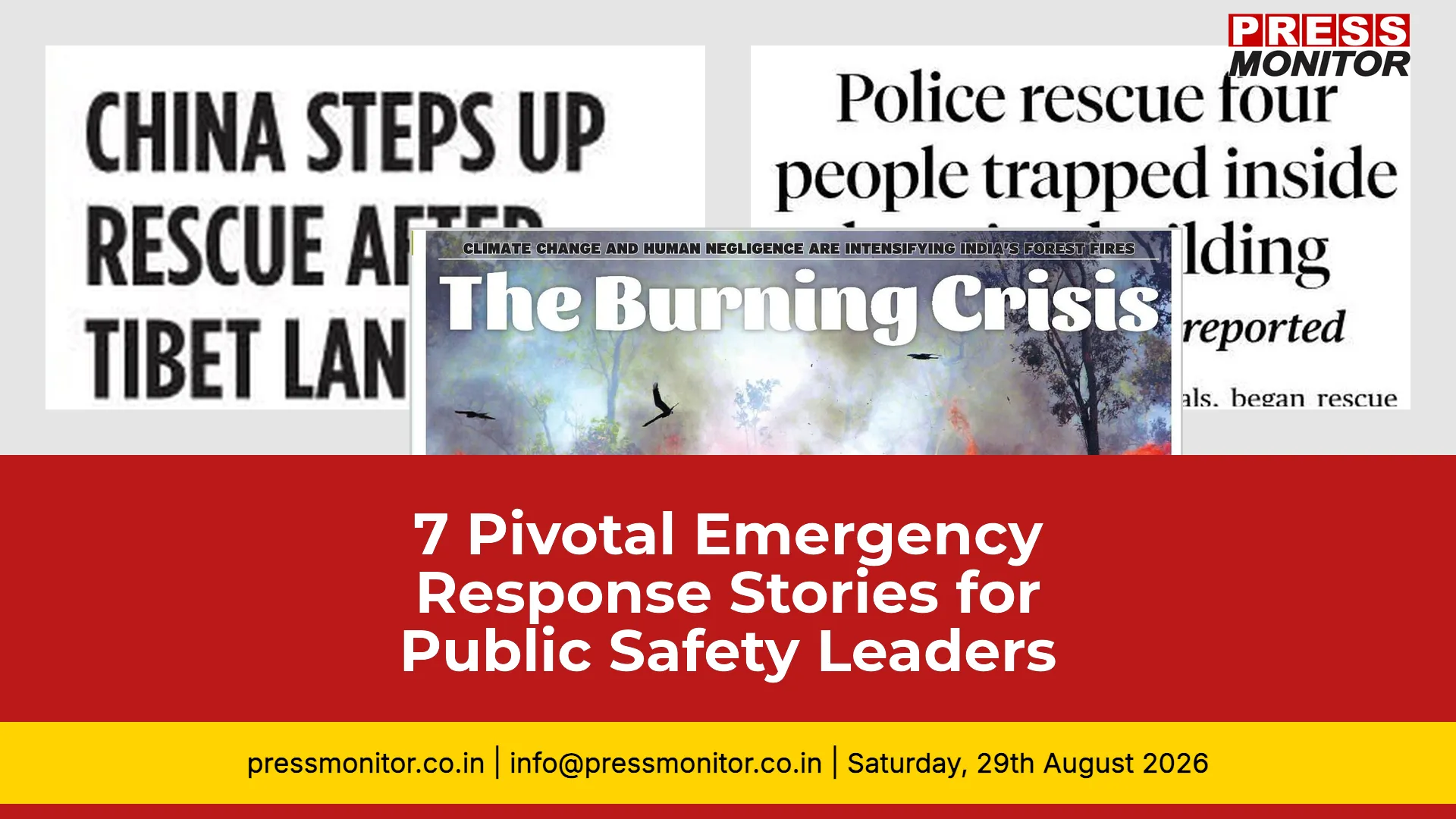
Tracking real-time developments across India’s print landscape requires precise media monitoring. This press review distills today’s most critical news on emergency services and disaster response into actionable media intelligence for safety directors and policy makers. According to Press Monitor's tracking of Indian publications, here are seven pivotal developments shaping how first responders operate today.
1. China Steps Up Rescue After Tibet Landslide
According to a front-page report in the Asian Age, Chinese President Xi Jinping chaired a meeting of top leaders about rescue operations in Tibet on Friday, two days after a landslide hit the Nepal-China border. Officials of the Chinese Communist Party's Polit-buro said all efforts must be made to search for and rescue missing people inside and outside of the country. There are still many hidden dangers of glaciers, ice lakes and geological disasters in the surrounding area, and rescue is facing great difficulties, Xinhua reported the leaders saying, adding that China was considering emergency aid to Nepal.
Why it matters: High-altitude geological disasters directly impact cross-border security and require rapid international coordination.
Key detail: President Xi Jinping chaired a top-leaders meeting focusing on search operations amid hidden glacier and ice-lake dangers, while considering emergency aid to Nepal.
Source: Asian Age
Next step: Monitor diplomatic channels for updated aid protocols and border closure notices.
2. Four Rescued From Burning Building in Delhi
“Selon Millennium Post, quatre personnes ont été secourues des troisième étages d’un immeuble après un incendie dans Baljeet Nagar. Après une alerte PCR reçue par la police de Patel Nagar jeudi, une équipe de police s’est rendue sur le site de l’incident à Hill Marg. Malgré des difficultés pour les pompiers d’atteindre le bâtiment en raison de ruelles étroites et encombrées, les agents de police, avec l’aide des habitants, ont commencé des efforts de sauvetage et de contrôle des incendies. De l’eau a été apportée par des terrasses et des maisons voisines pour contrôler les flammes et empêcher le feu de se propager aux bâtiments voisins. Les agents de police ont pénétré dans le bâtiment et secouru les quatre personnes, malgré une forte fumée et des flammes violentes. La police a éteint l’incendie, tandis que les éléments du bâtiment ont été détruits et aucun décès n’a été signalé.
Why it matters: Urban density and narrow infrastructure continue to challenge rapid fire suppression and evacuation.
Key detail: Despite tight alleyways in Baljeet Nagar, police and residents coordinated rooftop water transfers to contain flames until firefighters arrived, successfully extracting four trapped individuals.
Source: Millennium Post
Next step: Advocate for wider emergency access lanes in municipal redevelopment plans.
3. Over 5 Lakh Forest Fire Alerts Recorded in First Half of 2026
India has experienced a severe, unusual, and unprecedented surge in forest fires, recording over 5 lakh alerts during the first half of 2O26. These Alerts are not just for the forest fires, but an awakening call to everyone. It is time for all to feel the heat of disasters. Devastating fires have already destroyed over 5O hectares of forest coverage this year. Besides that, major loss of biodiversity will have an impact on humanity in times to come. Natural calamities have been on the rise due to both known and unknown reasons. Those both man-made and of natural occurrence. Out of these, few are preventable, but mostly beyond human control. Calamities turning into disasters if not controlled or watched intensely. Impact of climate change is reflected in bad weather disturbing human life. Increased Global warming has been the major cause of wide-spread disasters, maybe in the form of flooding, drought, cyclones, windstorms, earthquakes or other forms of disturbances. For the last few years, fires have been at rise due to the increase in temperature. With year 2O24, recorded as the ‘warmest year on record, wildfires also set a new record. To keep ecosystem, it is essential not only to conserve forests but also to increase their coverage. With climate change leading to warmer temperatures and drier conditions and the increasing urbanization of rural areas, the fire season is starting earlier and ending later. Wildfire events are getting more extreme in terms of acres burned,duration and intensity, and they can disrupt transportation, communications, water supply, and power and gas services. Increased temperature led wildfires have appeared as one of the major challenges affecting climate change. Earlier wildfires were more common in dense forests of North and South America, Africa, and the Mediterranean basin. But over the last five years, severe and recurring wildfires have expanded into non-traditional and historically low-risk geographic regions driven by rising global temperatures, prolonged droughts, and shifting weather anomalies. In Europe, Countries outside the traditional Mediterranean basin—such as Belgium, western Germany, and northern France—have faced intense, out-of-season blazes that stretch local emergency response systems. Also, record -breaking fires have pushed deeper into northern boreal forests and high-latitude areas in eastern Siberia and parts of Greenland, areas previously shielded by cold, wet tundra climates. The worst effect of wildfire has affected the South American region, with huge, devastating, and long-lasting fire destroying the most sought-after forest areas in the world. Destructive fire activity has pushed further into dense, carbon-rich interior rainforests of Brazil (specifically Amazons, Para, and Mato Grosso) and parts of Bolivia, shifting away from just transitional savannah fringes into wet tropical biomes. In Africa, Portions of central Africa's dense tropical rainforest zones have recorded anomalous, severe fire behaviours linked to human-induced drying trends. Wildfires have taken several untouched areas of Central and Northeastern India; fire seasons have intensified and spread beyond traditional hill states like Uttarakhand into central and northeastern re-gions, alongside heavy alert spikes in southern states like Telangana. North-east India is still the worst affected, but also been spikes across Himalayan states, Odisha, and southern regions. Expansion trends may reach other areas, as it happened during the recent past. Fires are starting earlier in the season, raising con-cerns about cli-mate-linked risks.
Why it matters: Climate-driven wildfire expansion threatens biodiversity, rural livelihoods, and air quality across non-traditional zones.
Key detail: India recorded over 500,000 alerts in H1 2026 alone, with fires pushing into central and northeastern states previously considered low-risk due to prolonged droughts and rising temperatures.
Source: First India
Next step: Integrate satellite heat mapping into regional forest ranger dispatch systems.
4. BBMB to Map Flood-Risk Zones in Beas Valley
“A first-of-its-kind dam break analysis is being undertaken to identify vulnerable areas and residents along the Beas from Pandoh Dam to Dehra,” stated Chandramani Sharma, Superintending Engineer, BBMB. The initiative, involving ICED Centre of IIT Roorkee, will map a 135km stretch, dividing populations into green, blue, and red zones based on flood risk. The BBMB also plans to create a database of mobile phone numbers to send emergency alerts and improve preparedness, aiming for a draft report within six months.
Why it matters: Proactive hydrological modeling prevents catastrophic dam-break scenarios before they occur.
Key detail: The Bhakra Beas Management Board, partnering with IIT Roorkee, is conducting a first-of-its-kind dam break analysis along a 135km stretch, categorizing populations into green, blue, and red risk zones.
Source: Tribune
Next step: Align local evacuation drills with the upcoming zone-based alert thresholds.
5. City Tightens Fire Safety Rules
A front-page report in Morning Standard says the Delhi government has made a range of fire-prevention and fire-safety measures mandatory for buildings in the national capital, including minimum emergency access route for fire engines, fire detection and alarm systems, sprinklers, emergency power and firefighting water storage.
Why it matters: Regulatory updates force building owners to upgrade legacy infrastructure to modern survival standards.
Key detail: Delhi mandates minimum emergency access routes, automated sprinklers, fire detection alarms, and dedicated firefighting water storage for all commercial and residential structures.
Source: Morning Standard
Next step: Audit existing compliance certificates and schedule mandatory system upgrades before year-end.
6. Gurgaon to use injection wells for waterlogging
A front-page report in Indian Express says the Haryana government plans to install high-capacity rainwater injection wells and underground reservoirs to curb perennial waterlogging in Gurgaon. Chief Minister Nayab Singh Saini briefed Prime Minister Narendra Modi on the project, which involves a partnership with IIT Gandhinagar to overhaul the city's drainage network.
Why it matters: Chronic urban flooding demands engineered subsurface solutions rather than temporary pumping fixes.
Key detail: Haryana’s government, briefing PM Modi, plans high-capacity rainwater injection wells and underground reservoirs co-developed with IIT Gandhinagar to permanently overhaul drainage networks.
Source: Indian Express
Next step: Track tender releases for civil engineering contractors specializing in subterranean hydrology.
7. Russia Batters Kyiv Region, Hits Homes & Warehouses
According to a front-page report in the Free Press Journal, Russian forces resumed drone barrages on Kyiv on Friday, targeting apartment buildings and warehouses. Officials reported damage to 14 warehouses, 16 private houses, and three apartment buildings, with one fatality and two injuries. A second drone strike after emergency crews arrived was a "double tap" targeting first responders. Russia also continued attacks on Ukraine's energy infrastructure, warning Kherson residents of prolonged power outages, while Russia shot down 512 Ukrainian drones overnight.
Why it matters: Modern conflict tactics increasingly target civilian infrastructure and emergency crews, redefining frontline response protocols.
Key detail: A reported “double tap” drone strike deliberately targeted first responders arriving at damaged apartment blocks, highlighting the lethal risks faced by medical and rescue teams in active war zones.
Source: Free Press Journal
Next step: Review protective gear standards and deconfliction communication channels for deployed personnel.
Print media remains the only editorial-vetted source for verified operational data amid digital noise. How is your organization adapting dispatch protocols to these shifting environmental and urban threats? Share your strategies below. Tracked by Press Monitor.