7 Pivotal Semiconductor Stories for Tech Leaders


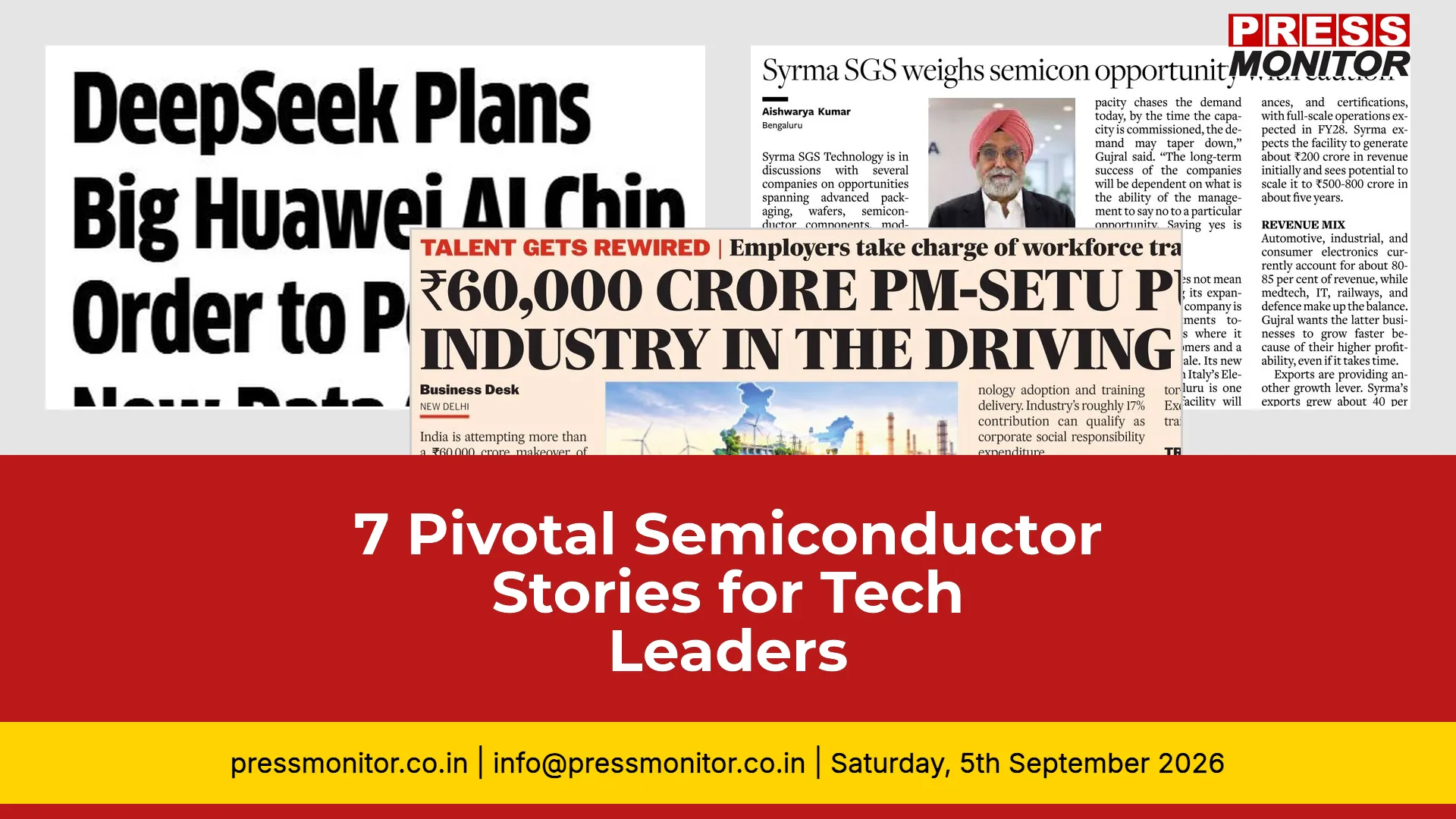
Welcome to today’s press review. Navigating news on Semiconductors & Chips requires sharp media intelligence. According to Press Monitor's tracking of Indian publications, here are the seven critical developments shaping hardware markets, supply chains, and workforce pipelines.
1. DeepSeek Plans Massive Huawei Chip Deployment
A front-page report in Economic Times says DeepSeek intends to deploy at least 160,000 of Huawei Technologies's next-generation Ascend 950DT chips at a massive data centre it is building in Inner Mongolia. The move could create one of the largest known clusters of Huawei AI chips and advance China's efforts to replace Nvidia, though the startup does not currently plan to use the chips for training models.
Why it matters: Signals a major pivot in AI infrastructure away from Western dominance.
Key detail: DeepSeek intends to deploy at least 160,000 Ascend 950DT chips at an Inner Mongolia data centre, creating one of the largest known clusters of Huawei AI accelerators.
Source: Economic Times
Next step: Track how this scaling impacts global GPU pricing and alternative chip architectures.
2. Syrma SGS Takes Cautious Approach to Semiconductor Expansion
A front-page report in Business Line says Syrma SGS Technology is in discussions with several companies on semiconductor opportunities spanning advanced packaging, wafers, and chip design, but Managing Director Jasbir Singh Gujral stated the company would not enter the sector simply because government incentives had made it attractive. The company requires a credible partner, access to futuristic technology, and a buyback arrangement, with technology partner credibility carrying the greatest weight, while directing investments to existing businesses including a new joint venture with Italy's Elemaster in Bengaluru expected to generate Rs 200 crore initially.
Why it matters: Highlights strategic filtering in India’s electronics manufacturing push.
Key detail: Managing Director Jasbir Singh Gujral emphasized that government incentives alone are insufficient; credible partners, futuristic technology access, and buyback arrangements are mandatory before committing capital.
Source: Business Line
Next step: Watch for announced joint ventures meeting these strict criteria.
3. Rs 60,000 Crore PM-SETU Programme Reshapes Vocational Training
A front-page report in Free Press Journal says India is launching a Rs 60,000 crore vocational education transformation through the PM-SETU programme in 2026 to align workforce skills with industry needs. The initiative will modernise 1,000 Industrial Training Institutes across hubs like Bhubaneswar, Chennai, Hyderabad, Kanpur, and Ludhiana, granting employers a 51 percent controlling stake over cluster management and curriculum design. Skill Development Secretary Debashree Mukherjee emphasised that industry-backed funding will bridge the accelerating talent mismatch in sectors such as artificial intelligence, green hydrogen, and semiconductors.
Why it matters: Directly addresses the talent gap fueling semiconductor and AI sector growth.
Key detail: The initiative will modernise 1,000 Industrial Training Institutes while granting employers a 51 percent controlling stake over curriculum design to align skills with industry needs.
Source: Free Press Journal
Next step: Monitor cluster allocations in Bhubaneswar, Chennai, Hyderabad, Kanpur, and Ludhiana.
4. Vance And Rubio Launch Foundry School Initiative
A front-page report in Hindustan Times says US Vice President JD Vance and Secretary of State Marco Rubio have announced the creation of a new training programme called Foundry School to rebuild domestic manufacturing. Founders and CEOs from India and other partner nations like Japan will serve as teachers and mentors within the Pax Silica partnership. Eight US universities will host sessions starting in September focusing on modern factory design and supply chains.
Why it matters: Rebuilds domestic manufacturing capacity through structured academic partnerships.
Key detail: Eight US universities will host sessions starting in September, featuring founders and CEOs from India and Japan as mentors under the Pax Silica partnership.
Source: Hindustan Times
Next step: Follow cohort enrollments and graduate placement metrics in advanced packaging.
5. Belgium Warns Europe Against Over-Reliance on China
A front-page report in First India says Belgian Prime Minister Bart De Wever admitted Europe saw the risks of economic dependence on China but failed to listen to India. He stressed that free trade must remain open but cannot mean being naive about economic coercion. Europe is now seeking strategic diversification through deeper cooperation with India in critical minerals, semiconductors, technology, pharmaceuticals, energy and defence.
Why it matters: Geopolitical realignment accelerating strategic diversification in critical tech sectors.
Key detail: Prime Minister Bart De Wever stressed that free trade cannot mean naivety regarding economic coercion, pushing for deeper cooperation with India in semiconductors, critical minerals, and defence.
Source: First India
Next step: Assess bilateral MoUs signed between New Delhi and Brussels this quarter.
6. Sikorski Advances Multilateral Talks on Trade, AI, and Defence
A front-page report in Financial Express says Radoslaw Sikorski held wide-ranging talks on Friday, focusing on trade and investment, space, AI, semiconductors, defence and energy, as well as the complex global challenges and conflicts in Ukraine and West Asia.
Why it matters: Expands diplomatic frameworks governing semiconductor export controls and allied tech standards.
Key detail: Radoslaw Sikorski held wide-ranging discussions covering space, artificial intelligence, semiconductors, and energy alongside complex regional security challenges.
Source: Financial Express
Next step: Track policy alignment outcomes between European and Indo-Pacific tech alliances.
7. Google Pixel Review Highlights Persistent Memory Chip Shortages
A front-page report in Mint says author Tushar Kanwar reviews a new Google Pixel phone, noting that memory chip shortages have made new phones and laptops more expensive. The review says the device offers one of the best cameras, excellent performance, solid build quality, seamless Google Gemini integration, a full day of intensive use, wireless charging and a snappy Android operating system.
Why it matters: Demonstrates how upstream fabrication bottlenecks directly inflate consumer electronics pricing.
Key detail: Despite excellent camera performance and Gemini integration, new devices face premium pricing due to ongoing memory chip supply constraints.
Source: Mint
Next step: Compare device cost trajectories against Q3 foundry utilization rates.
These developments underscore why rigorous print media monitoring remains essential for anticipating market shifts. Which of these semiconductor trends will most impact your supply chain strategy next quarter? Share your insights below.