7 Pivotal Supply Chain & Procurement Stories for Leaders


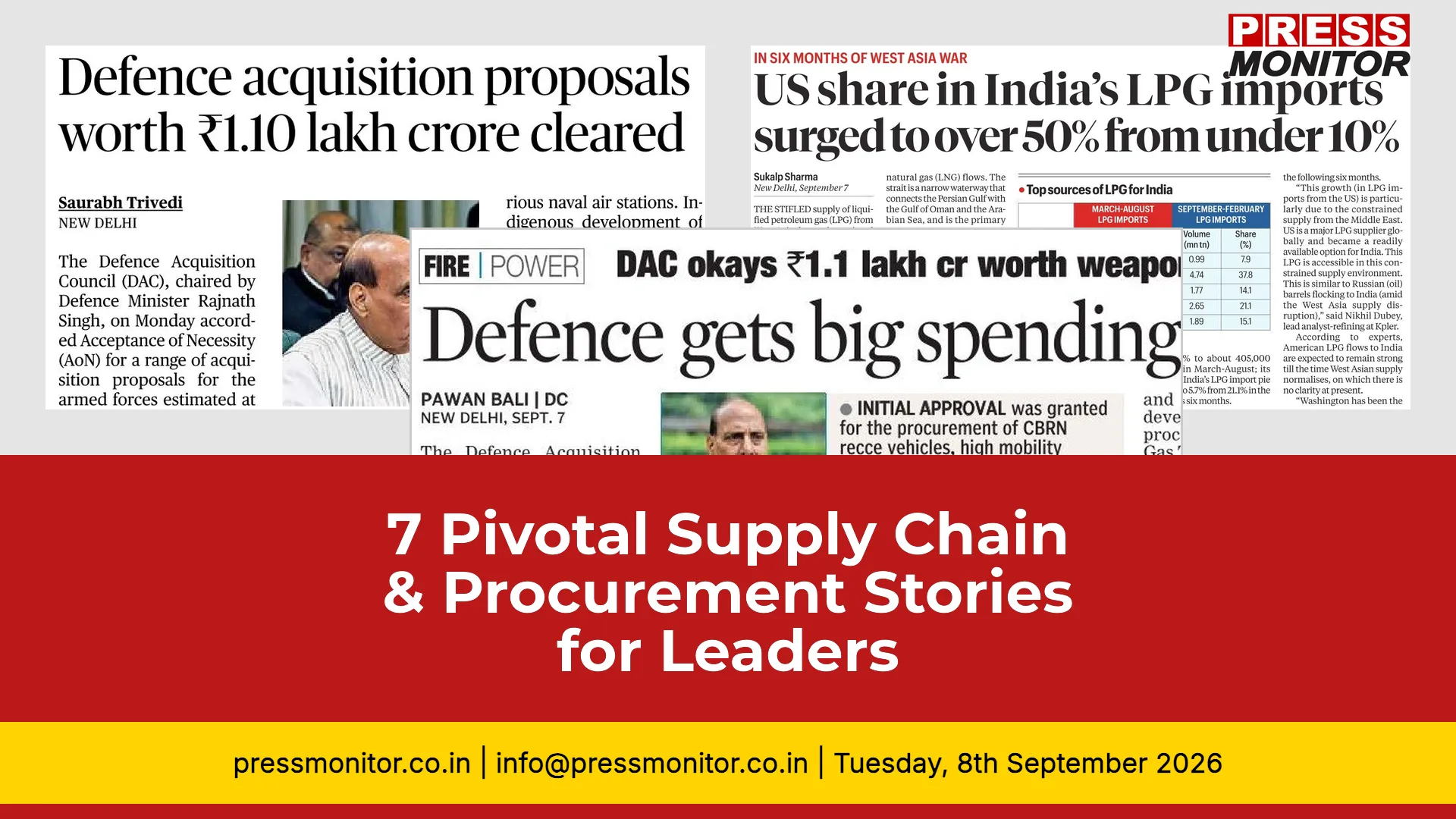
From defence procurement to energy security, today's news on supply chain and procurement reveals how Indian businesses and government agencies are reshaping logistics and sourcing. According to Press Monitor's tracking of Indian publications, this media monitoring roundup draws on print media monitoring and media intelligence to cover seven developments that matter for procurement leaders.
1. DAC Clears Rs 1.10 Lakh Crore in Defence Procurement
A front-page report in The Hindu says the Defence Acquisition Council, chaired by Defence Minister Rajnath Singh, accorded Acceptance of Necessity for acquisition proposals estimated at Rs 1.10 lakh crore, with approximately 98% of procurements planned from Indian industry. The approvals include CBRN reconnaissance vehicles and advanced light helicopters for the Army, Arudhra radars and marine gas turbines for the Navy, and multi-purpose jammers for the Air Force, alongside the installation of the Defence Forces Secure Access Card system to replace paper-based identity cards.
Why it matters: The single largest defence procurement cycle in recent history signals a structural shift toward domestic manufacturing and self-reliance in critical military hardware.
Key detail/stat: 98% of procurements planned from Indian industry; Rs 1.10 lakh crore in proposals cleared across Army, Navy, and Air Force.
Source: The Hindu, front page, 18 July 2026, by Saurabh Trivedi.
Next step: Watch for the second administrative stage of the procurement process and domestic vendor responses.
2. US Becomes India's Top LPG Supplier
A front-page report in Indian Express says India liquefied petroleum gas import patterns have dramatically shifted due to the West Asia conflict, with United States supplies climbing to over fifty two per cent of total arrivals from under ten per cent previously. Traditional Gulf exporters including the United Arab Emirates, Qatar, and Saudi Arabia experienced steep volume declines as shipping movements through the Strait of Hormuz were restricted. This transition highlights India securing alternative energy flows to maintain domestic fuel availability amidst regional instability.
Why it matters: A geopolitical crisis has forced India to completely rewire its energy supply chain in weeks, reducing dependence on traditional Gulf exporters.
Key detail/stat: US supplies jumped from under 10% to over 52% of India's LPG imports; UAE share dropped from 37.8% to 13.4%.
Source: Indian Express, front page, September 7, by Sukalp Sharma.
Next step: Monitor shipping route adjustments and new long-term supply contracts with US exporters.
3. DAC Approves Rs 2.10 Lakh Crore in Defence Deals
A front-page report in Deccan Chronicle says the Defence Acquisition Council, headed by Rajnath Singh, cleared defence acquisition proposals worth Rs 2.10 lakh crore for the Army, Navy, and Indian Air Force. The proposals include missiles for fighter jets, Advanced Light Helicopters, and Chemical Biological Radiological and Nuclear recce vehicles. Initial approvals were granted for CBRN recce vehicles, high mobility vehicles, self-propelled mechanical mine layers, Arudhra Radars, warship propulsion systems, and ground-based multi-purpose jammers.
Why it matters: A second wave of DAC approvals expands the scope of military modernization across all three services, with significant implications for domestic defence manufacturers.
Key detail/stat: Rs 2.10 lakh crore in proposals including missiles, ALHs, CBRN vehicles, marine gas turbines, and multi-purpose jammers.
Source: Deccan Chronicle, front page, September 7, by Pawan Bali.
Next step: Track which domestic firms win the contracts and how the procurement timeline unfolds.
4. ₹11 Lakh Crore Defence Upgrade Approved
A front-page report in First India says that on Monday, the defence ministry approved the acquisition of military hardware—including radars, advanced light helicopters and mechanised mine layers—for the three defence services at an estimated cost of eleven lakh crore rupees. The proposals were cleared by the Defence Acquisition Council headed by Defence Minister Rajnath Singh, and the CBRN recce vehicles will detect, identify, monitor and mark areas contaminated with CBRN agents.
Why it matters: An even larger procurement cycle signals the government's commitment to comprehensive military modernization across all domains.
Key detail/stat: Rs 11 lakh crore in approved acquisitions including radars, ALHs, and mechanised mine layers.
Source: First India, front page.
Next step: Follow the detailed item-wise breakdown and domestic industry participation rates.
5. LEAP India CEO Defines Supply Chain Agility
A front-page report in Business Standard says LEAP India Limited Managing Director and CEO Sunu Mathew describes agility in a supply chain as the ability to recognise change and respond without disrupting the customer. He outlines four essential elements: real-time visibility enabled by technology, flexible access to assets through pooling models, a strong physical network for execution, and resilience to ensure sustainability. Mathew concludes that as Indian supply chains become more interconnected, this adaptive operating model will distinguish efficient operations from merely large ones.
Why it matters: As supply chains grow more complex, the definition of agility is evolving beyond speed to include resilience and adaptability.
Key detail/stat: Four pillars identified: real-time visibility, asset pooling, physical network execution, and sustainability resilience.
Source: Business Standard, front page.
Next step: Evaluate how your organization scores on each of the four agility pillars.
6. CEOs Rewire India Through Agile Supply Chains
A front-page report in Business Standard says that at the 5th Supply Chain & Logistics Conclave, industry leaders including Dr Shailendra Shukla, Vishal Sharma, and Ramnik Gupta explored how organizations can embrace change, leverage technology, and build future-ready supply chains to support India's growth. The discussion emphasized that resilient supply chains require agility, adaptability, collaboration, and leadership willing to challenge convention and continuously rethink operating models.
Why it matters: Industry leaders are converging on a new operating model that prioritizes adaptability over scale in supply chain design.
Key detail/stat: The 5th Supply Chain & Logistics Conclave brought together CEOs from across sectors to discuss tech-enabled supply chain transformation.
Source: Business Standard, front page.
Next step: Attend or follow upcoming conclaves to stay ahead of supply chain strategy trends.
7. Argentina Pitches Lithium and Oil to India
A front-page report in Mint says Argentina is pitching itself as a reliable supplier of lithium, copper, oil, and gas to India as New Delhi seeks to diversify critical mineral supply chains away from China. India's crude petroleum imports from Argentina rose nearly 92 percent to 110 million dollars in fiscal year 2025-26, while lithium imports grew 31 percent to 46.91 million dollars. Argentina's ambassador Mariano Agustin Caucino said the two nations are deepening economic ties driven by complementarities in food, energy, and mineral resources.
Why it matters: Diversifying critical mineral supply chains away from China is a strategic priority, and Argentina is positioning itself as a key partner.
Key detail/stat: India's crude petroleum imports from Argentina rose 92% to 110 million dollars; lithium imports grew 31% to 46.91 million dollars in FY2025-26.
Source: Mint, front page, by Ramita Mishra, 18 July 2026.
Next step: Watch for bilateral trade agreements and mining investment announcements between the two countries.
Which of these developments will most impact your procurement strategy this quarter? Let us know in the comments.