8 Defining Nuclear Energy Stories for Indian Readers


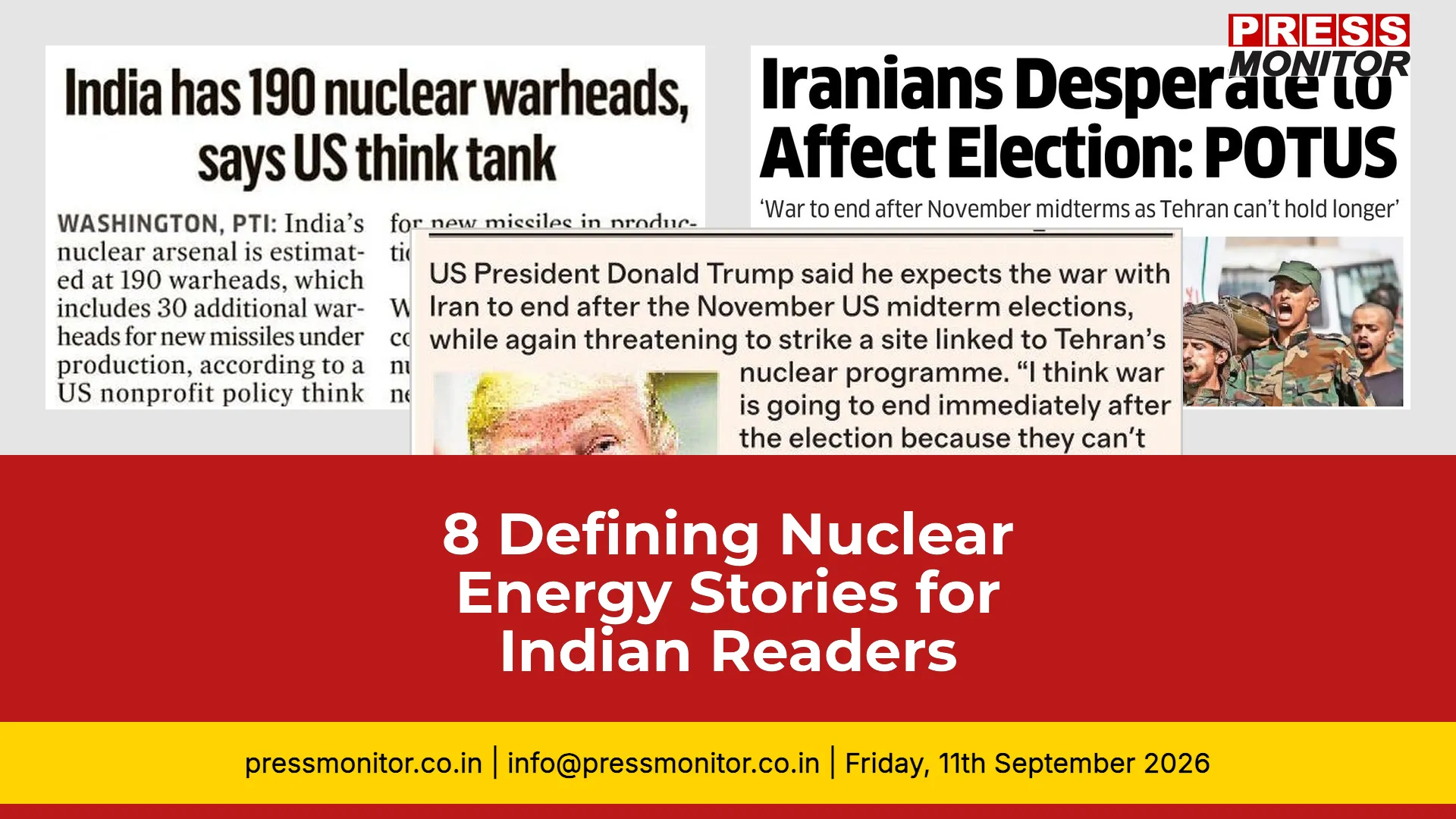
India's nuclear landscape is evolving rapidly across defense, energy, and geopolitics. This press review, tracked by Press Monitor, brings media monitoring and print media monitoring to bear on the day's most significant Indian print stories on nuclear energy, weapons, and trade. According to Press Monitor's tracking of Indian publications, these stories reflect the growing importance of media intelligence and press review in understanding news on nuclear energy. Below are the 8 defining stories from today's front pages.
1. US Think Tank Estimates India's 190 Warheads
A front-page report in Deccan Herald says the Federation of American Scientists estimates India possesses approximately 190 nuclear warheads, including 30 additional units for new missiles currently under production. The analysis indicates India has likely assembled enough weapon-grade plutonium for between 140 and 225 warheads while continuing to modernise its delivery systems and strategic capabilities. Experts note the stockpile is expected to grow further as advanced nuclear-capable aircraft, land-based, and sea-based platforms are developed or replaced.
Why it matters: The Federation of American Scientists' latest assessment places India's nuclear arsenal at approximately 190 warheads, a figure that shapes regional deterrence calculations and strategic planning across South Asia.
Key detail: India has likely assembled enough weapon-grade plutonium for between 140 and 225 warheads, with 30 additional units for new missiles currently under production and delivery systems being modernised across aircraft, land-based, and sea-based platforms.
Source: Deccan Herald, PTI, Washington
Next step: As India continues to modernise its nuclear triad, the stockpile is expected to grow further, raising questions about regional stability and arms control dynamics.
Closing question: How will this arsenal expansion reshape South Asian strategic stability?
2. Iran War May Extend Through 2029
A front-page report in Economic Times says that President Donald Trump said he expected the war with Iran to end after the November US midterm elections and threatened again to attack a site associated with the Islamic Republic's nuclear programme after the two sides launched their biggest wave of attacks on shipping since the start of the six-month-old war. Trump told reporters on Wednesday that Tehran was trying to influence the November US midterm elections, which will determine whether his Republican Party retains control of Congress. The Wall Street Journal reported later that top White House advisers, including Vice President JD Vance and Secretary of State Marco Rubio, have privately warned Trump that the conflict could extend through the remainder of his presidency, which ends in January 2029.
Why it matters: Top White House advisers have privately warned President Trump that the conflict with Iran could extend through the remainder of his presidency, ending in January 2029, even as he publicly predicts a quicker resolution.
Key detail: Vice President JD Vance and Secretary of State Marco Rubio have cautioned against expecting a fast conclusion, while Trump continues to threaten strikes on the Pickaxe Mountain site near Iran's Natanz uranium enrichment facility.
Source: Economic Times, Cairo | Washington | Dubai
Next step: The Pickaxe Mountain site remains a flashpoint, and the war's escalation has already drawn in shipping lanes across the region.
Closing question: Will diplomatic channels open before the conflict enters its fourth year?
3. India Nuclear Arsenal Grows Amid China Tensions
A front-page report in Free Press Journal says United States President Donald Trump expects the conflict with Iran to conclude following the upcoming November United States midterm elections. He warned of potential military strikes against Pickaxe Mountain, a heavily fortified site housing two deeply buried tunnel complexes near the damaged Natanz uranium enrichment facility, asserting that Tehran cannot hold out any longer.
Why it matters: India retains its no-first-use nuclear doctrine while expanding its arsenal, reflecting a strategic recalibration amid rising tensions with both Pakistan and China.
Key detail: India has 88 operational nuclear-capable land-based missiles including Agni missiles with ranges from 3,200 to 5,000 kilometres, and is expanding its fleet of nuclear-powered ballistic missile submarines with INS Arihant leading the force.
Source: Free Press Journal, Mumbai
Next step: The K-4 submarine-launched ballistic missile with an estimated range of 3,500 kilometres could expand strike capability from the Bay of Bengal.
Closing question: Can India's credible minimum deterrence doctrine hold as the arsenal grows?
4. Maharashtra Emerges as India Nuclear Power Hub
A front-page report in Deccan Herald says Maharashtra, which houses Asia's first nuclear power plant, is set to emerge as India's nuclear power hub with over Rs 6,00,000 crore investments expected to create around 1.5 lakh jobs. Chief Minister Devendra Fadnavis, who is also the state Energy Minister, is overseeing the programme guided by the Nuclear Power Corporation of India Ltd. The proposed 9,900 MW Jaitapur project in Ratnagiri district is regarded as one of the world's largest planned nuclear power plants and is a collaboration of NPCIL with France's EDF.
Why it matters: Maharashtra, home to Asia's first nuclear power plant, is set to become India's nuclear power hub with over Rs 6 lakh crore in investments and approximately 1.5 lakh jobs expected.
Key detail: The proposed 9,900 MW Jaitapur project in Ratnagiri district, a collaboration between NPCIL and France's EDF, is regarded as one of the world's largest planned nuclear power plants.
Source: Deccan Herald, Mumbai
Next step: Chief Minister Devendra Fadnavis, also the state Energy Minister, is overseeing the programme guided by the Nuclear Power Corporation of India Ltd.
Closing question: Will Jaitapur become the cornerstone of India's clean energy transition?
5. India Commands Nine Nuclear-Capable Systems
A front-page report in Times of India says India operates nine nuclear-capable systems, comprising two aircraft and six land-based ballistic missiles alongside one sea-based ballistic missile. At least two more systems are nearing completion and could enter military service within a few years.
Why it matters: India operates nine nuclear-capable delivery systems, with at least two more nearing completion, underscoring the country's growing strategic reach and technological self-reliance.
Key detail: The arsenal comprises two aircraft, six land-based ballistic missiles, and one sea-based ballistic missile.
Source: Times of India, New Delhi
Next step: The two additional systems could enter military service within a few years, further expanding India's nuclear triad.
Closing question: How will this expansion affect India's deterrence posture in the Indo-Pacific?
6. IAEA Reports Iran to UN Security Council
A front-page report in Statesman says the International Atomic Energy Agency board reported Iran to the UN Security Council for the first time in twenty years over its failure to cooperate on uranium trace investigations. Twenty-three nations backed the resolution sponsored by the United States, Britain, France and Germany, whereas China, Russia and Niger opposed it. Tehran's envoy condemned the vote as a political measure, stating that full cooperation is currently unfeasible amid ongoing regional tensions.
Why it matters: The International Atomic Energy Agency board referred Iran to the UN Security Council for the first time in twenty years over its failure to cooperate on uranium trace investigations.
Key detail: Twenty-three nations backed the resolution sponsored by the United States, Britain, France, and Germany, while China, Russia, and Niger opposed it.
Source: Statesman, Delhi, Vienna
Next step: Tehran's envoy condemned the vote as a political measure, stating that full cooperation is currently unfeasible amid ongoing regional tensions.
Closing question: Will this referral lead to renewed international pressure on Iran's nuclear programme?
7. INNOPROM India Fair Highlights Russian Tech Innovations
A front-page report in Economic Times says that a 300‑acre real estate project by the Pakistan Navy and a luxury naval sailing club have become the centre of a legal battle after the Islamabad High Court reversed a 2022 order. The court halted demolition of the club and stopped criminal proceedings against Admiral Zafar Mehmud Abbasi, citing the 27th constitutional amendment that grants the armed forces lifetime legal immunity. The decision is seen as a win for the Pakistan Army, solidifying its control over state real estate and limiting civilian oversight.
Why it matters: The maiden INNOPROM India industrial fair in New Delhi showcases leading Russian technology, AI, aviation, and space companies aiming to boost joint projects and reduce the bilateral trade deficit.
Key detail: Prime Minister Narendra Modi and Russian President Vladimir Putin will make a joint visit to the event, with nuclear energy partnerships featuring prominently alongside civil aviation and manufacturing.
Source: Economic Times, New Delhi
Next step: Key players like Roscosmos and Rosatom are participating, highlighting emerging partnerships in nuclear energy and advanced manufacturing.
Closing question: Can Indo-Russian tech collaboration meaningfully narrow the bilateral trade gap?
8. $5,000 Pledge Sparks Debate
A front-page report in Free Press Journal says that President Donald Trump promised to give every adult United States citizen five thousand dollars if Republicans retain control of the House, a pledge made during his speech at the Republican mid‑term convention in Dallas, Texas. Trump also warned that the war with Iran would end after the November 2026 mid‑term elections and threatened to strike the Pickaxe Mountain site linked to Tehran’s nuclear programme.
Why it matters: President Donald Trump's promise to give every adult US citizen five thousand dollars if Republicans retain House control has sparked domestic and international debate ahead of the November midterms.
Key detail: The pledge was made during Trump's speech at the Republican mid-term convention in Dallas, Texas, alongside warnings that the Iran war would end after the November 2026 mid-terms.
Source: Free Press Journal, Mumbai
Next step: Trump also threatened to strike the Pickaxe Mountain site linked to Tehran's nuclear programme, adding geopolitical stakes to the domestic political pledge.
Closing question: Will this pledge influence voter turnout ahead of the November midterms?
![[16] Essential Media and Publishing Stories for Industry Leaders](https://cdn.optcms.com/www.pressmonitor.co.in/assets/2026/202609/20260911/img-2026-202-23cfbab4679d94f6-300.webp)
[16] Essential Media and Publishing Stories for Industry Leaders
![[10] Key Bus Transport Stories for Professionals](https://cdn.optcms.com/www.pressmonitor.co.in/assets/2026/202609/20260911/img-2026-202-50ae9bfaff963320-300.webp)
[10] Key Bus Transport Stories for Professionals
![[2] Key Casino & Betting Stories for India](https://cdn.optcms.com/www.pressmonitor.co.in/assets/2026/202609/20260911/img-2026-202-b121f89e014f2a18-300.webp)
[2] Key Casino & Betting Stories for India
![[10] Pivotal Forex and Currency Stories for Indian Business](https://cdn.optcms.com/www.pressmonitor.co.in/assets/2026/202609/20260911/img-2026-202-25878f4a395e16c9-300.webp)
[10] Pivotal Forex and Currency Stories for Indian Business
![[15] Essential AI Stories for Business Leaders](https://cdn.optcms.com/www.pressmonitor.co.in/assets/2026/202609/20260911/img-2026-202-b52d96d18e03aa05-300.webp)