8 Key West Asia and Israel News Stories for Indian Professionals


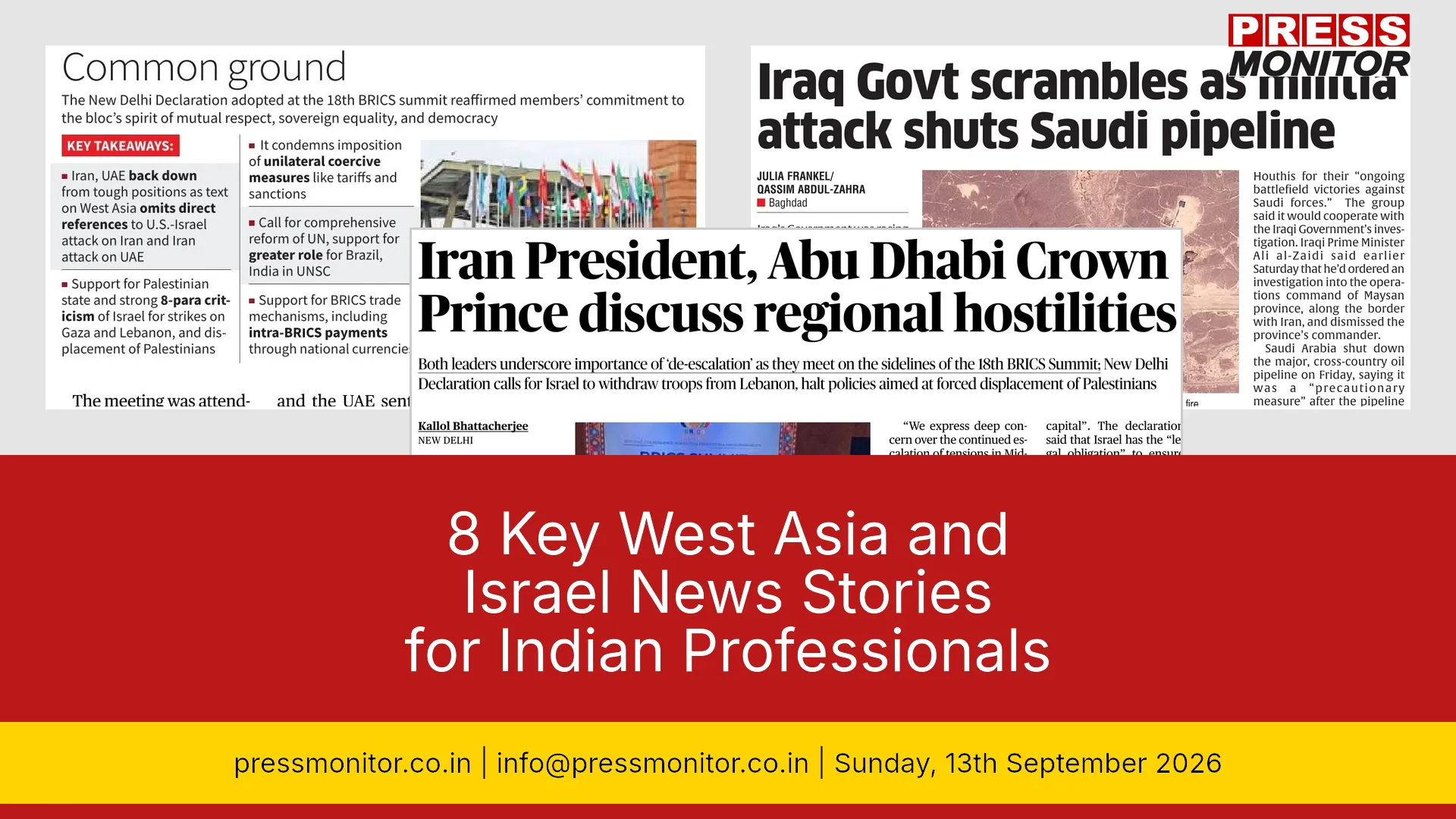
According to Press Monitor's tracking of Indian publications, this press review delivers media monitoring and media intelligence on the most consequential developments across Israel and West Asia. From the 18th BRICS Summit to the Saudi pipeline shutdown, these stories shape the region's future. news on Israel and West Asia reveals a rapidly shifting geopolitical landscape that demands attention from every stakeholder.
1. BRICS Summit Adopts New Delhi Declaration
A front-page report in The Hindu says the eighteenth BRICS summit concluded with the adoption of the New Delhi Declaration, reaffirming member states commitment to mutual respect, sovereign equality, and democracy. The agreement features strong criticism of Israel regarding strikes in Gaza and Lebanon, alongside support for a Palestinian state and calls for United Nations Security Council reform including expanded roles for India and Brazil. It also promotes intra-BRICS trade payments in national currencies, condemns unilateral sanctions and terrorism, and notes diplomatic softening between Iran and the United Arab Emirates regarding West Asian tensions. The 18th BRICS summit in New Delhi concluded with the adoption of the New Delhi Declaration, reaffirming member states' commitment to mutual respect, sovereign equality, and democracy. The agreement features strong criticism of Israel regarding strikes in Gaza and Lebanon, alongside support for a Palestinian state and calls for United Nations Security Council reform including expanded roles for India and Brazil. It also promotes intra-BRICS trade payments in national currencies and condemns unilateral sanctions and terrorism. This print media monitoring highlights how the bloc is reshaping global governance. Why it matters: The declaration signals a unified Global South voice on West Asian conflicts. Key detail: 140-point joint declaration adopted despite Iran-UAE tensions. Source: The Hindu. Next step: Watch for implementation of UN reform proposals at the upcoming General Assembly session.
2. Iran-Backed Militias Target Saudi Pipeline
A front-page report in The Pioneer says Iraq's Government is scrambling to contain fallout after Iran-backed militias attacked a key Saudi oil pipeline from Iraqi territory. Although an umbrella group denied involvement, the Government confirmed the attacks originated locally, dismissed a military commander, and pledged to investigate. Pressure mounts as Iraq faces a September 30 deadline for militias to disarm amid escalating Houthi advances in Yemen threatening global oil prices. Iraq's Government is scrambling to contain fallout after Iran-backed militias attacked a key Saudi oil pipeline from Iraqi territory. Although an umbrella group denied involvement, the Government confirmed the attacks originated locally, dismissed a military commander, and pledged to investigate. Pressure mounts as Iraq faces a September 30 deadline for militias to disarm amid escalating Houthi advances in Yemen threatening global oil prices. Why it matters: The pipeline shutdown disrupts 4-5% of global oil supply, impacting energy markets worldwide. Key detail: Iraqi authorities dismissed two senior officials over the incident. Source: The Pioneer. Next step: Monitor Iraq's disarmament deadline and any retaliatory moves by Iran-backed groups.
3. Iran and Abu Dhabi Push De-Escalation
A front-page report in The Hindu says Iranian President Masoud Pezeshkian and Abu Dhabi Crown Prince Sheikh Khaled bin Mohamed bin Zayed Al Nahyan met in New Delhi on Saturday alongside the eighteenth Brics Summit to discuss regional hostilities and stress the importance of de-escalation. The resulting New Delhi Declaration expressed deep concern over conflicts in West Asia, calling for Israeli withdrawal from Lebanon, halting policies targeting Palestinian displacement, and supporting an independent Palestinian state within nineteen sixty-seven borders. Both leaders emphasised strengthening regional stability while Saudi officials condemned recent Houthi militia attacks on sovereign territory. Iranian President Masoud Pezeshkian and Abu Dhabi Crown Prince Sheikh Khaled bin Mohamed bin Zayed Al Nahyan met in New Delhi alongside the 18th BRICS Summit to discuss regional hostilities and stress the importance of de-escalation. The resulting New Delhi Declaration expressed deep concern over conflicts in West Asia, calling for Israeli withdrawal from Lebanon, halting policies targeting Palestinian displacement, and supporting an independent Palestinian state within 1967 borders. Both leaders emphasised strengthening regional stability while Saudi officials condemned recent Houthi militia attacks on sovereign territory. Why it matters: This diplomatic breakthrough could reduce tensions across West Asia. Key detail: The declaration calls for Israeli withdrawal from Lebanon and a Palestinian state within 1967 borders. Source: The Hindu, by Kallol Bhattacherjee. Next step: Track whether the de-escalation framework holds as Houthi attacks continue.
4. Houthis Seize Three Red Sea Sites
A front-page report in The Hindu says Houthi militants captured the Red Sea port cities of Mokha and Dhubab along with Perim Island, extending their control over key maritime chokepoints. The Houthis also attacked four Saudi cities, wounding at least seventy-three people and sparking fires at oil facilities, reportedly in retaliation for Saudi air strikes on Yemeni provinces. The developments come amid the broader United States and Iran war and have disrupted maritime traffic through both the Strait of Hormuz and the Bab el-Mandeb Strait. Houthi militants captured the Red Sea port cities of Mokha and Dhubab along with Perim Island, extending their control over key maritime chokepoints. The Houthis also attacked four Saudi cities, wounding at least seventy-three people and sparking fires at oil facilities, reportedly in retaliation for Saudi air strikes on Yemeni provinces. The developments come amid the broader United States and Iran war and have disrupted maritime traffic through both the Strait of Hormuz and the Bab el-Mandeb Strait. Why it matters: Control of these ports threatens global maritime trade and energy exports. Key detail: At least 73 people wounded in attacks on Saudi cities. Source: The Hindu. Next step: Assess the impact on international shipping routes and oil supply chains.
5. Houthis Seize Red Sea Chokepoint
A front-page report in The Hindu says Houthi militants have seized full control of the Bab el Mandeb Strait and disrupted shipping across the Red Sea after breaking a fragile ceasefire with Saudi backed forces. Following a dispute over an Iranian transport flight carrying Yemen rebel leadership, Saudi forces bombed Sana airport runways, prompting immediate Houthi offensives that captured key port cities and coastal territory within weeks. The escalation has handed Ansar Allah significant leverage over two critical global maritime chokepoints, threatening international energy exports and reshaping regional power dynamics. Houthi militants have seized full control of the Bab el Mandeb Strait and disrupted shipping across the Red Sea after breaking a fragile ceasefire with Saudi-backed forces. Following a dispute over an Iranian transport flight carrying Yemen rebel leadership, Saudi forces bombed Sana airport runways, prompting immediate Houthi offensives that captured key port cities and coastal territory within weeks. The escalation has handed Ansar Allah significant leverage over two critical global maritime chokepoints, threatening international energy exports and reshaping regional power dynamics. Why it matters: The Bab el-Mandeb Strait is a vital energy corridor; its disruption affects global markets. Key detail: Houthi forces now control both the Strait of Hormuz and Bab el-Mandeb. Source: The Hindu. Next step: Evaluate the strategic implications for international energy security and regional stability.
6. Saudi Arabia pressures over Hormuz and Red Sea
A front-page report in The Hindu says renewed conflict brings Saudi Arabia under enormous pressure as Iran disrupts traffic through the Strait of Hormuz. Riyadh increasingly relied on its Red Sea terminals to export crude oil, but the Houthis directly targeted Saudi oil infrastructure and shut the East-West Pipeline on September 11. Now both the Strait of Hormuz and the Bab el-Mandeb Strait are disrupted, and any final settlement will have to address the Houthis' demands. Renewed conflict brings Saudi Arabia under enormous pressure as Iran disrupts traffic through the Strait of Hormuz. Riyadh increasingly relied on its Red Sea terminals to export crude oil, but the Houthis directly targeted Saudi oil infrastructure and shut the East-West Pipeline on September 11. Now both the Strait of Hormuz and the Bab el-Mandeb Strait are disrupted, and any final settlement will have to address the Houthis' demands. Why it matters: Saudi Arabia faces a two-front energy crisis that could reshape global oil markets. Key detail: Both Strait of Hormuz and Bab el-Mandeb are now disrupted simultaneously. Source: The Hindu. Next step: Monitor Saudi Arabia's diplomatic moves to secure alternative export routes.
7. Modi hails India-UAE ties amid West Asia uncertainty
A front-page report in The Hindu says Prime Minister Narendra Modi held bilateral meetings with Sheikh Khaled bin Mohamed bin Zayed Al Nahyan of the United Arab Emirates, Ethiopian Prime Minister Abiy Ahmed Ali, Vietnamese Prime Minister Le Minh Hung, and Malaysian Prime Minister Anwar Ibrahim on the sidelines of the eighteenth BRICS Summit in New Delhi on Saturday. Modi described India-UAE ties as a symbol of stability and prosperity during a time of uncertainty in West Asia, while the two leaders discussed major investment opportunities including the role of the UAE's new sovereign investment fund L'Imad and an eleven point five billion dollar investment in an aluminium project in Odisha. Discussions with Ethiopia, Vietnam, and Malaysia covered strategic partnerships, defence cooperation, trade, and infrastructure development. Prime Minister Narendra Modi held bilateral meetings with Sheikh Khaled bin Mohamed bin Zayed Al Nahyan of the United Arab Emirates, Ethiopian Prime Minister Abiy Ahmed Ali, Vietnamese Prime Minister Le Minh Hung, and Malaysian Prime Minister Anwar Ibrahim on the sidelines of the 18th BRICS Summit in New Delhi. Modi described India-UAE ties as a symbol of stability and prosperity during a time of uncertainty in West Asia, while the two leaders discussed major investment opportunities including the role of the UAE's new sovereign investment fund L'Imad and an eleven point five billion dollar investment in an aluminium project in Odisha. Why it matters: India-UAE strategic partnership deepens amid regional instability, offering economic opportunities. Key detail: 11.5 billion dollar aluminium investment planned in Odisha. Source: The Hindu, by Kallol Bhattacherjee and T.C.A. Sharad Raghavan. Next step: Follow the implementation of the L'Imad fund and Odisha aluminium project timelines.
8. BRICS Backs UAE Palestine Resolution
A front-page report in Hindustan says the BRICS joint statement supports a two-state solution for Israel-Palestine, with UAE demanding Palestinian full UN membership. Iran's President Pezeshkian reportedly backed the proposal, and UAE also proposed declaring Central Asia a nuclear-weapon-free zone. The BRICS joint statement supports a two-state solution for Israel-Palestine, with UAE demanding Palestinian full UN membership. Iran's President Pezeshkian reportedly backed the proposal, and UAE also proposed declaring Central Asia a nuclear-weapon-free zone. Why it matters: This marks a significant shift in Global South diplomacy on the Israel-Palestine issue. Key detail: UAE demands Palestinian full UN membership; Central Asia proposed as nuclear-weapon-free zone. Source: Hindustan. Next step: Observe how the two-state solution proposal gains traction in international forums.
This press review demonstrates the power of print media monitoring in delivering grounded, editorial-vetted intelligence on Israel and West Asia. As regional tensions escalate, staying informed through trusted media monitoring sources like Press Monitor becomes essential. What developments will you be watching next in this evolving West Asian landscape?
5 Pivotal Petroleum Stories for Indian Professionals
5 Key Civil Aviation Stories for Indian Professionals

5 Pivotal European Union News Stories for Indian Professionals
6 Essential Alcoholic Beverages Stories for Indian Professionals