9 Critical Logistics and Supply Chain Stories for Professionals


Welcome to today's Press Monitor press review, where we curate the most impactful logistics and supply chain stories from across Indian print media. According to Press Monitor's tracking of Indian publications, these nine stories are shaping the sector today.
1. DGFT Eases Rupee Export Payment Rules
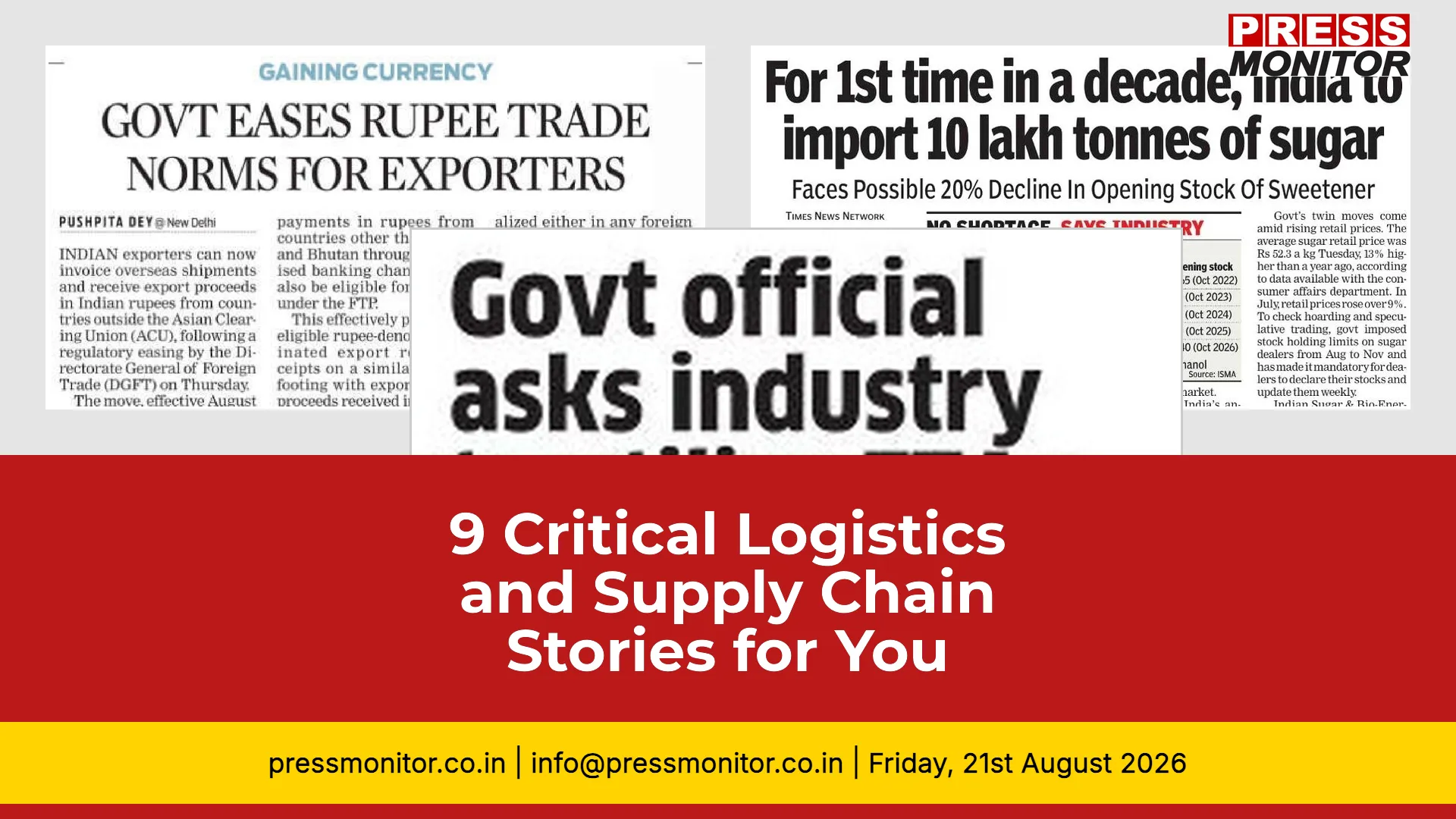
"A front-page report in New Indian Express says" Indian exporters can now invoice overseas shipments and receive export proceeds in Indian rupees from countries outside the Asian Clearing Union (ACU), following a regulatory easing by the Directorate General of Foreign Trade (DGFT) on Thursday. The move, effective August 20, aligns the Foreign Trade Policy (FTP) with the Reserve Bank of India’s foreign exchange regulations and gives exporters greater flexibility to settle transactions either in Indian rupees or foreign currency. Indian exporters receiving payments in rupees from countries other than Nepal and Bhutan through authorised banking channels will also be eligible for benefits under the FTP. This effectively places eligible rupee-denominated export receipts on a similar footing with export proceeds received in foreign currency. "Allexport contracts and invoices, other than those invelving member countries of the Asian Clearing Union (ACU), shall be de-nominated either in foreign currency or Indian Rupees. Export proceeds shall be re- alized either in any foreign eurrency or in Indian Ru- pees," the DGFT said in its notification. Export contracts and in- voices under EXIM Bank/ Government of India Lines of Credit can also be denominated in Indian rupees. The ACU is a re- gional payment ar- rangement that facili- tates trade settlement among participating coun- tries by periodically netting their obligations. Its members include India, Iran, Pa- kistan, Sri Lanka, Nepal, Bhutan, Myanmar and the Maldives. The Directorate General of Foreign Trade has amended the Foreign Trade Policy to allow export contracts and payments with non-Asian Clearing Union countries to be settled in rupees. Why it matters: This move promotes the rupee in global trade and helps countries facing dollar shortages. Key detail: Exports to countries outside the ACU can now be invoiced and paid in INR, with full trade policy benefits.
Source: New Indian Express. Next step: Exporters should update their invoicing systems to leverage this flexibility.
2. Government Allows Duty-Free Sugar Import for First Time in a Decade
A front-page report in Times of India says the government allowed import of 10 lakh tonnes of raw sugar, the first such move in a decade, as the industry faces a possible 20% decline in opening stock. The move follows a food ministry order limiting bulk consumers' inventory to 15 days, with production projected to fall to 296 lakh tonnes, the lowest since 2019-20. India has permitted 1 million tonnes of raw sugar at zero duty until October 31 to cool prices. Why it matters: This addresses a 16-year high in domestic sugar prices and ensures supply ahead of festivals. Key detail: Production is expected to fall to 296 lakh tonnes.
Source: Times of India. Next step: Bulk consumers should prepare for stock limits.
3. Government Urges Industry to Leverage FTAs and Diversify Markets
A front-page report in The Pioneer says the Indian Government has urged the industry to utilise Free Trade Agreements to boost manufacturing and diversify export markets. Additional Secretary Yashvir Singh stated that businesses must actively use these agreements to attract investment and build resilient supply chains during a manufacturing conclave. Additional Secretary Yashvir Singh called on businesses to use free trade agreements to build resilient supply chains. Why it matters: Export diversification reduces reliance on any single market. Key detail: Singh stressed investment in critical minerals and electronic components.
Source: The Pioneer. Next step: Review your export markets and FTA benefits.
4. Fleetx.ai Acquires Pando.ai to Unify Fleet Visibility and Freight Execution
A front-page report in Business Line says that Fleetx.ai, an AI-native fleet and logistics technology company, has announced the acquisition of Pando.ai, a transportation management system provider, for an undisclosed amount. Through this, customers gain access to a unified AI-native platform spanning the entire journey from fleet visibility to freight execution. Fleetx.ai, an AI-native logistics tech company, has acquired Pando.ai, a transportation management system provider. Why it matters: This creates a unified platform from fleet visibility to freight execution. Key detail: Customers get end-to-end AI-native logistics.
Source: Business Line. Next step: Evaluate how integrated logistics platforms can streamline your operations.
5. Alstom Eyes Follow-on Order of 200 Locomotives from Indian Railways
A front-page report in Deccan Chronicle says Alstom is discussing a follow-on order of two hundred locomotives with Indian Railways for its manufacturing plant in Madhepura, Bihar. The initial order of eight hundred electric freight locomotives will be completed by March 2028. Alstom is in discussions for additional electric freight locomotives for its Madhepura plant. Why it matters: This would boost rail freight capacity and manufacturing in Bihar. Key detail: Initial order of 800 locomotives to be completed by March 2028.
Source: Deccan Chronicle. Next step: Rail-dependent logistics firms should monitor expansion plans.
6. Venezuela Becomes India's Fourth-Largest Crude Oil Supplier
A front-page report in Free Press Journal says India is accelerating crude-supply diversification towards Latin America due to Middle East disruptions. Venezuelan shipments rose to approximately 444,000 barrels per day in August, establishing Venezuela as India's fourth-largest supplier. Shipments surged to 444,000 bpd in August as India diversifies away from Middle East disruptions. Why it matters: Geopolitical risks in the Strait of Hormuz are reshaping global oil supply chains. Key detail: Venezuelan crude now accounts for a significant share of India's imports.
Source: Free Press Journal. Next step: Energy supply chain managers should watch this trend.
7. Indian Oil Finalizes LPG Import Deal with Algeria's Sonatrach
A front-page report in Mint says: Indian Oil Corporation has finalized an LPG import agreement with Algeria’s Sonatrach for delivery in 2027. The pact involves monthly shipments of gas carriers carrying 45,000 to 55,000 metric tonnes through diversified energy sourcing amid reduced reliance on Gulf markets. The agreement responds to disruptions from the Red Sea blockade affecting Asia’s energy flows. Monthly shipments of 45,000-55,000 tonnes of LPG will start in 2027. Why it matters: This reduces reliance on Gulf markets and strengthens energy security. Key detail: The deal responds to Red Sea blockade disruptions.
Source: Mint. Next step: LPG distributors should prepare for new supply sources.
8. Swiggy Moves Instamart to Inventory-Led Model
A front-page report in Financial Express says Swiggy is transitioning its quick-commerce unit, Instamart, to an inventory-led model following shareholder approval for its foreign ownership cap. The move aims to improve margins and supply chain control as it competes with market leader Blinkit in India's 11.5 billion dollar quick-commerce market. Shareholder approval for foreign ownership cap allows the quick-commerce unit to operate an inventory-owned model. Why it matters: This improves margins and supply chain control in a $11.5 billion market. Key detail: Blinkit, already on inventory model, has seen positive margins.
Source: Financial Express. Next step: Quick-commerce players must adapt their logistics strategies.
9. China Visa Denials Disrupt Indian Startup Supply Chains
A front-page report in Economic Times says China is increasingly denying visas to Indian executives, causing logistical difficulties for Indian startups which need to frequently travel to China for meeting supply chain partners and staying abreast of global innovation. Some firms are exploring alternate supply chain partners in Hong Kong, Taiwan, and Singapore, while others are waiting for clarity. The challenge is particularly acute for smaller firms having low volumes. Indian executives increasingly denied visas, affecting trips to meet supply chain partners. Why it matters: Startups face logistical hurdles in sourcing from China. Key detail: Some firms are exploring partners in Hong Kong, Taiwan, and Singapore.
Source: Economic Times. Next step: Diversify supply chain sources to mitigate visa risks.
This media monitoring intelligence helps you stay ahead. Which story impacts your business most? Follow Press Monitor for daily print media insights on logistics and supply chain.