9 Critical Nuclear Energy Stories for Policy and Defense Leaders


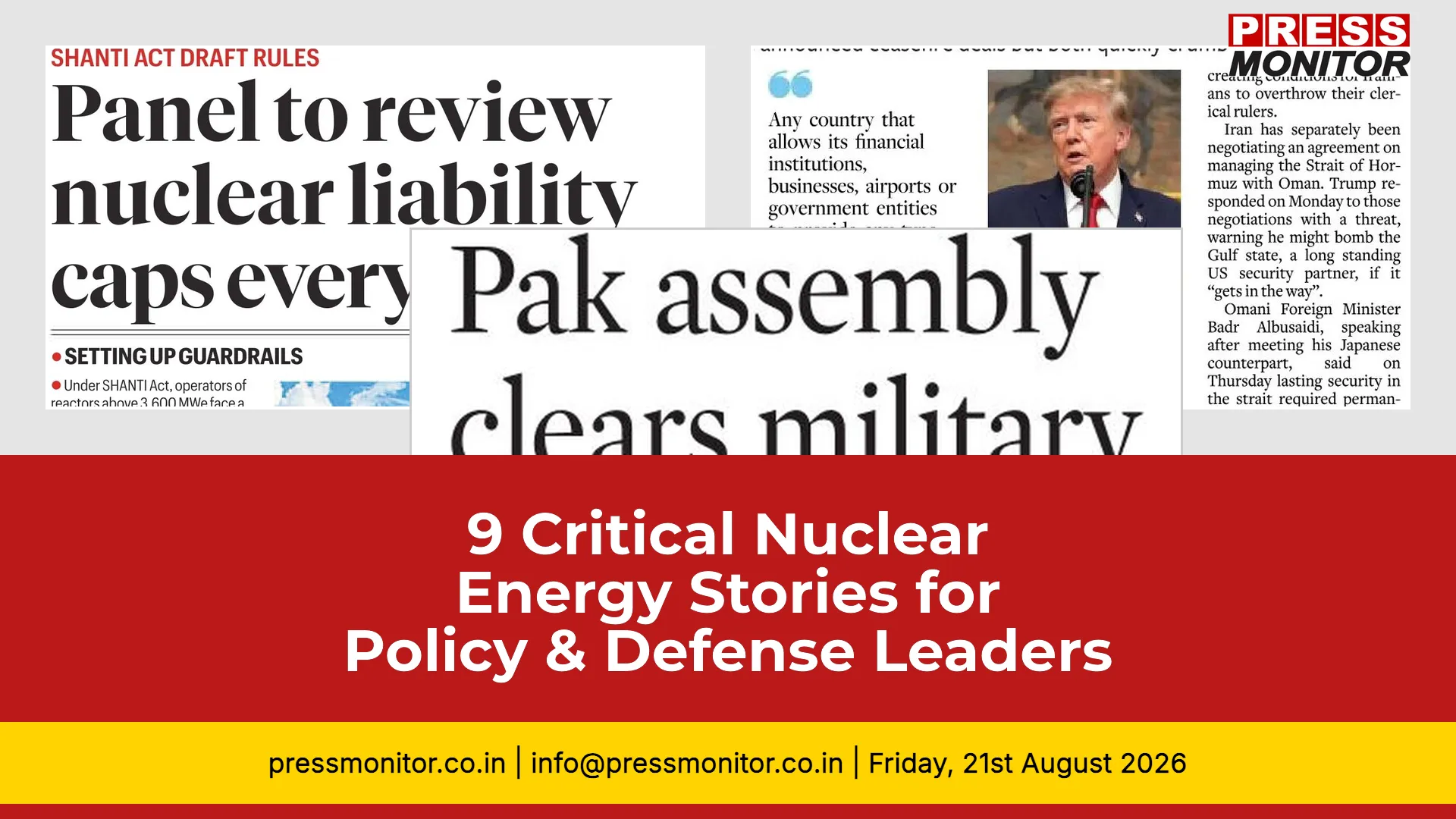
Stay ahead of the rapidly shifting nuclear landscape with Press Monitor's curated press review. According to Press Monitor's tracking of Indian publications, today's print media brings you the most critical developments in nuclear energy, weapons, and trade — from India's SHANTI Act liability framework to escalating global tensions. This media intelligence roundup covers the stories that matter for decision-makers. Here are 9 essential updates you need to know, sourced from national dailies across India.
1. SHANTI Act Liability Caps Finalised
A front-page report in Indian Express says the Department of Atomic Energy has released draft rules for the SHANTI Act, which establish graded liability caps reviewed every five years by an expert group. The new framework sets maximum liability for nuclear operators between Rs 100 crore and Rs 3000 crore based on reactor size, replacing the previous general cap of Rs 1500 crore. The rules also address concerns regarding the operator's right of recourse against nuclear equipment suppliers.
Why it matters: India's nuclear liability regime is foundational for private sector participation and international reactor supply.
Key detail: The Department of Atomic Energy released draft rules under the SHANTI Act, setting graded liability caps from Rs 100 crore to Rs 3,000 crore based on reactor size. Caps will be reviewed every five years by an expert group. Operators retain right of recourse against equipment suppliers.
Source: Front-page report by Pratyush Deep, Indian Express.
Next step: Industry stakeholders should submit comments before final rules are gazetted.
Question: Is the graded cap sufficient to attract global reactor vendors?
2. Trump Threatens Iran with Economic Warfare
US President Donald Trump insisted on policies he described as failed would bring further failures and alienate Iranians. He said America’s economic terrorism threatens the global economy and the national sovereignty of countries around the world. Trump has yet to achieve the objectives he set out at the start of the war: dismantling Iran’s nuclear programme, curbing its ability to attack regional rivals, and creating conditions for Iranians to overthrow their clerical rulers. Meanwhile, the United Arab Emirates suspended all trade activities with Iran, Oman is negotiating an agreement on managing the Strait of Hormuz, and Trump threatened to bomb Oman if it ‘gets in the way.’
Why it matters: US-Iran tensions directly impact global oil prices, nuclear proliferation risk, and trade routes.
Key detail: President Trump warned of unprecedented economic consequences for nations supporting Iran. Iran's foreign minister condemned the move as economic terrorism. UAE suspended trade with Iran; Oman negotiated Hormuz management.
Source: Business Line, Delhi edition.
Next step: Monitor Indian crude imports and remittance routes through the Gulf.
Question: How will India balance energy needs with diplomatic pressure?
3. Pakistan Passes Military and Nuclear Command Bills
A front-page report in New Indian Express says Pakistan’s National Assembly passed two bills related to the military and nuclear command structure. The Defence Forces of Pakistan Act, 2O26 and the amended National Command Authority Act, 2OlO were presented by Defence Minister Khawaja Asif while Prime Minister Shehbaz Sharif was present in the lower house of parliament.
Why it matters: Legal changes to Pakistan's nuclear command structure affect regional stability and non-proliferation.
Key detail: The National Assembly passed the Defence Forces of Pakistan Act, 2026 and an amendment to the National Command Authority Act, 2010. Defence Minister Khawaja Asif presented both bills with PM Shehbaz Sharif present.
Source: Front-page, New Indian Express, Chennai edition.
Next step: Track Pakistan's nuclear doctrine disclosures under the amended acts.
Question: Does this enhance or undermine civilian oversight of nuclear assets?
4. North Korea Launches 10 Ballistic Missiles
A front-page report in Asian Age says South Korea’s presidential office condemned the launch of more than 10 short-range ballistic missiles on Thursday and ordered its military to maintain full readiness during ongoing joint exercises with the United States. The launch came after North Korea’s Kim Yo Jong condemned the US-South Korea military drills.
Why it matters: Missile tests during US-South Korea joint drills heighten Northeast Asia security risks.
Key detail: Over 10 short-range ballistic missiles launched Thursday; South Korea condemned the provocation. Kim Yo Jong criticised the joint exercises.
Source: Asian Age, Delhi edition.
Next step: Review India's missile defense preparedness and diplomatic posture.
Question: Is North Korea's testing cycle tied to US election timelines?
5. Nuclear Capacity vs. Electricity Bills — Cost Challenge
A front-page report in Mint says India has set a goal of reaching 100GW of nuclear power capacity by 2047 but the tariffs from these plants may not be competitive against cheaper renewable energy options.
Why it matters: India's 100 GW nuclear target by 2047 faces economic viability questions.
Key detail: Mint reports tariffs from new nuclear plants may not compete with cheap renewable energy. Cost overruns and long construction timelines remain hurdles.
Source: Front-page, Mint, by Alok Kumar.
Next step: Compare levelised cost of nuclear vs solar+storage in upcoming NITI Aayog reports.
Question: Can small modular reactors (SMRs) change the cost equation?
6. China Rejects Sanctions on Iran, Calls for Diplomacy
A front-page report in Financial Express says, China calls on relevant parties to take responsible measures and sought to solve the issue through diplomatic and political means.
Why it matters: Chinese position influences global sanctions regime and oil markets.
Key detail: Beijing urged responsible parties to solve the Iran issue through diplomatic and political means, opposing unilateral sanctions.
Source: Financial Express, Delhi edition.
Next step: Analyse Indian diplomatic alignment between Quad partners and Iran trade.
Question: Will China's stance give Iran economic breathing room?
7. India Removes Pakistan High Commission Queue Liners
"Selon The Times of India, Indian authorities removed queue liners outside the Pakistan high commission visa section along with other encroachment on a lane outside the compound. The action Wednesday followed removal of parking poles and security barricades outside the Indian high commission in Islamabad earlier this week. Official sources said the liners were removed from a side lane outside the high commission and not the main gate. The response was said to be proportionate to the Pakistaniaction outside the Indian mission. Official sources said India was hoping the matter would end here but added govt would respond accordingly if Pakistan chooses to escalate. India’s ties with Pakis-tan remain in a freeze with govt last year after the Pahalgam terror attack cutting down the strength of high commissions from the already downgraded 55 to 3O. Both sides continue to have functional engagements though, including DGMO-level talks, exchange of pre-notification of flight testing of ballistic missiles, exchange of list of nuclear installations, and exchange of list of prisoners in each other's custody. India strongly denies having any Track-2 dialogue with Pakistan. Visuals showed that India’s action left a trail of rubble outside the mission, with broken metal railings and gates, twisted metal frames, roofing sheets, bricks and chunks of concrete and plaster strewn across the paved area. The main entrance of the high commission, with its white walls, domed features and large metal gates bear the Pakistani emblem, remained intact,"
Why it matters: Tit-for-tat diplomatic actions impact nuclear confidence-building measures and consular access.
Key detail: Indian authorities removed queue liners and security barricades outside Pakistan High Commission in Delhi. Action followed similar removal at Indian mission in Islamabad. Both sides continue nuclear and ballistic missile pre-notification exchanges.
Source: Times of India, New Delhi edition.
Next step: Monitor impact on bilateral nuclear confidence-building measures.
Question: Could this escalate to disrupt consular prisoner exchanges?
8. World Beyond the Shadow of Nuclear Explosions
A front-page report in State Times says that since the first nuclear test in 1945, more than two thousand nuclear explosions have been conducted across the world, leaving behind environmental destruction, human suffering, displacement, and long-lasting radioactive contamination.
Why it matters: Environmental and humanitarian costs of 2,000+ nuclear tests call for renewed disarmament efforts.
Key detail: Since 1945, over 2,000 nuclear detonations have caused radioactive contamination, displacement, and health crises. Article ahead of International Day Against Nuclear Tests.
Source: State Times, Jammu edition, by Gourav Sabharwal and Kashish Sabharwal.
Next step: Advocate for ratification of the Comprehensive Nuclear-Test-Ban Treaty (CTBT) by holdout states.
Question: Can India push for a global test ban while maintaining credible deterrence?
9. Trump Narrowly Focused as Midterms Approach
A front-page report in Hindustan Times says President Donald Trump remains fixated on a narrow set of concerns, including building monuments to his own greatness, clamping down on immigration, and pressuring to make voting harder for American citizens. Despite these actions, he may escape political repercussions due to gerrymandering and lack of a unified Democratic message.
Why it matters: Presidential priorities shape US foreign policy, including nuclear deals with Iran and arms control.
Key detail: Trump remains fixated on immigration, monuments, and the SAVE Act, while ignoring public concerns on inflation — compounding the Iran war's economic impact. He may escape electoral punishment due to gerrymandering.
Source: Hindustan Times, Delhi edition.
Next step: Assess how US domestic politics will affect Iran nuclear negotiations and arms control talks.
Question: Will a change in Congress alter US nuclear posture?
These nine stories represent the most critical nuclear energy, weapons, and trade developments as tracked by Indian print media today. Press Monitor's dedicated media monitoring ensures you never miss a policy shift or geopolitical signal that can reshape your strategy. Which of these developments affects your organisation most directly? Share your perspective.