9 Critical Rural Stories for Development Leaders


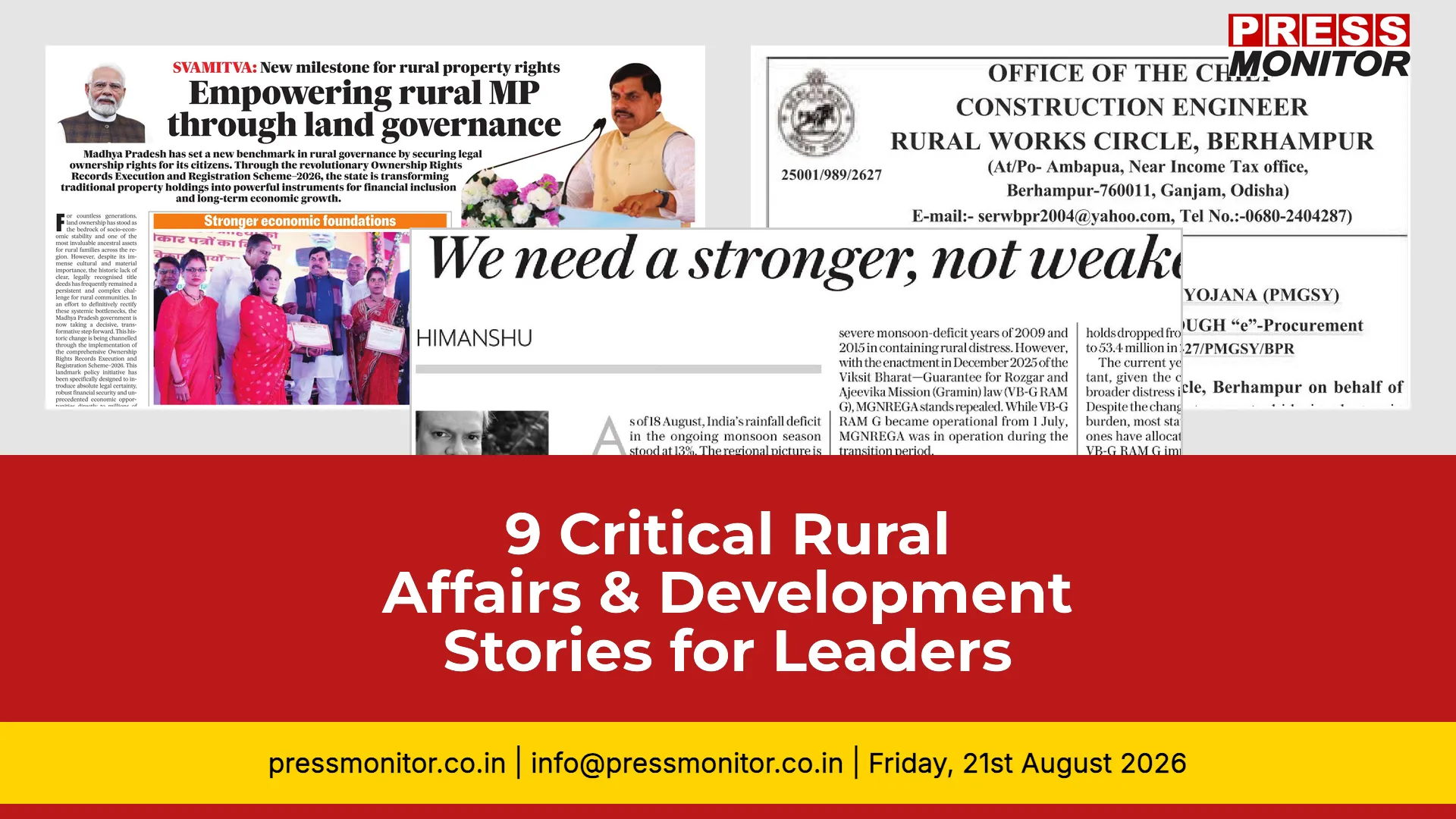
Rural Affairs & Development are shifting rapidly. Tracking the pulse of India’s hinterland requires precise print media monitoring. This press review distills today’s most impactful developments in infrastructure, policy, and finance into actionable media intelligence.
1. Madhya Pradesh Land Ownership Rights Scheme
A front-page report in Free Press Journal says Madhya Pradesh has launched the Ownership Rights Records Execution and Registration Scheme-2026, granting legally recognized ownership rights to rural citizens and removing financial barriers. The initiative builds on the MITVA and SVAMITVA schemes, using drone-based mapping to create accurate land records and enabling access to bank credit.
Why it matters: Formalizing informal assets unlocks institutional credit for millions.
Key detail: The state waived stamp duty and registration fees, using drone-based mapping to issue legal titles under the SVAMITVA framework.
Source: Free Press Journal
Next step: Monitor bank adoption rates for collateralized lending.
2. PMGSY-IV Road Projects Launch in Odisha
A front-page report in Indian Express says the Odisha State Rural Road Agency invites competitive bids for constructing roads and bridges across ten packages in Kandhamal under PMGSY-IV, with a total cost of Rs 7.66 crore, including five-year maintenance.
Why it matters: Last-mile connectivity directly impacts agricultural supply chains and market access.
Key detail: Ten packages worth Rs 7.66 crore awarded for roads and bridges in Kandhamal district, including five-year maintenance clauses.
Source: Indian Express
Next step: Track contractor registrations and completion timelines.
3. India's Job Guarantee Scheme Weakens
A front-page report in Mint says that work generated under India’s rural employment guarantee programme was falling for years before it was redesigned but this July's number, the first since its rejig, has been particularly low.
Why it matters: Declining MGNREGA days signal shifting rural distress patterns and budget reallocation needs.
Key detail: July figures mark the first post-rejig drop, highlighting implementation gaps ahead of peak monsoon demand.
Source: Mint
Next step: Assess regional allocation adjustments for Q3.
4. Sujalam Bharat ID to Modernise Rural Water Supply
A front-page report in The Pioneer says Sujalam Bharat seeks to organise information around common digital identifiers, standardised metadata and interoperable registries to support the transition towards utility-based, data-driven rural water governance.
Why it matters: Interoperable registries are critical for utility-scale water governance and leak reduction.
Key detail: The initiative standardizes metadata and digital identifiers to transition rural water management toward data-driven operations.
Source: The Pioneer
Next step: Watch for state-level integration pilots.
5. Centre to Expand Mechanised Sanitation Scheme
A front-page report in The Hindu says the Social Justice Ministry proposes expanding the NAMASTE scheme to rural India with an outlay of Rs 498.73 crore. The initiative aims to eradicate sewer and septic tank deaths by mechanising sanitation work and supporting workers with capital subsidies. However, the National Commission for Scheduled Castes has flagged a high rate of application rejections for these subsidies.
Why it matters: Eradicating manual scavenging deaths requires capital subsidies and mechanization adoption.
Key detail: NAMASTE gets Rs 498.73 crore outlay, though the National Commission for Scheduled Castes flags high subsidy rejection rates.
Source: The Hindu
Next step: Review grievance redressal mechanisms for applicants.
6. Govt Pushes for Standardized Farm Financing
“A front-page report in Mint says the government has asked public sector banks and the Indian Banks’ Association to develop a standard loan product and uniform documentation for contract farming, including financing for farm machinery, within 6-12 months. The proposed framework envisages an anchor buyer or processor tie-up, with buyer payments routed through an escrow account with a defined waterfall. It would include sub-limits for input finance, procurement advances, warehouse receipt finance and processing capex. Lending decisions would be based on the reliability of the buyer's purchase agreement, rather than collateral,” according to two sources. The government also proposed that the SEPEs in India, IBA and Nabard are referenced to explore Credit Guarantee Fund and Trust for Micro and Small Enterprises, National.
Why it matters: Uniform loan products reduce friction in contract farming ecosystems and lower default risks.
Key detail: Public sector banks must develop escrow-backed frameworks within 6-12 months, shifting risk assessment from collateral to buyer reliability.
Source: Mint
Next step: Prepare compliance roadmaps for agri-finance desks.
7. India Post Innovates Mountain Post Offices with Drones
A front-page report in Tribune says India Post is deploying drones to accelerate mail and healthcare delivery to remote Himalayan and NE Indian villages, addressing repeated road and transport barriers. Each initiative targets Himachal Pradesh, Assam, and Arunachal Pradesh to ensure faster access to documents, medicine, and social benefits with safeguards.
Why it matters: Aerial logistics bypass Himalayan terrain barriers for healthcare and essential mail delivery.
Key detail: Deployments target Himachal Pradesh, Assam, and Arunachal Pradesh to accelerate medicine and document delivery.
Source: Tribune
Next step: Evaluate safety protocols and route scalability.
8. Laptop Voucher Scheme Faces Implementation Delays
A front-page report in Free Press Journal says around 26,000 more eligible students will receive a Rs 25,000 laptop voucher compared to last year, under India’s laptop scheme targeting Class 12 students scoring 75% or more. The government has mandated complete student and bank account details be uploaded to the BEMS portal, but delay persists due to incomplete rural district records amid post-advice updates.
Why it matters: Digital inclusion initiatives stall when rural district records lag behind central mandates.
Key detail: 26,000 additional Class 12 students eligible for Rs 25,000 vouchers, but BEMS portal uploads face administrative bottlenecks.
Source: Free Press Journal
Next step: Coordinate with state education boards for data cleanup.
9. Gen Z at Jantar Mantar Highlights Rural Unemployment
According to a front-page report in the Indian Express, after a month-long protest from Jantar Mantar to Parliament, Gen Z demonstrated a distinct organizational structure, unlike previous mass movements in India. The movement, lacking a central leader, utilized social media, campus unions, and student federations to mobilize, showing the state’s capacity to repress doesn’t automatically guarantee success. The protest was triggered by the NEET leak, but the underlying issues of systemic exam reform, job creation, and rural unemployment persist.
Why it matters: Youth mobilization underscores persistent structural job deficits outside metro hubs.
Key detail: Leaderless protests leverage campus networks to demand systemic exam reform and rural employment generation.
Source: Indian Express
Next step: Analyze demographic shifts in labor force participation.
Powered by rigorous print media monitoring, this analysis equips stakeholders with verified ground truth. How will your organization adapt to these shifting rural dynamics? Share your perspective below.