9 Essential Climate Disaster Stories for Policy Leaders


India's flood crisis demands urgent attention. According to Press Monitor's tracking of Indian publications, this media monitoring briefing covers 9 essential climate disaster stories that every policy leader must read today. From the Himalayan glacier collapse in Nepal to rising river levels across Uttar Pradesh, Bihar, Odisha, and Madhya Pradesh, these stories capture the full scope of the climate emergency unfolding across South Asia.
1. PM Modi Reviews Varanasi Flood Situation
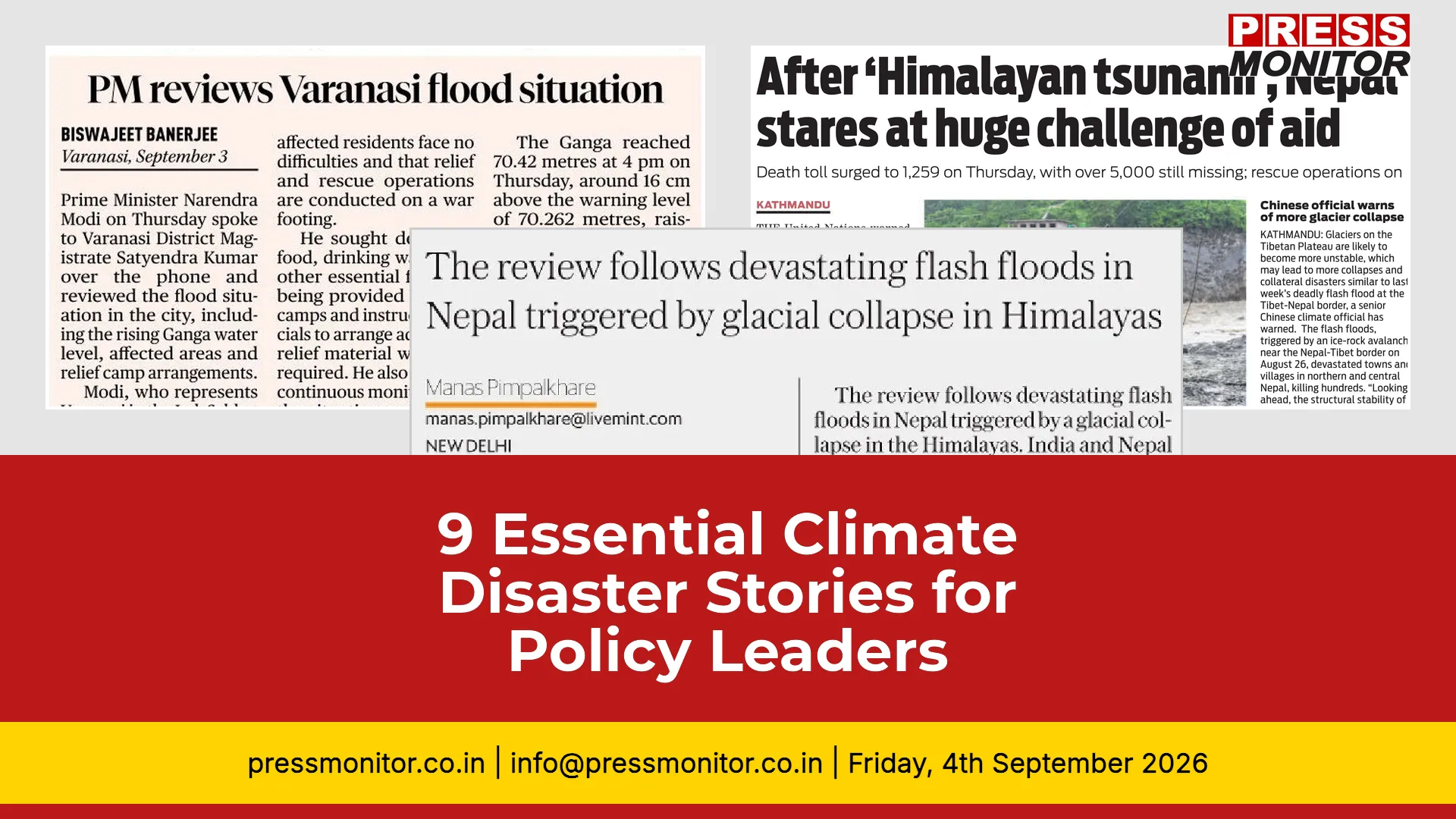
A front-page report in Millennium Post says Prime Minister Narendra Modi spoke to Varanasi District Magistrate Satyendra Kumar on Thursday to review the flood situation in the city, including the rising Ganga water level, affected areas, and relief camp arrangements. He directed the administration to ensure affected residents face no difficulties and that relief and rescue operations are conducted on a war footing. The Ganga reached 70.42 metres at 4 pm on Thursday, around 16 cm above the warning level of 70.262 metres, raising concerns in low-lying areas.
Prime Minister Narendra Modi reviewed the flood situation in Varanasi on Thursday as the Ganga river crossed danger levels. Six Indian publications tracked his telephone conversation with District Magistrate Satyendra Kumar, covering water levels, relief camp arrangements, and essential facilities for affected families. The Ganga reached 70.42 metres at 4 pm, around 16 cm above the warning level of 70.262 metres, raising concerns in low-lying areas. Authorities said 29 villages and wards were affected, displacing 2,900 people, while around 16,000 have been evacuated across Uttar Pradesh.
Why it matters: The Prime Minister's direct engagement signals the severity of the Varanasi flood situation and the need for coordinated relief.
Next step: District administration must ensure relief camps are fully operational before the next rainfall cycle.
2. Nepal Flood Death Toll Rises to 1,259
A front-page report in Morning Standard says the United Nations warned of immense challenges reaching Nepal flood survivors after a catastrophic glacial mountain collapse on August 26. At least 1,259 people have been killed and over 5,600 are missing along the China-Nepal border, with more than 800 foreigners from 34 countries among those unaccounted for. Rescue operations are underway using cargo drones and porters as destroyed roads isolate Himalayan communities.
Five Indian and international outlets reported the United Nations warning on immense challenges reaching Nepal flood survivors after the catastrophic glacial mountain collapse on August 26. At least 1,259 people have been killed and over 5,600 are missing along the China-Nepal border, with more than 800 foreigners from 34 countries among those unaccounted for. Rescue operations are underway using cargo drones and porters as destroyed roads isolate Himalayan communities.
Why it matters: The scale of the Nepal disaster and the number of foreign nationals missing underscore the need for international coordination.
Next step: International coordination on glacial monitoring must be accelerated before the next monsoon season.
3. India Reviews Glacial Flood Alerts
A front-page report in Mint says the Indian government reviewed its readiness for glacial lake outburst floods following a catastrophic glacier collapse in Nepal that killed over one thousand two hundred people. Chaired by Union home secretary Govind Mohan, the meeting brought together central agencies and state officials to strengthen early warning systems, monitor vulnerable lakes across Himalayan borders, and improve evacuation protocols. Experts recommend enhanced monitoring as recent studies show floods cause roughly sixty-seven percent of India’s natural disaster-related economic losses.
Mint reported that the Indian government reviewed its readiness for glacial lake outburst floods following a catastrophic glacier collapse in Nepal that killed over one thousand two hundred people. Chaired by Union Home Secretary Govind Mohan, the meeting brought together central agencies and state officials to strengthen early warning systems, monitor vulnerable lakes across Himalayan borders, and improve evacuation protocols. Experts recommend enhanced monitoring as recent studies show floods cause roughly sixty-seven percent of India's natural disaster-related economic losses.
Why it matters: The government's proactive review of GLOF preparedness could save lives in Himalayan states vulnerable to similar events.
Next step: Himalayan states must fast-track the National Glacial Lake Outburst Flood Risk Mitigation Programme.
4. 373 Villages Inundated in Odisha
A front-page report in The Hindu says that 373 villages were inundated by floods across Balasore, Jajpur and Mayurbhanj districts in north Odisha. The Subarnarekha river affected 214 villages in Balasore, 62 in Jajpur and 97 in Mayurbhanj, and about 35,740 people were evacuated from Balasore.
The Hindu reported that 373 villages were inundated by floods across Balasore, Jajpur and Mayurbhanj districts in north Odisha. The Subarnarekha river affected 214 villages in Balasore, 62 in Jajpur and 97 in Mayurbhanj, and about 35,740 people were evacuated from Balasore alone.
Why it matters: The scale of inundation in Odisha highlights infrastructure vulnerability in eastern India's flood-prone river basins.
Next step: State disaster management teams should prioritise embankment repairs in the Subarnarekha basin.
5. Madhya Pradesh Floods
A front-page report in Morning Standard says that on Thursday heavy rain caused flooding in Madhya Pradesh rivers, affecting Vindhya, Bundelkhand and Mahakoshal. In Bundelkhand, Panna and Chhatarpur saw river flooding, with families moved to camps and schools closed in Chhatarpur, while Sidhi faced a landslide and damaged road connectivity. The weather department issued a red alert for very heavy rain in Damoh and Tikamgarh, orange alerts for thirteen central Madhya Pradesh districts, and the Bargi Dam opened five gates to release excess Narmada River water.
Heavy rain caused flooding in Madhya Pradesh rivers, affecting Vindhya, Bundelkhand and Mahakoshal. In Bundelkhand, Panna and Chhatarpur saw river flooding, with families moved to camps and schools closed in Chhatarpur, while Sidhi faced a landslide and damaged road connectivity. The weather department issued a red alert for very heavy rain in Damoh and Tikamgarh, orange alerts for thirteen central Madhya Pradesh districts, and the Bargi Dam opened five gates to release excess Narmada River water.
Why it matters: Central India is experiencing flooding outside the typical flood belt, signaling changing rainfall patterns.
Next step: State authorities should pre-position relief materials in flood-prone Bundelkhand districts.
6. 40 Workers Survive Nepal Tunnel Flood
A front-page report in Times of India says that 40 workers trapped inside the Upper Trishuli Hydropower Project tunnel survived a flood on August 26 after a vehicle blocked the tunnel mouth. The workers escaped through mud and water in a two-and-a-half-hour ordeal and were later moved to an army camp in Nuwakot by Nepal army personnel.
Times of India reported that 40 workers trapped inside the Upper Trishuli Hydropower Project tunnel survived a flood on August 26 after a vehicle blocked the tunnel mouth. The workers escaped through mud and water in a two-and-a-half-hour ordeal and were later moved to an army camp in Nuwakot by Nepal army personnel.
Why it matters: The survival story highlights both the dangers of Himalayan infrastructure projects and the importance of emergency protocols.
Next step: Hydropower project safety protocols must be reviewed for extreme weather scenarios in the Himalayan region.
7. 20,000 Houses to Rebuild After Nepal Floods
A front-page report in Hindustan Times says Nepal will have to rebuild around 20,000 houses in flood-ravaged areas after a glacier collapse on 26 August sent a deluge of ice, rock and mud through the border region with China. Authorities estimate 7,500 houses were completely destroyed and at least 1,252 people were killed in the catastrophe, with rescuers still searching for workers trapped in tunnels linked to hydropower projects.
Hindustan Times reported that Nepal will have to rebuild around 20,000 houses in flood-ravaged areas after a glacier collapse on 26 August sent a deluge of ice, rock and mud through the border region with China. Authorities estimate 7,500 houses were completely destroyed and at least 1,252 people were killed in the catastrophe, with rescuers still searching for workers trapped in tunnels linked to hydropower projects.
Why it matters: The reconstruction challenge is enormous and will require sustained international aid and domestic coordination.
Next step: International aid agencies should coordinate with Nepal's reconstruction authority on housing and infrastructure.
8. 13 Districts Flooded in Bihar
A front-page report in Morning Standard says the flood situation in Bihar worsened as major rivers crossed danger marks, inundating thirteen districts and disrupting life across the state. Chief Minister Samrat Choudhary reviewed the Ganga water level in Patna and directed officials to take evacuation and safety measures. Water Resources Department officials said the Ganga, Sone, Punpun, Kosi, Gandak, Burhi Gandak, Bagmati and Ghaghara were flowing above danger levels.
Morning Standard reported that the flood situation in Bihar worsened as major rivers crossed danger marks, inundating thirteen districts and disrupting life across the state. Chief Minister Samrat Choudhary reviewed the Ganga water level in Patna and directed officials to take evacuation and safety measures. Water Resources Department officials said the Ganga, Sone, Punpun, Kosi, Gandak, Burhi Gandak, Bagmati and Ghaghara were flowing above danger levels.
Why it matters: Bihar is one of India's most flood-prone states and the expanding scope of flooding demands elevated preparedness.
Next step: Bihar's flood response teams should activate pre-positioned relief assets in the most affected districts.
9. Five Killed in Heavy Rains Across India
A front-page report in Millennium Post says heavy rains across several Indian states on Thursday killed five people in Uttar Pradesh, pushed the Ganga River toward its highest flood mark in Bihar, and triggered landslides in Himachal Pradesh. The floods also disrupted road and rail services in West Bengal.
Millennium Post reported heavy rains across several Indian states on Thursday killed five people in Uttar Pradesh, pushed the Ganga River toward its highest flood mark in Bihar, and triggered landslides in Himachal Pradesh. The floods also disrupted road and rail services in West Bengal. Five people were killed in separate rain-related incidents in the districts of Chitrakoot, Amethi and Barabanki.
Why it matters: Multi-state flooding on a single day illustrates the widespread nature of the current climate emergency.
Next step: Multi-state coordination on early warnings and evacuation must be strengthened ahead of the peak monsoon period.
These nine stories, tracked through print media monitoring by Press Monitor, provide a press review of the day's most important news on climate disasters across South Asia. This media intelligence underscores the urgent need for climate adaptation and disaster preparedness. What steps is your organisation taking to prepare for the next extreme weather event?