9 Essential Cybersecurity Stories for IT Leaders


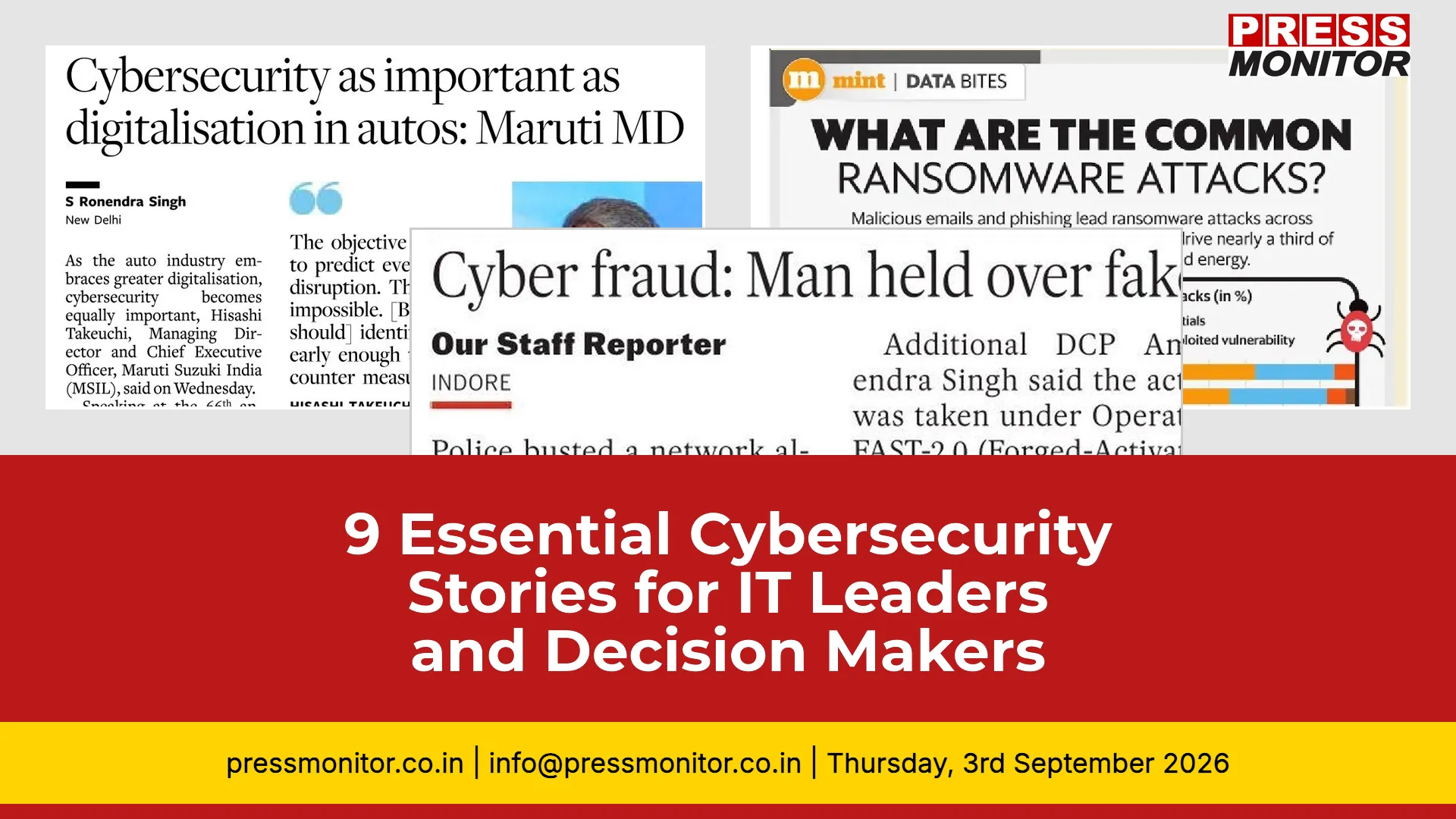
According to Press Monitor's tracking of Indian publications, today's cybersecurity landscape demands constant vigilance. This press review covers 9 essential stories on news on cybersecurity that every IT leader must read. From ransomware surges to AI-powered threats and government policy shifts, these developments shape the future of information security across India.
1. Maruti Suzuki Warns of Rising Auto Cyber Threats
A front-page report in Business Line says cybersecurity is becoming as important as digitalisation in the automobile industry, according to Maruti Suzuki India Managing Director and Chief Executive Officer Hisashi Takeuchi. Speaking at the 66th annual convention of the Automotive Component Manufacturers Association in New Delhi, he warned that hackers are becoming more sophisticated and companies must stay one step ahead with robust contingency plans. He cited recent cyber attacks on Jaguar Land Rover and Suzuki Motorcycle India that disrupted plant operations, and said government initiatives such as the Production Linked Incentive scheme and the India Semiconductor Mission are building capabilities in critical areas.
Why it matters: The auto industry is a growing target for hackers as vehicles become more connected.
Key detail: Hisashi Takeuchi, MD and CEO of Maruti Suzuki India, warned that hackers are becoming more sophisticated and companies must stay one step ahead with robust contingency plans. He cited recent cyber attacks on Jaguar Land Rover and Suzuki Motorcycle India that disrupted plant operations.
Source: Business Line, New Delhi, 2 September
Next step: Auto companies should invest in supply chain security and incident response capabilities.
2. Ransomware Attacks Surge Across Sectors
A front-page report in Mint says that malicious emails and phishing are leading ransomware attacks across most sectors, while compromised credentials drive nearly a third of attacks in distribution, healthcare and energy.
Why it matters: Ransomware continues to be the most disruptive cyber threat for businesses of all sizes.
Key detail: Malicious emails and phishing are leading ransomware attacks across most sectors, while compromised credentials drive nearly a third of attacks in distribution, healthcare, and energy.
Source: Mint, Delhi, 2026-09-03
Next step: Organizations should strengthen email security, enforce MFA, and conduct regular phishing simulations.
3. 151 Fake SIMs Exposed in Cyber Fraud Ring
A front-page report in Free Press Journal says Indore police have arrested a man for his alleged role in a cyber fraud network that used fake SIM cards. The action was taken under Operation FAST-2.0, based on data from the Indian Cyber Crime Coordination Centre and the Ministry of Home Affairs, after 151 suspected fake SIM cards linked to 49 SIM sellers were identified. The cards were used in 21 financial fraud complaints across the country, and police are searching for three more suspects.
Why it matters: Telecom-based fraud is escalating, with fake SIM cards enabling large-scale financial crimes.
Key detail: Indore police arrested a man for his alleged role in a cyber fraud network using 151 fake SIM cards linked to 49 SIM sellers, used in 21 financial fraud complaints across the country. Police are searching for three more suspects.
Source: Free Press Journal, Mumbai, 2026-09-03
Next step: Telecom operators and banks must enhance SIM verification and fraud detection systems.
4. Google Cloud CISO Shares AI Security Insights
A front-page report in Financial Express says, Daryl Pereira, head of the Office of the Chief Information Security Officer, Asia-Pacific, Google Cloud, shares insights on AI-led cyber threats, emphasizing that owning advanced AI models isn’t necessarily the best defense. He advocates for well-engineered, environment-fine-tuned harnesses and smaller, specialized models for effective cybersecurity.
Why it matters: AI is reshaping cybersecurity defense, but owning advanced models is not enough.
Key detail: Daryl Pereira, head of the Office of the Chief Information Security Officer, Asia-Pacific at Google Cloud, emphasized that well-engineered, environment-fine-tuned harnesses and smaller, specialized models are more effective than generic large AI models.
Source: Financial Express, Delhi, 2026-09-03
Next step: Security teams should evaluate specialized AI models for their specific threat landscapes.
5. Government Must Prepare for AI-Assisted Cyber Attacks
A front-page report in Morning Standard says, Home minister Saifuddin Nasution Ismail on Wednesday emphasized that the government must be fully prepared to deal with AI-assisted cyber attacks. "When criminals change how they commit crime, we must change how we protect," Ismail said, calling Gen AI the biggest change in cybersecurity.
Why it matters: Generative AI is transforming the threat landscape, requiring new government preparedness strategies.
Key detail: Home Minister Saifuddin Nasution Ismail stated, "When criminals change how they commit crime, we must change how we protect," calling Gen AI the biggest change in cybersecurity.
Source: Morning Standard, New Delhi, 2026-09-03
Next step: Government agencies must accelerate AI-driven threat detection and cross-sector collaboration.
6. Anthropic and Google Launch New AI Models
A front-page report in Free Press Journal says chief scientist Jakub Pachocki has disputed characterisations of an architectural change while acknowledging that chain-of-thought monitoring remains fragile. Anthropic has launched Claude Fable 5.1 and Claude Mythos 5.1, claiming leading coding and scientific research benchmarks while cutting typical workload prices by around 25%, with sensitive cybersecurity and biology uses of Mythos restricted to vetted users. Google has introduced Gemini 3.8 Flash and the cybersecurity-focused Gemini 3.8 Flash Cyber through Fairwind, alongside agentic video understanding for Gemini 3.7 Flash that it says cuts token consumption by up to 88% and costs by up to 66% while improving accuracy by up to 7%.
Why it matters: New AI models are introducing cybersecurity-focused capabilities that could reshape defense strategies.
Key detail: Anthropic launched Claude Fable 5.1 and Claude Mythos 5.1 with typical workload prices cut by around 25%. Google introduced Gemini 3.8 Flash and the cybersecurity-focused Gemini 3.8 Flash Cyber through Fairwind.
Source: Free Press Journal, Mumbai, 2026-09-03
Next step: Enterprises should evaluate these new models for security operations and threat intelligence.
7. OpenAI, Anthropic, Google Unveil AI Models
A front-page report in Free Press Journal says OpenAI, Anthropic and Google have unveiled next-generation artificial intelligence models, sharpening competition in reasoning, coding, cybersecurity and content creation. OpenAI said its upcoming model Astra became the first to reach the "Critical" cybersecurity capability tier, having discovered two genuine zero-day vulnerabilities during an internal evaluation. Anthropic launched Claude Fable 5.1 and Claude Mythos 5.1 with typical workload prices cut by around 25%, while Google introduced Gemini 3.8 Flash and cybersecurity-focused Gemini 3.8 Flash Cyber, reigniting a debate over AI safety and oversight.
Why it matters: The AI arms race is extending into cybersecurity, with models now capable of finding zero-day vulnerabilities.
Key detail: OpenAI's upcoming model Astra became the first to reach the Critical cybersecurity capability tier, having discovered two genuine zero-day vulnerabilities during an internal evaluation.
Source: Free Press Journal, Mumbai, 2026-09-03
Next step: Organizations must prepare for AI-driven vulnerability discovery and faster patch cycles.
8. Delhi to Appoint Data Protection Officers
A report in The Statesman says the Delhi government will designate Data Protection Nodal Officers in every department and issue detailed standards for handling personal information as it begins implementing the Digital Personal Data Protection (DPDP) Act, 2023. The measures were discussed at a workshop organised by the Information Technology Department of the Government of NCT of Delhi with the National e-Governance Division and the Ministry of Electronics and Information Technology at the Delhi Secretariat. Information Technology Minister Pankaj Kumar Singh said protecting the personal data citizens submit through services such as ration cards and caste certificates is the government's responsibility.
Why it matters: India's data protection framework is strengthening with concrete implementation steps.
Key detail: The Delhi government will designate Data Protection Nodal Officers in every department and issue detailed standards for handling personal information as it implements the Digital Personal Data Protection Act, 2023.
Source: The Statesman, Delhi, 2 September
Next step: Organizations should prepare for compliance with the DPDP Act and designate their own data protection officers.
9. IIT Madras Launches 100-Hour Multicloud Training Program
A front-page report in New Indian Express says IIT Madras Pravartak Technologies Foundation has launched a 100-hour multicloud training program with SWAYAM Plus to build industry-ready talent in cloud computing and cybersecurity. The program covers Amazon Web Services, Microsoft Azure, and Google Cloud Platform, and includes cloud security concepts.
Why it matters: India faces a significant cybersecurity talent gap that training programs like this aim to address.
Key detail: IIT Madras Pravartak Technologies Foundation launched a 100-hour multicloud training program with SWAYAM Plus, covering Amazon Web Services, Microsoft Azure, and Google Cloud Platform, including cloud security concepts.
Source: New Indian Express, Chennai, 2026-09-03
Next step: Enterprises should partner with academic institutions to build a pipeline of cybersecurity talent.
This media intelligence roundup demonstrates why print media monitoring remains indispensable for tracking the fast-evolving cybersecurity landscape in India. As threats grow more sophisticated, staying informed through trusted sources like Press Monitor ensures organizations can respond proactively. What cybersecurity development concerns you most this week?