9 Essential Delivery Services Stories for Logistics Leaders


India's delivery services and logistics sector is undergoing a rapid transformation, from quick commerce dominance to festival-season hiring surges and global workforce restructuring. This press review of 9 stories, drawn from print media monitoring and media intelligence across Indian publications, reveals how e-commerce, quick commerce, and last-mile delivery are reshaping the economy. According to Press Monitor's tracking of Indian publications, these developments define the news on delivery services and logistics for the week.
1. India's E-commerce Market to Triple to $345 Billion
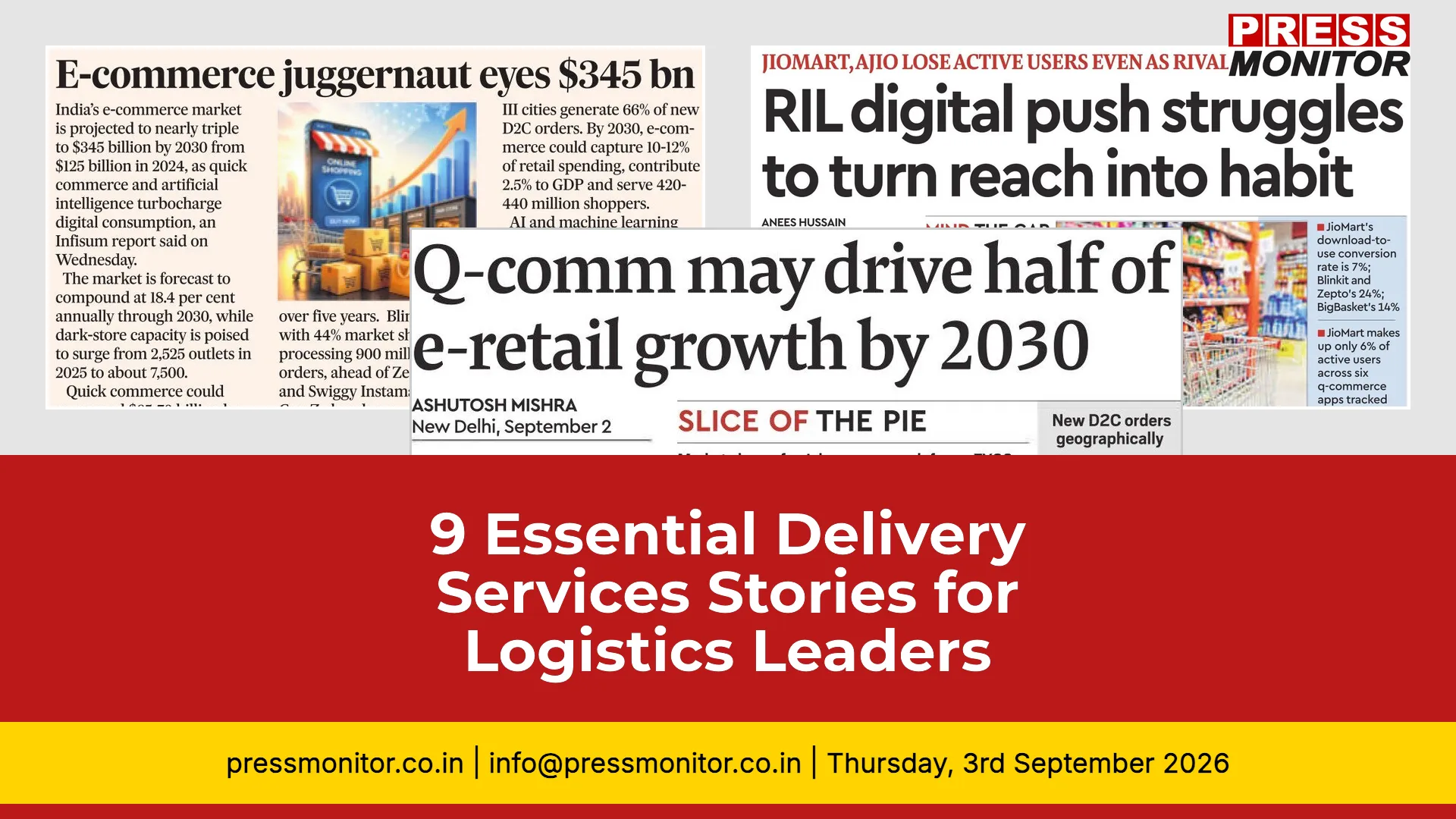
A front-page report in Free Press Journal says India's e-commerce market is projected to nearly triple to $345 billion by 2030 from $125 billion in 2024, as quick commerce and artificial intelligence turbocharge digital consumption. The Infisum report forecasts 18.4 per cent annual growth through 2030, with Blinkit leading quick commerce at 44% market share, ahead of Zepto at 25% and Swiggy Instamart at 20%. By 2030, e-commerce could capture 10-12% of retail spending, contribute 2.5% to GDP and serve 420-440 million shoppers.
Why it matters: The Infisum report 'Smart Growth in a Fast Market' projects India's e-commerce sector will nearly triple to $345 billion by 2030, with quick commerce and AI as primary growth engines. Key detail: Blinkit leads quick commerce at 44% market share, ahead of Zepto (25%) and Swiggy Instamart (20%). Dark stores will expand from 2,525 to 7,500. By 2030, e-commerce could capture 10-12% of retail spending and contribute 2.5% to GDP, serving 420-440 million shoppers. Source: Free Press Journal. Next step: Logistics and delivery platforms should align capacity plans with the projected 18.4% annual growth. How is your organization preparing for this scale?
2. JioMart and Ajio Lose Active Users While Rivals Expand
A front-page report in Financial Express says Reliance Retail's digital platforms JioMart and Ajio have lost weekly active users this year while rivals Blinkit, Zepto and Myntra expanded their bases. JioMart lost 17 lakh weekly active users and Ajio 15 lakh, whereas Blinkit added 1.34 crore and Myntra 68 lakh, according to a CLSA report citing Sensor Tower data. Only about 7% of JioMart's 13.24 crore downloads convert into weekly users, against 24% for Blinkit and Zepto, highlighting Reliance's struggle to turn reach into regular habits.
Why it matters: Reliance Retail's digital platforms JioMart and Ajio are losing weekly active users even as competitors Blinkit, Zepto, and Myntra expand their bases. Key detail: JioMart lost 17 lakh weekly active users and Ajio 15 lakh, while Blinkit added 1.34 crore and Myntra 68 lakh. Only 7% of JioMart's 13.24 crore downloads convert to weekly users, against 24% for Blinkit and Zepto. Source: Financial Express. Next step: Delivery and quick-commerce platforms should study the retention gap as a benchmark for their own user engagement strategies.
3. Quick Commerce to Drive 45-50% of E-Retail Growth
A front-page report in Financial Express says quick commerce is set to become a major engine of India’s e-commerce growth, contributing 45-50% of incremental e-retail growth over the next five years as the segment value expands to an estimated $65-70 billion by 2030, according to a report by research consultancy Infisum.
Why it matters: Quick commerce is set to become the dominant engine of India's e-commerce growth, contributing 45-50% of incremental e-retail growth over the next five years. Key detail: The segment value is projected to reach $65-70 billion by 2030. Source: Financial Express. Next step: Logistics leaders should invest in dark store networks and instant delivery infrastructure to capture this growth.
4. Amazon Expands Workforce for Festival Season
A front-page report in Business Standard says Amazon India is expanding its workforce to strengthen fulfilment and logistics capabilities for the festival season. Opportunities in Tier-II and Tier-III cities now account for nearly 55 per cent of gig jobs on the platform.
Why it matters: Amazon India is scaling its workforce to strengthen fulfilment and logistics for the festival season, with Tier-II and Tier-III cities accounting for nearly 55% of gig jobs. Key detail: This signals a strategic shift toward smaller-city delivery networks. Source: Business Standard. Next step: Delivery platforms and logistics firms should evaluate similar tier-city expansion strategies.
5. Uber Slashes 3,300 Jobs in Global Restructuring
A front-page report in Business Standard says that Uber Technologies is cutting about 3,300 roles, or 10 per cent of its staff globally, in a massive restructuring aimed at reducing management layers and reallocating spending into its ride-sharing, delivery and robotaxi businesses.
Why it matters: Uber Technologies is cutting about 3,300 roles, or 10% of its global staff, to reduce management layers and reallocate spending into ride-sharing, delivery, and robotaxi businesses. Key detail: The restructuring signals a strategic pivot toward delivery and autonomous mobility. Source: Business Standard. Next step: Delivery and logistics stakeholders should monitor how Uber's reallocation affects competition in the last-mile segment.
6. Bids Invited for Courier & Transport Services in Rajasthan
A front-page report in Times of India says bids for providing courier and transport services for delivering printed materials in Rajasthan and outside are invited from interested bidders up to 5:00 PM dated 22/09/2026.
Why it matters: The Rajasthan government is inviting bids for courier and transport services for delivering printed materials, signaling continued demand for physical logistics even in a digital-first economy. Key detail: Bids are open until 22 September 2026. Source: Times of India. Next step: Logistics firms should consider this as a government procurement opportunity.
7. Retail Evolution in India: From Kirana to Quick Commerce
A front-page report in Business Standard says how economic liberalisation transformed the retail landscape in India from traditional kirana stores to quick commerce, highlighting the rise of global retailers and the influence of ecommerce.
Why it matters: Economic liberalisation has transformed India's retail landscape from traditional kirana stores to quick commerce, with global retailers and e-commerce reshaping consumer behaviour. Key detail: This evolution underpins the entire delivery services ecosystem. Source: Business Standard. Next step: Understanding this retail evolution is essential for any logistics or delivery strategy in India.
8. Festival Demand Boosts Hiring in E-commerce and Logistics
A front-page report in Business Standard says that with the festival season around the corner, ecommerce, quick-commerce, and logistics firms are ramping up hiring to meet a longer demand period.
Why it matters: E-commerce, quick-commerce, and logistics firms are ramping up hiring ahead of the festival season to meet extended demand. Key detail: Seasonal hiring is a critical indicator of sector confidence. Source: Business Standard. Next step: Workforce planning teams should align hiring timelines with festival demand cycles.
9. Swiggy Partners with Hero MotoCorp for Vehicle Ownership
A front-page report in Business Standard says Swiggy riders can select their preferred Hero model on the Swiggy app to avail exclusive pricing at Hero dealerships, and have access to customised and lucrative financing solutions.
Why it matters: Swiggy riders can now select preferred Hero MotoCorp models on the Swiggy app for exclusive pricing and customised financing at Hero dealerships. Key detail: This partnership addresses the vehicle ownership challenge for delivery riders, a critical pain point in last-mile logistics. Source: Business Standard. Next step: Delivery platforms and vehicle manufacturers should explore similar models to improve rider retention and fleet efficiency.
These 9 stories, tracked through media monitoring of Indian print publications, show that delivery services and logistics are at the centre of India's economic transformation. From $345 billion e-commerce projections to rider welfare initiatives, the news on delivery services and logistics demands attention from every stakeholder. What will your strategy be for the next quarter?