9 Essential Forex and Currency Stories for Treasury Leaders


India's foreign exchange landscape is shifting rapidly. According to Press Monitor's tracking of Indian publications, a surge in reserves, aggressive bank borrowing, and policy reforms are reshaping currency markets. Here are 9 critical developments from today's print media that treasury and forex professionals need on their radar.
1. Forex Reserves Hit $716.9B — Highest in Six Months
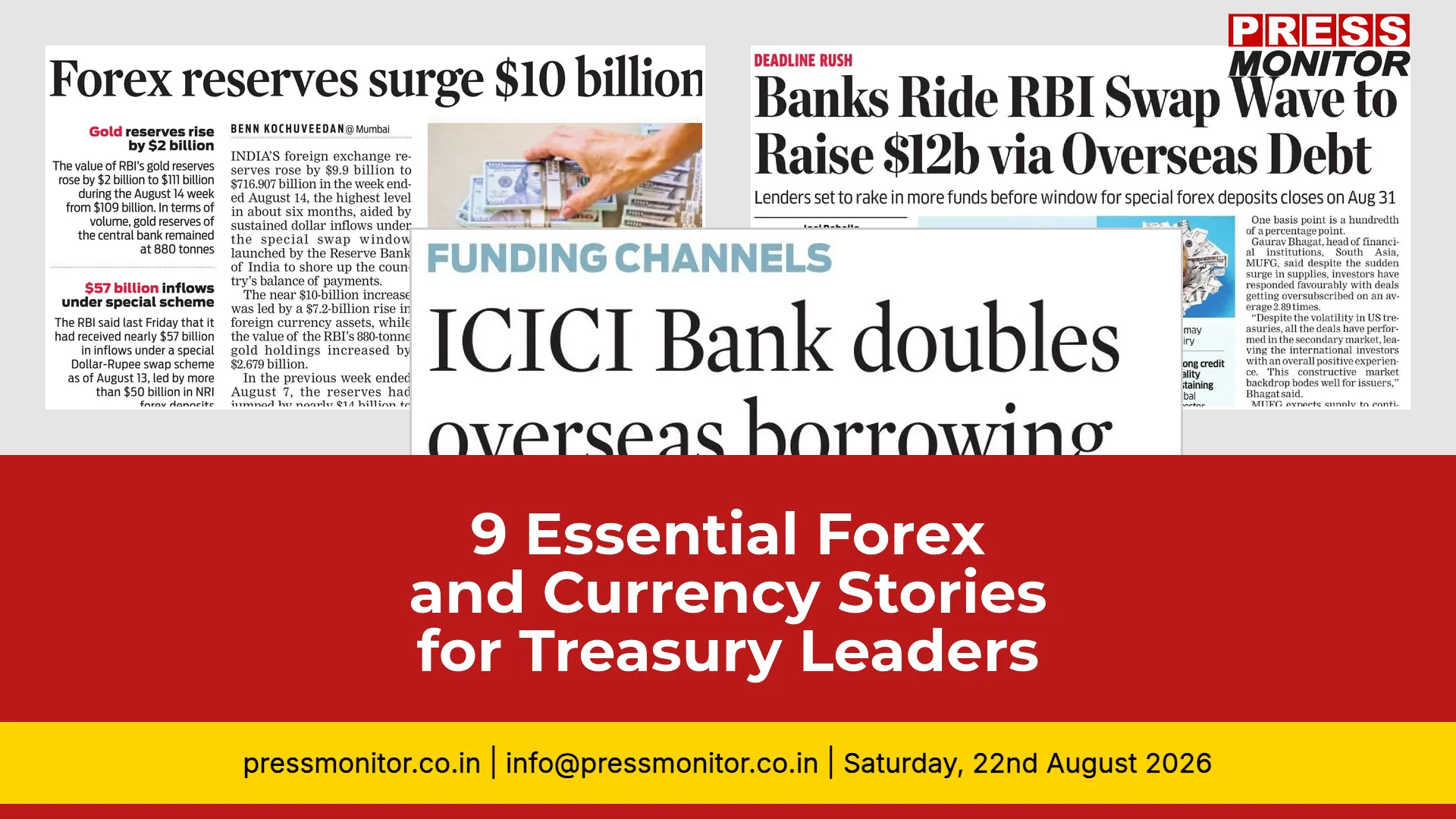
A front-page report in Morning Standard says India's foreign exchange reserves surged by nearly ₹9.9 billion to ₹7,169.07 billion as of August 14th, the highest in about six months. This rise was fueled by $57 billion in inflows under special forex schemes, driven by over $50 billion in NRI deposits. The Reserve Bank of India also announced gold reserves risen by ₹2.679 billion to ₹111 billion, alongside increases in foreign currency assets and a push from a recently announced USD-Rupee swap initiative.
Why it matters: India's forex buffer strengthens to $716.9 billion, a six-month high, driven by $57 billion in special forex scheme inflows and a rupee-dollar swap window. Gold reserves also rose. This cushion protects against global volatility.
Key detail: Reserves jumped $9.9 billion in a single week; cumulative rise since June is nearly $50 billion.
Source: Morning Standard.
Next step: Monitor RBI's swap window strategy and its impact on rupee stability.
2. Indian Banks Raise $12B Abroad via RBI Swap Facility
A front-page report in Economic Times says Indian banks have raised $12 billion abroad this year via the RBI’s one-time swap facility, with $17 billion total in 2026 on track to surpass $22 billion in 2021. This week was the busiest for forex debt issuance, as ICICI Bank, Kotak Mahindra Bank, IDFC First Bank, HDFC Bank and Bank of Baroda raised $4.4 billion to fund FCNR (B) deposits ahead of the August 31 deadline.
Why it matters: Banks are aggressively tapping overseas debt to fund FCNR(B) deposits before August 31 deadline. This week saw $4.4 billion from ICICI, Kotak, IDFC, HDFC, and Bank of Baroda.
Key detail: Total forex debt issuance in 2026 on track to surpass $22 billion.
Source: Economic Times.
Next step: Evaluate your bank's exposure to forex debt and swap window benefits.
3. ICICI Bank Doubles Overseas Borrowing Limit to $5B
A front-page report in New Indian Express says ICICI Bank has doubled its overseas borrowing limit to $5 billion to increase flexibility in raising funds. This move follows a trend where Indian banks have collectively raised $10 billion in foreign-currency debt since June.
Why it matters: ICICI Bank has doubled its overseas borrowing limit, signaling confidence in foreign currency fundraising. The bank has already raised $2 billion since July.
Key detail: This move follows a trend where Indian banks collectively raised $10 billion in foreign-currency debt since June.
Source: New Indian Express.
Next step: Assess how ICICI's expanded capacity affects lending rates and foreign currency availability.
4. Rupee Internationalisation Gets Policy Boost
A front-page report in Economic Times says that amendments to the Foreign Trade Policy will allow exporters to invoice and receive payments in Indian rupees, promoting rupee internationalisation in trade settlement. CII chairman Sanjay Budhia said industry welcomes the government’s continued efforts to simplify and strengthen India’s global trade competitiveness.
Why it matters: Amendments to the Foreign Trade Policy will allow exporters to invoice and settle in rupees, reducing dependency on the dollar. CII chairman Sanjay Budhia welcomes the move.
Key detail: The policy aims to make rupee a settlement currency for international trade, lowering transaction costs.
Source: Economic Times.
Next step: Exporters should prepare for rupee invoicing processes.
5. RBI Deputy Governor: Local Currencies to Play Bigger Role in Trade
A front-page report in Focus News says that Reserve Bank of India (RBI) Deputy Governor Rohit Jain has stated that the role of local currencies in cross-border trade and payments will increase in the future, reducing transaction costs, mitigating currency imbalances, and enhancing payment settlement efficiency.
Why it matters: RBI Deputy Governor Rohit Jain said local currencies will reduce transaction costs and mitigate currency imbalances. This complements the rupee internationalisation push.
Key detail: Expect enhanced payment settlement efficiency as local currency use expands.
Source: Focus News.
Next step: Corporates should evaluate currency risk management strategies for cross-border transactions.
6. CBDC Pilot Expands — Digital Rupee for DBT
A front-page report in Amar Ujala says that the central bank digital currency (CBDC) based direct benefit transfer (DBT) pilot in Gujarat, Puducherry, Chandigarh, and Dadra and Nagar Haveli has been successful. Now, it will be implemented in Uttar Pradesh, Delhi, Madhya Pradesh, Maharashtra, Jammu-Kashmir, Tamil Nadu, and Andhra Pradesh.
Why it matters: The central bank digital currency (CBDC) pilot for direct benefit transfers has been successful in four states and is now expanding to seven more including UP, Delhi, and Maharashtra.
Key detail: The pilot uses CBDC for food subsidy distribution, improving transparency and efficiency.
Source: Amar Ujala.
Next step: Watch for CBDC implementation in your state — it may change payment infrastructure.
7. Bond Yields Harden, Rupee Slips on Hawkish MPC, Rising Crude
A front-page report in Business Standard says bond yields hardened during the week as the Reserve Bank of India’s (RBI’s) decision to close the FCNR(B) swap window a month early and hawkish signals from the Monetary Policy Committee (MPC) minutes weighed on market sentiment. The rupee also came under pressure during the week on the back of rise in crude oil prices and month-end demand for dollar among importers.
Why it matters: The RBI’s closure of FCNR(B) swap window early, coupled with hawkish MPC minutes, pushed bond yields up. The rupee weakened with rising crude oil prices and month-end dollar demand.
Key detail: The 10-year yield rose amid tight liquidity expectations.
Source: Business Standard.
Next step: Hedge against rupee volatility using forward contracts if dollar exposure is high.
8. Forex Reserves Surge $50 Billion Since July
A front-page report in Economic Times says India’s foreign exchange reserves surged by nearly $50 billion since July as inflows swelled into the banks’ foreign currency non-resident bank (FCNR-B) following the Reserve Bank of India’s measures to attract dollars.
Why it matters: Cumulative inflows under RBI's swap window have swelled reserves by $50 billion, providing a strong buffer against global shocks.
Key detail: FCNR(B) deposits led by NRIs drove the surge, with $50+ billion in NRI deposits.
Source: Economic Times.
Next step: Plan forex hedging strategies considering the strength of reserves.
9. Iran-Iraq Push to Bypass Sanctions with National Currency Trade
A front-page report in Tribune says Iranian Parliament Speaker Mohammad Bagher Ghalibaf called for a plan to overcome sanctions and urged Iran and Iraq to conduct trade using national currencies. This follows US Treasury Secretary Scott Bessent's announcement of the toughest sanctions ever imposed on Tehran.
Why it matters: Iranian Parliament Speaker Ghalibaf calls for trade in national currencies with Iraq, following US sanctions. Could set precedent for de-dollarisation in West Asia.
Key detail: Iran seeks to circumvent the toughest sanctions ever imposed by the US.
Source: Tribune.
Next step: Companies with exposure to Iran or Iraq should monitor sanctions impact and alternative trade mechanisms.
Closing: Which of these forex developments will most affect your treasury strategy? Engage with us — tracked by Press Monitor's media monitoring of Indian print media. #Forex #CurrencyMarkets