9 Essential Geopolitics & International Relations Stories for Foreign Policy Analysts


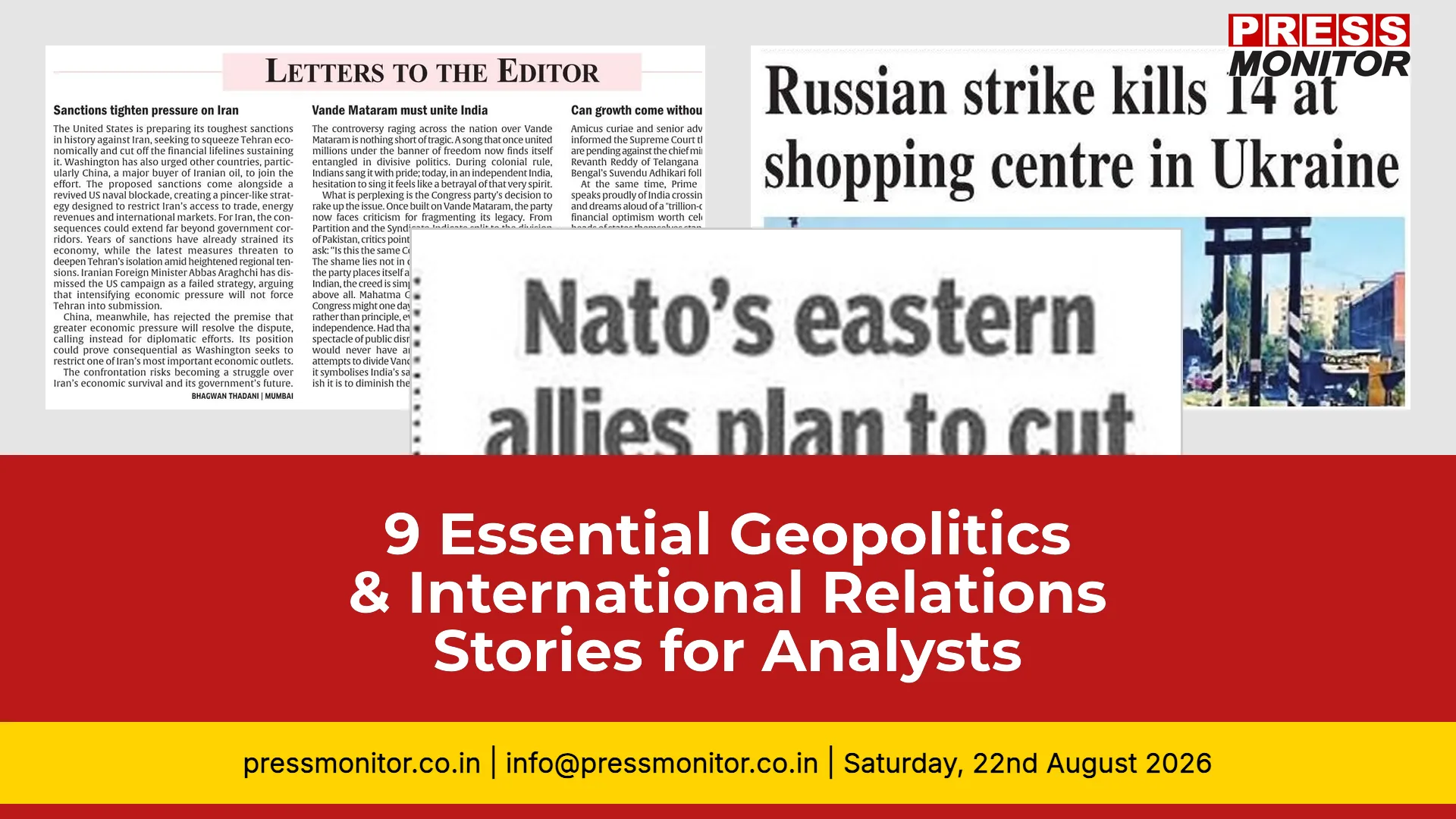
From escalating US-Iran tensions to shifting alliances in Asia, today's print media tracking reveals a week of high-stakes diplomacy and conflict. Here are the 9 most-covered stories, powered by Press Monitor's comprehensive print media monitoring of Indian publications.
1. US Prepares Toughest Sanctions Against Iran; China Urges Diplomacy
The United States is preparing its toughest sanctions in history against Iran, seeking to squeeze Tehran economically and cut off the financial lifelines sustaining it. Washington has also urged other countries, particularly China, a major buyer of Iranian oil, to join the effort. The proposed sanctions come alongside a revived US naval blockade, creating a pincer-like strategy designed to restrict Iran’s access to trade, energy revenues and international markets. For Iran, the consequences could extend far beyond government corridors. Years of sanctions have already strained its economy, while the latest measures threaten to deepen Tehran’s isolation amid heightened regional ten-sions. Iranian Foreign Minister Abbas Araghchi has dismissed the US campaign as a failed strategy, arguing that intensifying economic pressure will not force Tehran into submission.
Why it matters: The United States is preparing its most severe sanctions in history against Iran, aiming to collapse Tehran's economy and cut off oil revenues. Key detail: Washington's campaign includes secondary sanctions against allies and China, with Treasury chief Scott Bessent warning of 'economic D-Day'.
Source: Covered across 16 Indian dailies including The Pioneer, The Hindu, Times of India, and Economic Times. Next step: Monitor how India navigates its oil imports from Iran and growing US pressure.
2. 14 Killed in Russian Shopping Centre Strike in Ukraine
A front-page report in The Pioneer says Russian drones struck a shopping centre in Kryvyi Rih, Central Ukraine, on Friday, killing 14 people and wounding 91 others, including six children. President Volodymyr Zelenskyy described the attack as a double tap and called it a terrorist act.
Why it matters: A Russian drone strike on a shopping centre in Kryvyi Rih killed 14 and wounded 91, including children. Key detail: President Zelenskyy called it a 'double tap' terror act.
Source: The Pioneer. Next step: The attack underscores the ongoing humanitarian cost of the war and may influence Western aid decisions.
3. NATO Countries Offer to Foot More Bill for US Troops
A front-page report in Times of India says NATO countries are offering to cut costs for US troops stationed on their soil to discourage the Trump administration from reducing its military footprint there.
Why it matters: Allies are offering to cover costs to discourage the Trump administration from reducing military presence in Europe. Key detail: The offer comes amid NATO's desire to maintain deterrence against Russia.
Source: Times of India. Next step: This could reshape burden-sharing debates within the alliance.
4. US, South Korea Cut Short Military Drill as Conciliatory Gesture to North Korea
"A front-page report in The Pioneer says that the US and South Korean militaries wrapped up their annual drill six days earlier than initially scheduled on Friday in a conciliatory gesture toward North Korea, though the North said the step isn’t enough to persuade it to return to talks. Us President Donald Trump had earlier abruptly ordered the Pentagon to "substantially reduce" the Ulchi Freedom Shield exercise just before it began on Monday. Trump cited what he described as a good relationship with North Korean leader Kim Jong Un and South Korea’s refusal to support him over the war in Iran. South Korea's military said the Ulchi Freedom Shield, a command post exercise with the US, ended on Friday. This month's exercise was initially reportedly scheduled to be held in two phases for 11 days in simulation of North Korean attacks — the first part until Friday on defensive operations and the second part until August 27 on counteroffensive operations. North Korea is extremely sensitive to the second phase."
Why it matters: The annual Ulchi Freedom Shield exercise ended six days early after President Trump ordered a reduction. Key detail: North Korea said the move was insufficient to resume talks.
Source: The Pioneer. Next step: Expected impacts on inter-Korean diplomacy and regional security.
5. Britain Stands Firm Over Russia Drone War Warning
Britain’s response to Russia's latest warning influences the shape of the Ukraine war despite being a response to warnings. It marks a step towards Western countries shaping Ukraine's ability to take the war to Russia.
Why it matters: London's robust response shapes Western allies' stance on Ukraine's ability to strike Russian territory. Key detail: Britain is reportedly stepping up support despite Russian warnings.
Source: Statesman. Next step: Watch for escalation or diplomatic offramps.
6. Israel Strikes Syria After Turkey Military Move
A front-page report in Statesman says Israel acted against Syria's Abu al-Duhur airbase following undisclosed intelligence about Turkey's alleged military expansion in Syria. Yechiel Leiter accused Ankara of crossing red lines despite prior warnings.
Why it matters: Israel targeted Syria's Abu al-Duhur airbase over alleged Turkish military expansion. Key detail: Israeli officials accused Ankara of crossing red lines.
Source: Statesman. Next step: Potential further confrontation as Turkey asserts influence in Syria.
7. BRICS Summit: Putin to Visit India for High-Level Talks
A front-page report in Dainik Bhaskar says... रूसी राष्ट्रपति पुतिन 72-3 सितंबर को दिल्ली में होने वाले ब्रिक्स शिखर सम्मेलन में शामिल होने भारत आएंगे। इस दौरान भारत और रूस रक्षा सहयोग से जुड़े दो बड़े प्रस्तावों पर भी चर्चा होने की संभावना है।
Why it matters: Russian President Vladimir Putin will attend the BRICS summit in New Delhi in September. Key detail: India and Russia are expected to discuss two major defense cooperation proposals.
Source: Dainik Bhaskar. Next step: Strengthened India-Russia ties amid Western sanctions on Moscow.
8. India and Japan Sign Maritime Security Pact
A front-page report in The Pioneer says India and Japan signed a Memorandum of Arrangement on Maritime Security Cooperation in New Delhi on August 20, building on over $10 billion in agreements announced in July and setting a target of 10 trillion yen in Japanese investment over the coming decade.
Why it matters: A new Memorandum of Arrangement on Maritime Security Cooperation was signed in New Delhi. Key detail: It builds on $10 billion agreements and targets 10 trillion yen in Japanese investment.
Source: The Pioneer. Next step: Enhanced Quad cooperation in the Indo-Pacific.
9. India Describes Removal of Structures at Pakistan Mission as Proportionate Response
A front-page report in Indian Express says India described the dismantling of temporary structures outside the Pakistan High Commission in New Delhi as a proportionate action in response to Pakistani authorities removing some structures outside the Indian High Commission in Islamabad. The Ministry of External Affairs said the action followed a request for Pakistan not to remove the structures, which were then removed by a JCB machine, leaving rubble outside the mission.
Why it matters: India removed temporary structures outside Pakistan's High Commission after a similar Pakistani action. Key detail: The MEA called it a proportionate action under diplomatic norms.
Source: Indian Express. Next step: Bilateral tensions remain high; media intelligence suggests this could escalate further.
Which of these stories impacts your organisation most? Stay ahead with Press Monitor's daily press review service.