9 Essential Legal and Regulatory Stories for Legal Professionals


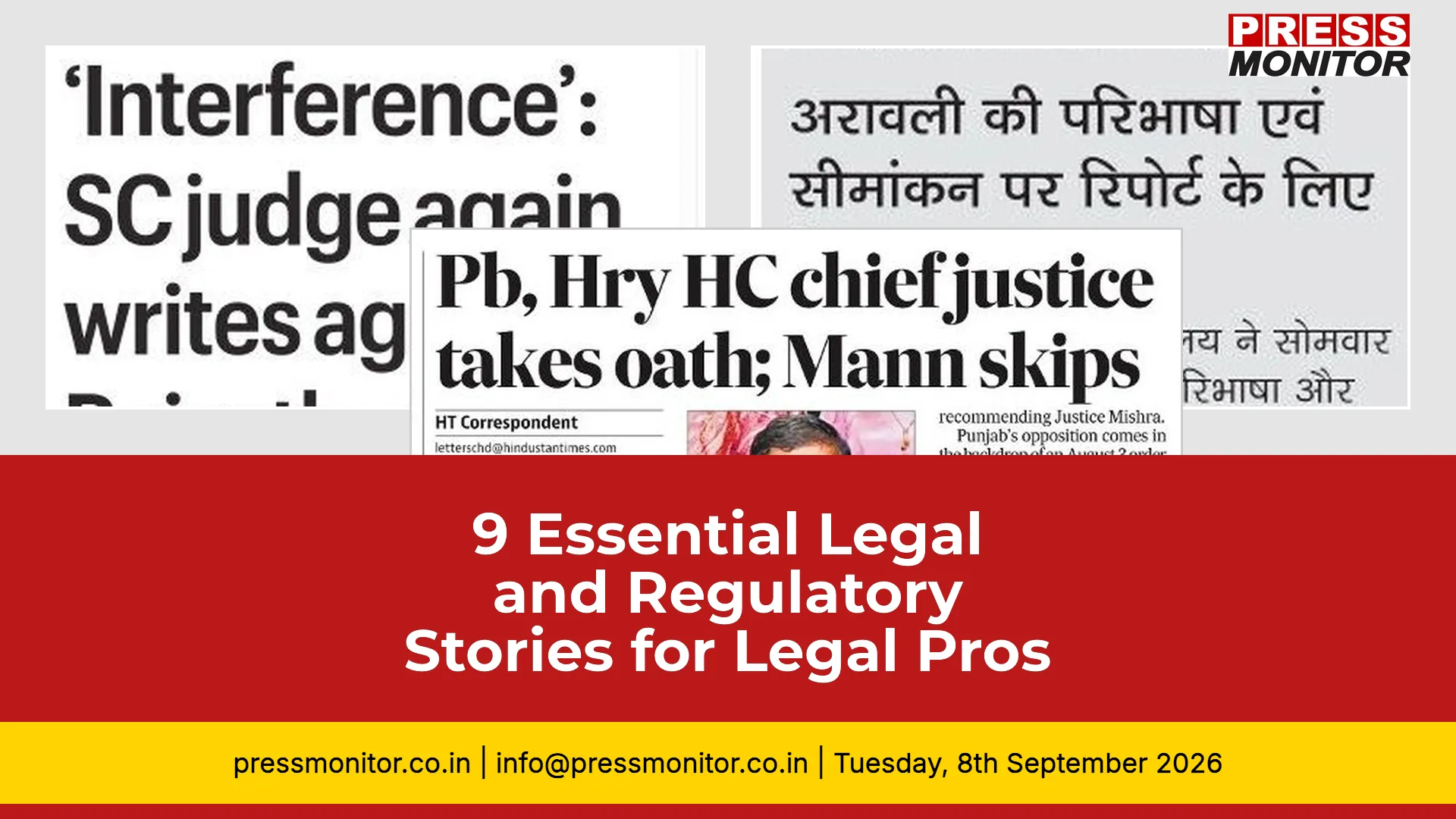
According to Press Monitor's tracking of Indian publications, this print media monitoring press review covers 9 essential legal and regulatory stories defining today's judicial and regulatory landscape. From Supreme Court rulings on corporate criminal liability to judicial independence disputes, these stories represent the most consequential news on legal and regulatory developments in India, offering media intelligence for professionals who need to stay ahead of judicial and regulatory shifts.
1. Justice Mehta's Fourth Letter Sparks Judicial Crisis
A front-page report in Indian Express says even as accusations against former acting Chief Justice of the Rajasthan High Court Sanjeev Prakash Sharma are being examined, a fourth letter by Supreme Court judge Justice Sandeep Mehta levelling fresh allegations against him has come to light. In the letter dated August 30 to Chief Justice of India Surya Kant, Justice Mehta claimed he has further information regarding arbitrary and high-handed acts of Justice Sharma. Justice Agarwal was sworn in as Chief Justice of the Rajasthan High Court on Monday, replacing Justice Sharma.
Why it matters: The fourth letter from Supreme Court Justice Sandeep Mehta accusing Rajasthan High Court acting Chief Justice Sanjeev Prakash Sharma of interference and corruption has escalated into a full-blown institutional crisis that threatens judicial independence.
Key detail: The letter dated August 30 was addressed to Chief Justice of India Surya Kant, alleging arbitrary rule changes, judicial interference in land disputes, and broader corruption at the Rajasthan High Court. Justice Sanjay Kumar Agarwal was sworn in as the new Chief Justice of Rajasthan High Court on Monday, replacing Sharma.
Source: Indian Express, New Indian Express, Free Press Journal, The Pioneer
Next step: Watch for the CJI's response and any further letters or inquiries that could deepen the crisis.
2. Supreme Court Rejects Aravalli Report Extension
A front-page report in Deshbandhu says the Supreme Court rejected the Aravalli hills delimitation committee's request for a February 2027 deadline, giving it only until 30 November to submit its report. The bench, led by Chief Justice Suryakant, noted the committee had sought extra time to accommodate the Chief Justice's retirement on 9 February. The committee, which cited the need to consult tribal communities in Rajasthan and Gujarat, must now submit its final report by the new deadline.
Why it matters: The Supreme Court's refusal to grant the Aravalli Hills delimitation committee a six-month extension signals urgency around environmental and tribal rights protections in Rajasthan and Gujarat.
Key detail: The committee must now submit its final report by 30 November, with the bench led by Chief Justice Suryakant warning of reconstitution if the deadline is missed. The committee cited the need to consult tribal communities in both states.
Source: Deshbandhu, Free Press Journal, First India
Next step: Monitor the committee's interim reports and the tribal consultation process for updates.
3. Punjab Government Skips Chief Justice Swearing-In
A front-page report in Hindustan Times says Kumar Mishra was sworn in as the chief justice of the Punjab and Haryana High Court on Monday despite opposition from Punjab chief minister Bhagwant Mann. The state government skipped the ceremony and objected to the appointment alleging it violated the Memorandum of Procedure by not awaiting state feedback. Justice Mishra subsequently warned the court would not be browbeaten by any tactics while hearing applications regarding pending dearness allowance payments ordered by the court.
Why it matters: Punjab Chief Minister Bhagwant Mann's decision to skip the oath ceremony for Justice Ashwani Kumar Mishra as Punjab and Haryana High Court Chief Justice raises fundamental constitutional questions about the separation of powers between the state and the judiciary.
Key detail: The Punjab cabinet passed an emergency resolution stating the Centre bypassed constitutional norms by appointing the Chief Justice without the state government's consent. Justice Mishra warned the court would not be browbeaten by any tactics while hearing applications regarding pending dearness allowance payments.
Source: Hindustan Times, Indian Express
Next step: Watch for further constitutional challenges and court responses to the appointment dispute.
4. Supreme Court Warns Assaulters Against Doctors in Maharashtra
A front-page report in Statesman says the Supreme Court voiced strong concern over repeated assaults on doctors in Maharashtra, observing that a set of people sharing the same ideology were allegedly involved in such incidents. A bench of Justice Vikram Nath and Justice Sandeep Mehta made the remarks while hearing a plea by Shiv Sena corporator Ramesh Sukrya Mhatre challenging the stringent conditions imposed by the Bombay High Court while granting him relief in the Dombivli assault case. The top court also took note of a fresh assault on doctors and hospital staff in Palghar and indicated it was inclined to cancel Mhatre's bail, with the case set for next hearing on 28 September.
Why it matters: The Supreme Court's strong concern over repeated assaults on doctors in Maharashtra, particularly the Shiv Sena corporator Ramesh Sukrya Mhatre case, signals the court's willingness to cancel bail and protect medical professionals from political violence.
Key detail: The bench of Justice Vikram Nath and Justice Sandeep Mehta noted a fresh assault on doctors and hospital staff in Palghar and indicated it was inclined to cancel Mhatre's bail. The case is set for hearing on 28 September.
Source: Statesman, Economic Times
Next step: Track the 28 September hearing outcome and the bail cancellation decision.
5. Supreme Court Rules Corporations Face Criminal Liability
A front-page report in Times of India says the Supreme Court held that companies can be convicted for criminal offences even when they cannot possess a guilty mind or face mandatory imprisonment, provided any jail term is substituted by a fine. The bench rejected Sanofi India's argument that prosecutions require an identified natural person, clarifying that corporate criminal liability remains intact under current Indian law. This judgment addresses allegations against Sanofi regarding pharmaceutical supplies to the Bhabha Atomic Research Centre where medicine procurement was allegedly inflated.
Why it matters: The Supreme Court's ruling that companies can be convicted for criminal offences even without a guilty mind or mandatory imprisonment has major implications for corporate compliance frameworks across India.
Key detail: The bench rejected Sanofi India's argument that prosecutions require an identified natural person, clarifying that corporate criminal liability remains intact under current Indian law. The case relates to allegations of inflated medicine procurement for Bhabha Atomic Research Centre.
Source: Times of India
Next step: Corporate legal teams should review compliance frameworks in light of this ruling.
6. Allahabad High Court Quashes NSA Detention
A front-page report in Hindustan Times says the Allahabad High Court has quashed the National Security Act detention of Delhi University graduate Akriti Chaudhary in Noida and directed the payment of Rs 2.5 lakh in compensation. The bench strongly criticised the district administration and police for issuing a retrospective arrest notice and relying on unproven WhatsApp records to justify her five-month preventive custody following violent workers' protests. The court also reprimanded law enforcement officials for bureaucratic overreach, reminding them that their primary allegiance must remain to the Constitution rather than the political executive, and warned against restricting peaceful protests based on mere speculation.
Why it matters: The Allahabad High Court's order quashing the National Security Act detention of Delhi University graduate Akriti Chaudhary and awarding Rs 2.5 lakh in compensation sets a significant precedent for protecting civil liberties against bureaucratic overreach.
Key detail: The bench strongly criticised the district administration and police for issuing a retrospective arrest notice and relying on unproven WhatsApp records to justify five months of preventive custody following violent workers' protests.
Source: Hindustan Times
Next step: Monitor similar NSA cases and potential compensation claims across the country.
7. Supreme Court Allows West Bengal Report on Sumit Roy
A front-page report in The Pioneer says the Supreme Court on Monday permitted the West Bengal government to file a detailed investigation report in a sealed cover regarding Sumit Roy, personal secretary to TMC leader Abhishek Banerjee, in the Salboni land-grab case. The court extended Roy's protection from arrest until the next hearing while it hears his appeal challenging the Calcutta High Court's denial of pre-arrest bail.
Why it matters: The Supreme Court permitting the West Bengal government to file a detailed investigation report in a sealed cover regarding Sumit Roy, personal secretary to TMC leader Abhishek Banerjee, keeps political accountability in focus amid ongoing legal proceedings.
Key detail: The court extended Roy's protection from arrest until the next hearing while it hears his appeal challenging the Calcutta High Court's denial of pre-arrest bail in the Salboni land-grab case.
Source: The Pioneer
Next step: Watch for the sealed report's contents and the next hearing date in the appeal.
8. Supreme Court Overturns Child Rape Conviction
A front-page report in Free Press Journal says the Supreme Court acquitted a man previously convicted of raping a five-year-old girl on Monday. Justices Sandeep Mehta and Manmohan ruled that both the trial court and Rajasthan High Court made grave errors by affirming the conviction on allegedly unreliable evidence. The bench emphasised that criminal trials must prioritise uncovering the truth over mere adversarial contests.
Why it matters: The Supreme Court's acquittal of a man previously convicted of raping a five-year-old girl underscores the judiciary's commitment to prioritizing truth over procedural finality in criminal trials.
Key detail: Justices Sandeep Mehta and Manmohan ruled that both the trial court and Rajasthan High Court made grave errors by affirming the conviction on allegedly unreliable evidence, emphasising that criminal trials must prioritise uncovering the truth over mere adversarial contests.
Source: Free Press Journal
Next step: This ruling may influence how evidence standards are applied in future criminal appeals across India.
9. Supreme Court Suspends Life Sentence of NSCN Official
A front-page report in Statesman says the Supreme Court on Monday suspended the life sentence of Hopeson Ningshen, a former lieutenant colonel of the National Socialist Council of Nagaland (Isak-Muivah), after he spent more than 17 years in jail. The two-judge bench granted conditional suspension and directed him to remain within Delhi until his appeal is disposed of. The court cited his long incarceration in the 2009 abduction and murder of three government officials in Manipur.
Why it matters: The Supreme Court's conditional suspension of the life sentence of Hopeson Ningshen, a former NSCN lieutenant colonel who spent over 17 years in jail, raises critical questions about prolonged pre-trial detention in northeastern India.
Key detail: The two-judge bench granted conditional suspension and directed Ningshen to remain within Delhi until his appeal is disposed of, citing his long incarceration in the 2009 abduction and murder of three government officials in Manipur.
Source: Statesman
Next step: Monitor the appeal proceedings and potential broader implications for Naga conflict-related detainees.
Closing: Which of these nine rulings will have the most lasting impact on India's legal and regulatory framework? Share your thoughts in the comments and stay tuned to Press Monitor for daily updates on Indian print media coverage of legal and regulatory developments.