9 Essential Space & Aerospace Stories for Industry Leaders


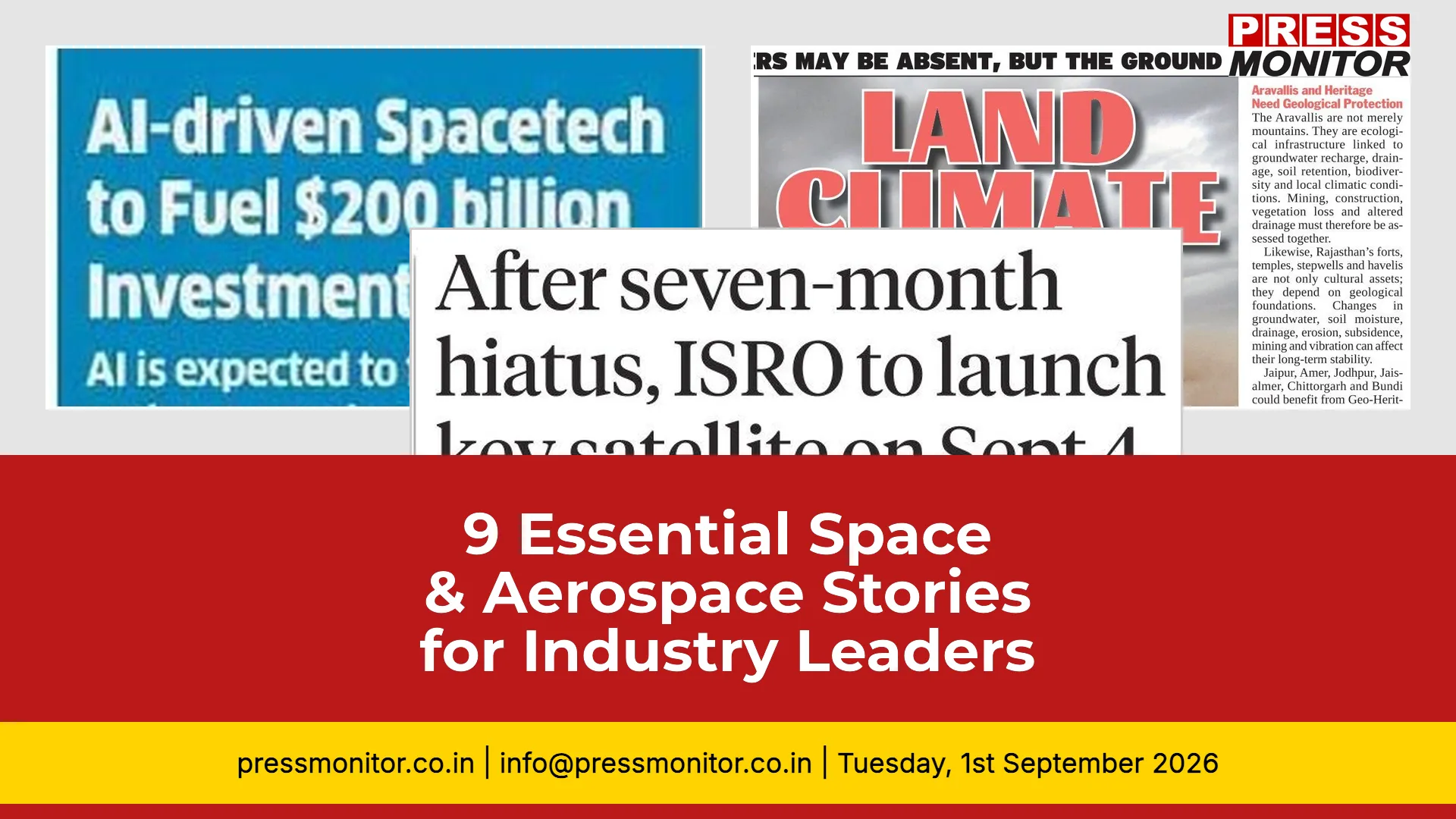
India's space and aerospace sector is accelerating at an unprecedented pace. From ISRO's upcoming satellite launch to private rocket milestones and radiation-shielding breakthroughs, these stories define the week. According to Press Monitor's tracking of Indian publications, here are the top developments shaping the industry — powered by comprehensive media monitoring and media intelligence.
1. Cheaper Space Access Drives Sector Growth
“Cheaper access to space, reusable rockets, autonomous spacecraft and growing commercial investment are among the factors driving the sector's growth,” a front-page report in the Economic Times says. The report highlights how innovations in space technology are becoming more accessible, fueling a surge in investment and potentially transforming industries. This development could lead to significant advancements in areas such as satellite communications, space exploration, and resource management. The trends point to a future where space travel and exploration are more commonplace.
Why it matters: Lower costs and reusable rockets are opening new frontiers. Key detail: The Economic Times reports that autonomous spacecraft and growing commercial investment are fueling a surge in the space sector.
Source: Economic Times front-page. Next step: Watch for increased startup activity and satellite deployments.
2. Rajasthan Needs Urgent Land and Disaster Monitoring System
A front-page report in First India highlights Rajasthan’s critical need for a Desert Dynamics Monitoring System using satellite and ground data to track land degradation, erosion, vegetation loss, and natural hazards such as sandstorms and flash floods. Climate resilience efforts must shift focus from mere sapling planting to recovery of native vegetation, soil carbon sequestration, and integrated risk management for geography, rivers, and cultural heritage.
Why it matters: Satellite data can mitigate desertification and natural hazards. Key detail: First India reports a critical need for a Desert Dynamics Monitoring System using satellite and ground data.
Source: First India front-page. Next step: Policymakers should explore public-private partnerships for satellite-based monitoring.
3. ISRO's EOS-O5 Satellite Launch Set for September 4
A front-page report in The Indian Express says that the earth observation satellite EOS-O5 will be launched via GSLV Fl7 on September 4 at 02:55 am from Sriharikota. This will end the space agency’s seven-month-long hiatus since the last failed launch — PSLV-C62 Mission — in January this year.
Why it matters: Ends a seven-month hiatus after a failed launch. Key detail: Indian Express reports the launch via GSLV Fl7 at 02:55 am from Sriharikota.
Source: Indian Express front-page. Next step: Track launch success for future mission confidence.
4. AstroRad Vest Shields Astronauts Against Radiation
A front-page report in The Hindu says a new vest developed by StemRad and Lockheed Martin could reduce the radiation dose received by astronauts by up to sixty percent during solar storms. The vest offers a lighter shield for the chest, abdomen, and pelvis, and NASA has successfully tested it on the Artemis I mission.
Why it matters: Critical for long-duration missions to Mars and beyond. Key detail: The Hindu reports the vest, developed by StemRad and Lockheed Martin, reduces radiation dose by up to 60% during solar storms.
Source: The Hindu front-page. Next step: Evaluate vest for future crewed missions.
5. NASA Launches Powerful Space Telescope
A front-page report in Deshbandhu says: NASA has successfully launched its new powerful space telescope 'Nancy Grace Roman' to explore dark energy, black holes, and the universe's mysteries. This mission aims to discover if life exists beyond Earth on other planets.
Why it matters: The Nancy Grace Roman telescope will explore dark energy and exoplanets. Key detail: Deshbandhu reports the launch aims to discover if life exists beyond Earth.
Source: Deshbandhu front-page. Next step: Follow first images and data releases.
6. Bacteria Could Survive on Moon
A front-page report in Jansatta says that NASA scientists have discovered some bacteria and fungi capable of surviving on the moon's surface. This discovery raises concerns about the potential impact on future manned missions to the moon.
Why it matters: Raises planetary protection concerns for lunar missions. Key detail: Jansatta reports NASA scientists found bacteria and fungi that could survive on the moon's surface.
Source: Jansatta front-page. Next step: Update sterilization protocols for lunar landers.
7. India's Deep-Tech Firm Deploys Optical Link in NZ
Selon Free Press Journal, Wireless Technologies, in partnership with New Zealand-Australia regional partner 9Rayz, has deployed a Free-Space Optical Communication (FSOC) link across Auckland’s Waitemata Harbour, showcasing India-developed optical wireless technology in an international setting. FSOC enables high-capacity data transmission through highly directional beams of light without physical fibre, making it useful for waterways, remote areas, difficult terrain and temporary networks. The deployment also involves researchers at The University of Auckland, including Dr. Nicholas Indian Deep-Tech Rattenbury, who leads research into free-space optical communications. The project — provides researchers an opportunity to study the technology in real-world conditions. Hardik Soni, Co-Founder and CTO of Nav Wireless Technologies, said the initiative demonstrates India’s engineering capabilities and its potential to develop globally relevant communication technologies. Falgun Patel, Director of 9Rayz, said the deployment will help assess how FSOC can address connectivity challenges across New Zealand and Australia.
Why it matters: Showcases Indian optical wireless technology globally. Key detail: Free Press Journal reports Nav Wireless Technologies deployed FSOC across Auckland's harbour with partner 9Rayz.
Source: Free Press Journal. Next step: Monitor FSOC for broadband connectivity solutions in challenging terrains.
8. India's Vikram-l Rocket Launch: Private Space Milestone, Funding Challenges Remain
“A launch is a single afternoon. What matters is what follows,” Prime Minister Modi stated after India’s Skyroot Aerospace successfully launched the Vikram-l rocket from Sriharikota in July 2O26. This marks India’s third instance of a private company independently designing, building, and flying a rocket into orbit, following the United States and China. Despite this achievement, the sector faces a critical funding gap, with concerns raised about the ability to sustain growth and compete with global players like SpaceX, highlighting the need for increased domestic capital investment.
Why it matters: India's third private orbital launch, but funding gaps persist. Key detail: Millennium Post reports Skyroot Aerospace's Vikram-l launch, with PM Modi noting the need for sustained investment.
Source: Millennium Post. Next step: Track government initiatives for private space funding.
9. NASA Astronaut Evaluates AstroRad Vest on ISS
A NASA astronaut evaluated the AstroRad vest onboard the International Space Station in 2022. The vest is designed to provide radiation protection for astronauts during long-duration missions. This testing helps determine the vest’s effectiveness and suitability for future space exploration endeavors.
Why it matters: Real-world testing validates radiation protection for long missions. Key detail: The Hindu reports an astronaut tested the vest on the ISS in 2022, assessing its effectiveness.
Source: The Hindu. Next step: Follow further ISS tests and commercialization.
Which of these developments will most impact your organization? Share your thoughts. This press review is brought to you by Press Monitor — your trusted source for Indian print media monitoring.