9 Essential Water Stories for Infrastructure Leaders


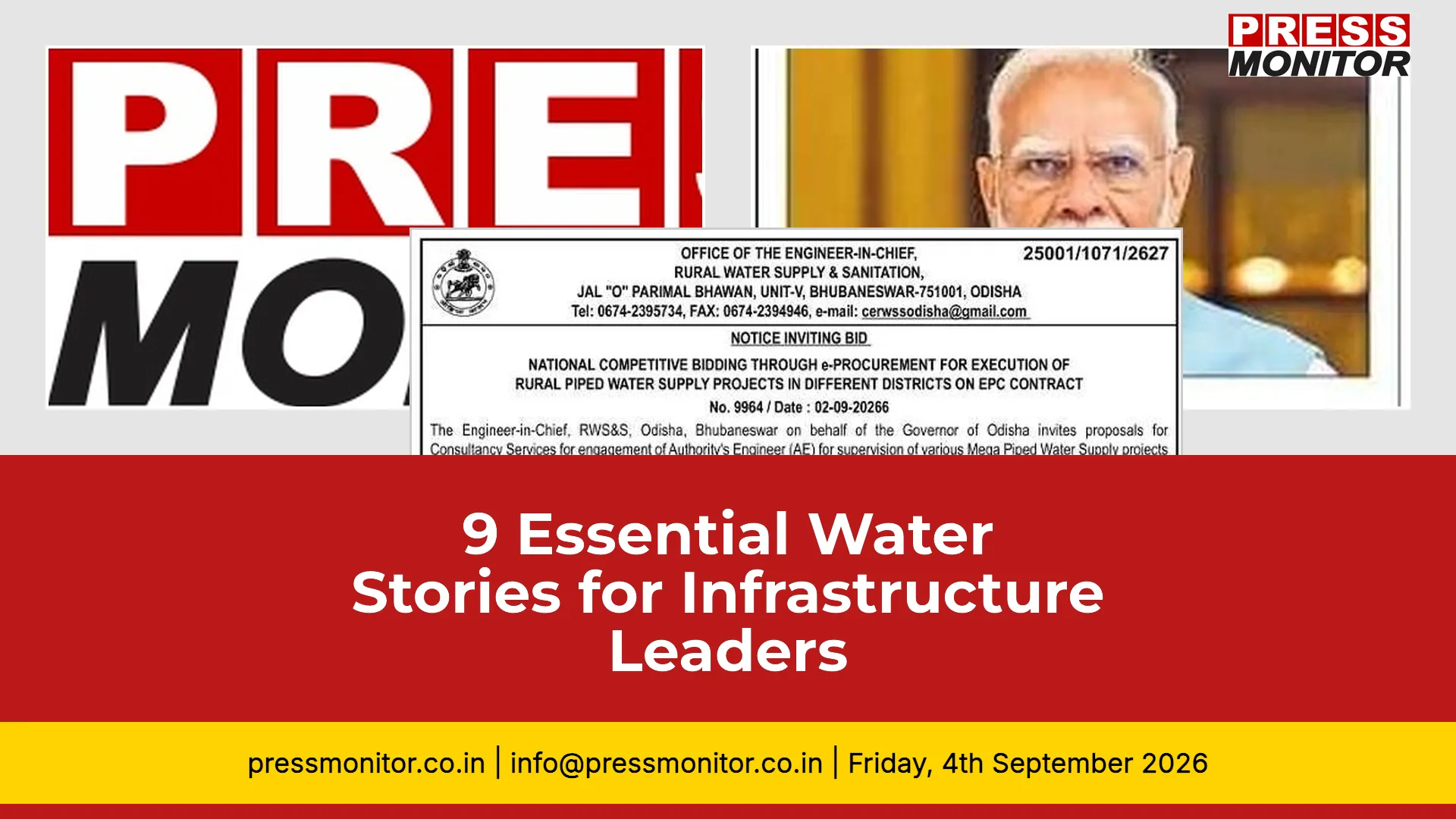
According to Press Monitor's tracking of Indian publications, today's media monitoring reveals nine essential developments in India's water and wastewater sector. This media intelligence report delivers the press review your team needs — covering policy summits, infrastructure tenders, and judicial outcomes that define the news on water infrastructure. From the Delhi court granting bail in the DJB STP tender scam to PM Modi's meeting with fourteen state water ministers, these are the stories that will shape the sector this week.
1. Satyendar Jain Granted Bail in DJB STP Tender Case
A front-page report in Statesman says a Delhi court granted bail on Thursday to Aam Aadmi Party leader and former Delhi minister Satyendar Jain in a corruption case involving alleged irregularities in the tendering of sewage treatment plant projects of the Delhi Jal Board. Special Judge Digvinay Singh directed Jain's release on a personal bond of Rs 2 lakh and two sureties of the same amount. Jain was arrested by the Anti-Corruption Bureau on August 18 along with four others in the case, which was registered on May 11, 2024, following a complaint by the Delhi government's Directorate of Vigilance alleging large-scale irregularities and criminal conspiracy in contracts for augmentation and upgradation of Delhi Jal Board sewage treatment plants.
Why it matters: The Delhi Jal Board sewage treatment plant tender scam case took a significant turn as former Delhi minister Satyendar Jain was granted bail. The court noted the 27-month gap between FIR and arrest raised questions about the investigation's thoroughness, impacting public trust in water sector procurement.
Key detail: Bail granted on Rs 2 lakh personal bond with two sureties of like amount. Five other accused remain in judicial custody. The case involves alleged criminal conspiracy in contracts for augmentation and upgradation of Delhi Jal Board sewage treatment plants.
Source: Statesman, New Delhi
Next step: Watch for the court's detailed order and the September 5 hearing for remaining accused. Stakeholders in water infrastructure should monitor how this ruling affects future tender transparency.
2. Modi Meets 14 States Water Ministers
A front-page report in Hindustan Times says Prime Minister Narendra Modi held a meeting with water resources ministers from fourteen BJP-ruled states in New Delhi on Thursday. The meeting focused on water conservation, revival of water bodies, and improved use of technology in water management as part of the Viksit Bharat campaign. Modi called for better management of water-related data using artificial intelligence, wider use of water-saving technologies, and greater use of treated wastewater for agriculture.
Why it matters: Prime Minister Narendra Modi convened water resources ministers from fourteen BJP-ruled states for a meeting focused on water conservation, revival of water bodies, and technology-driven water management under the Viksit Bharat campaign. This signals a coordinated national approach to water policy.
Key detail: Fourteen states represented; discussions centered on AI-powered water data management, wider use of water-saving technologies, and greater use of treated wastewater for agriculture. A 25-to-50-year water resource planning horizon was proposed.
Source: Hindustan Times, New Delhi
Next step: States will now coordinate on long-term water management frameworks. Utility leaders should prepare for potential policy shifts in water pricing and technology adoption.
3. Odisha Invites Bids for Rural Water Supply Projects
A front-page report in Hindustan Times says that the Office of the Engineer-in-Chief, Rural Water Supply and Sanitation in Odisha is inviting proposals for consultancy services for the engagement of the Authority's Engineer for supervision of mega piped water supply projects. The invitation is part of a national competitive bidding through e-procurement for execution of rural piped water supply projects in different districts on an EPC contract. The notice was issued on two September two thousand twenty-six and is available on the e-procurement portal.
Why it matters: The Government of Odisha has issued a national competitive bidding tender for rural piped water supply projects across multiple districts under EPC contract. This is a major infrastructure opportunity for engineering and water sector firms.
Key detail: The Engineer-in-Chief of Rural Water Supply and Sanitation in Odisha is inviting consultancy proposals for Authority Engineers to supervise mega piped water supply projects. E-procurement portal active from September 2 to October 9, 2026.
Source: Hindustan Times, Bhubaneswar
Next step: Engineering firms should prepare eligibility documents for the standard bidding window. Water infrastructure contractors should monitor the e-procurement portal for tender documents.
4. Jal Shakti Issues Himachal Pradesh Water Repair Tender
A front-page report in The Hindu says the Jal Shakti Ministry has invited electronic tenders from eligible contractors for restoring rain-damaged water supply networks across multiple blocks in Himachal Pradesh’s Kullu district. The projects, spanning sub-divisions like Nirmand, Showad, and Dalash, carry estimated costs ranging from Rs 43 lakh to Rs 65 lakh, with completion deadlines set at six months. Contractors must submit their bids through the state tender portal by 9 September 2026.
Why it matters: The Jal Shakti Ministry has invited electronic tenders for restoring rain-damaged water supply networks across multiple blocks in Himachal Pradesh's Kullu district. This is a time-sensitive opportunity for civil engineering contractors.
Key detail: Projects span sub-divisions including Nirmand, Showad, and Dalash with estimated costs between Rs 43 lakh and Rs 65 lakh each. Six-month completion deadline; bids due by September 9, 2026.
Source: The Hindu, Kullu
Next step: Civil engineering contractors enrolled with the division should submit bids through the state tender portal immediately. Delays could mean missing the monsoon recovery window.
5. EIB Funds Uttarakhand Water and Sanitation Project
A front-page report in Times of India says the Urban Development Department of the Government of Uttarakhand has received financing from the European Investment Bank for the Uttarakhand Water and Sanitation Project. The Uttarakhand Urban Sector Development Agency invites online bids through the state e-procurement portal for water supply works in Kashipur and Rudrapur towns. Bids must be submitted by late October 2026 with documents available from early October.
Why it matters: The European Investment Bank has financed the Uttarakhand Water and Sanitation Project, signaling international confidence in India's urban water infrastructure. This opens opportunities for water supply contractors in the state.
Key detail: The Urban Development Department of Uttarakhand invites online bids for water supply works in Kashipur and Rudrapur towns. Bid submission deadline is late October 2026; documents available from early October.
Source: Times of India, New Delhi
Next step: Water infrastructure contractors should monitor the state e-procurement portal for tender documents. International firms with EIB experience may find partnership opportunities.
6. Clean Water Brings Hope to Kidney Patients in Andhra Pradesh
A front-page report in Free Press Journal says the completion of a forty-nine point ninety-four crore rupee drinking water project under the Jal Jeevan Mission—Amarajeevi Jaldhara program is bringing hope to kidney disease patients in A. Konduru mandal of NTR district. Deputy Chief Minister Pawan Kalyan prioritized the project after the 2024 elections, and it was completed within twenty-six months using nearly one hundred thirty kilometres of pipeline and twelve overhead tanks to supply treated Krishna water to around seventy-five thousand people, each receiving fifty-five litres of safe drinking water daily.
Why it matters: A forty-nine point ninety-four crore rupee drinking water project under the Jal Jeevan Mission has been completed in A. Konduru mandal of NTR district, bringing safe drinking water to 75,000 people. This demonstrates the impact of targeted water infrastructure investment.
Key detail: Around 75,000 people now receive 55 litres of safe drinking water daily from treated Krishna water. The project used nearly 130 km of pipeline and twelve overhead tanks, completed within twenty-six months.
Source: Free Press Journal, A. Konduru
Next step: Similar piped water projects should be replicated across other drought-affected mandals. Public health officials should monitor water quality outcomes in the target communities.
7. Rajasthan PHED Tender for Water Supply Pump Components
A front-page report in Statesman says online tenders are invited on behalf of the Governor of Rajasthan for the replacement of non-face water supply pump set components and switchyard components at Sri Mohangarh month supply project phase-l. The estimated cost is Rs 24,75,75,48,35,00.00 with an earnest money of Rs 5,000.00 and a tender period of 3 months. Contractors enlisted with PHED Rajasthan and meeting eligibility criteria may apply after giving prescribed earnest money. Documents can be downloaded from the website http;/eproc rajasthun.gow.in.
Why it matters: Online tenders are invited for replacement of non-face water supply pump set components and switchyard components at the Sri Mohangarh month supply project phase-l in Barmer. This is a procurement opportunity for PHED-enlisted contractors.
Key detail: Estimated cost is Rs 24,75,75,48,35,00.00 with an earnest money requirement of Rs 5,000.00. Three-month tender period. Contractors enlisted with PHED Rajasthan and meeting eligibility criteria may apply.
Source: Statesman, Delhi
Next step: PHED-enlisted contractors should download tender documents from the e-procurement portal at eproc rajasthun.gow.in and submit within the tender period.
8. Karnataka Faces 23% Rainfall Deficit
A front-page report in Deccan Herald says that deficient rainfall and drought are exposing two sides of India's water crisis, with failing crops in rural areas and shrinking access to drinking water in urban centres. Karnataka's deficit is deeper at 23 percent according to the India Meteorological Department, with no relief expected in September and about 20 lakh hectares of the state's sowing target remaining unsown. The city of Bengaluru, heavily dependent on the Cauvery river, recorded a 63 percent rainfall shortage in August, prompting calls for long-term strategies like watershed development and rainwater harvesting.
Why it matters: Deficient rainfall and drought are exposing two sides of India's water crisis, with failing crops in rural areas and shrinking access to drinking water in urban centres. Karnataka's deficit is deeper at 23% according to the India Meteorological Department.
Key detail: About 20 lakh hectares of the state's sowing target remain unsown. Bengaluru, heavily dependent on the Cauvery river, recorded a 63% rainfall shortage in August. No relief expected in September.
Source: Deccan Herald, Bengaluru
Next step: State governments should accelerate rainwater harvesting mandates and watershed programs. Water utilities in Bengaluru should prepare for potential supply restrictions.
9. 38% Rainfall Deficit Yet Water Tables Rise
A front-page report in Deccan Chronicle says an 1.61-metre rise in water tables despite a 38 per cent rainfall deficit shows that conservation efforts are yielding results. Rainwater harvesting must be strengthened to prevent depletion and ensure water security.
Why it matters: An 1.61-metre rise in water tables despite a 38% rainfall deficit demonstrates that conservation efforts are yielding measurable results. This positive data point reinforces the case for sustained investment in water conservation.
Key detail: Groundwater recovery is possible even during deficit years with sustained conservation investment. Rainwater harvesting must be strengthened to prevent depletion and ensure long-term water security.
Source: Deccan Chronicle, Hyderabad
Next step: Policy makers should scale rainwater harvesting incentives based on these positive indicators. Water utilities should integrate groundwater monitoring into their planning cycles.
Closing: These nine stories, tracked through print media monitoring, show that India's water sector is at a critical juncture — from policy summits in New Delhi to on-ground infrastructure in Odisha and Himachal Pradesh. Which of these developments will you be tracking most closely this quarter?