9 Essential Women's Rights Stories for Policy Leaders


According to Press Monitor's tracking of Indian publications, this press review highlights nine essential stories — news on women's rights and gender equality from today's Indian print media. These stories reflect the power of media monitoring and media intelligence in tracking the issues that shape women's lives across India. From parliamentary reform to international discrimination, from legal setbacks to policy expansion, each story below is grounded in verified print data through print media monitoring.
1. Om Birla Predicts Greater Women Representation in Parliament
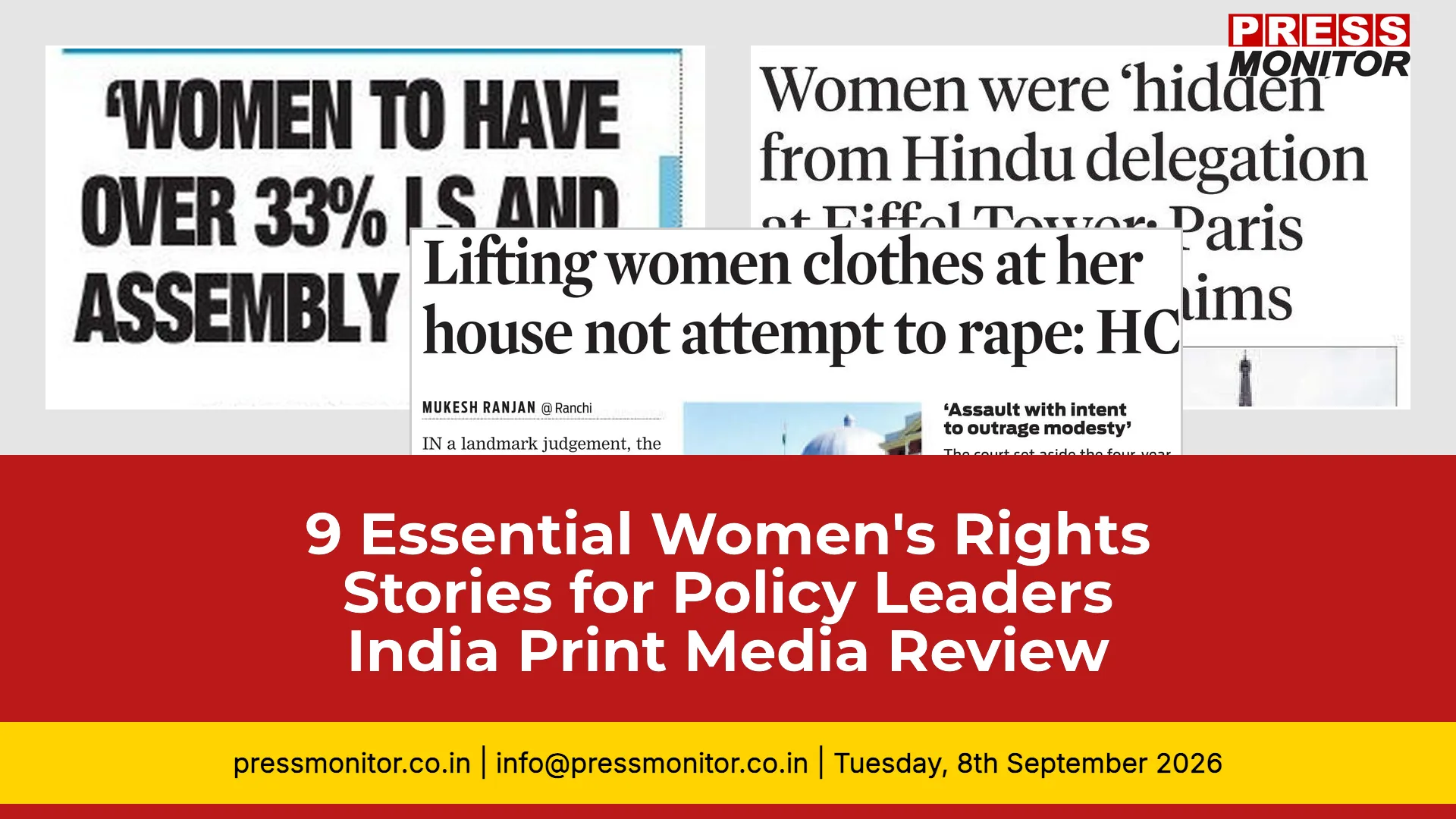
A front-page report in Asian Age says Lok Sabha Speaker Om Birla expressed confidence that women will secure greater representation beyond the existing 33 per cent reservation in state assemblies and the Lok Sabha in the coming years. Speaking at a capacity-building workshop organised by the National Commission for Women in Faridabad on Monday, he highlighted women's historic role as change-makers from the freedom movement to nation-building. He noted that female leadership is now prominently visible across social, political, governmental and private sectors. Lok Sabha Speaker Om Birla expressed confidence that women will secure greater representation beyond the existing 33 per cent reservation in state assemblies and the Lok Sabha. At the NCW capacity-building workshop in Faridabad, he highlighted women's historic role as change-makers from the freedom movement to nation-building.
Why it matters: This signals a potential shift in India's legislative gender balance and could influence future reservation policy debates.
Key detail: Women's leadership is now prominently visible across social, political, governmental and private sectors.
Source: Asian Age, New Delhi, Sept 7
Next step: Watch for parliamentary committee discussions on expanding reservation beyond 33%.
2. Eiffel Tower Staff Protest Gender Discrimination During BAPS Visit
A front-page report in Indian Express says the Eiffel Tower was closed on Monday after employees protested over being asked to step aside for a Hindu religious delegation visiting the landmark. Union representatives stated that women were asked to leave their workstations during a private visit by about one hundred people linked to BAPS, a group inaugurating a temple in the Paris suburbs. Paris city authorities have launched an investigation into the incident that angered staff. Eiffel Tower employees protested after being asked to step aside for a Hindu religious delegation visiting the landmark. Union representatives stated that women were asked to leave their workstations during a private visit by about one hundred people linked to BAPS. Paris city authorities have launched an investigation.
Why it matters: This incident exposes gender discrimination in international settings and raises questions about corporate responsibility for female employees at global landmarks.
Key detail: The Eiffel Tower was closed on Monday following the staff protest.
Source: Indian Express, Delhi
Next step: Monitor whether SETE and BAPS issue formal responses or policy changes.
3. Jharkhand High Court Reduces Rape Charge in 1999 Case
A front-page report in Morning Standard says the Jharkhand High Court ruled that lifting a woman's clothes and holding her at night without overt acts proximate to rape does not constitute an attempt to commit rape under Section 376/511 of the Indian Penal Code. The court modified a lower court order from 1999, treating the incident as assault with intent to outrage modesty under Section 354, citing the 26-year delay and the accused's clean record. The Jharkhand High Court ruled that lifting a woman's clothes and holding her at night without overt acts proximate to rape does not constitute an attempt to commit rape under Section 376/511 of the Indian Penal Code. The court modified the conviction to Section 354 (assault with intent to outrage modesty).
Why it matters: This ruling highlights significant gaps in legal definitions of sexual violence and could set a precedent for similar cases.
Key detail: The court cited the 26-year delay and the accused's clean record in modifying the sentence.
Source: Morning Standard, Ranchi, 26 July 2026
Next step: Follow up on whether this ruling triggers legislative review of Section 376 definitions.
4. Six Muslim Reformists Push For Gender Equality
A front-page report in Indian Express says six progressive Muslim activists and scholars issued an open letter urging the dismantling of patriarchal norms within the Indian Muslim community. Addressed following a major gathering of Generation Z women in Pune, the writers call on conservative bodies to uphold constitutional guarantees of equality over selective religious freedoms. The signatories demand comprehensive legal reforms including bans on polygamy, child marriage, and female genital mutilation, alongside equal inheritance and marital rights for Muslim women. Six progressive Muslim activists and scholars issued an open letter urging the dismantling of patriarchal norms within the Indian Muslim community. The signatories demand comprehensive legal reforms including bans on polygamy, child marriage, and female genital mutilation, alongside equal inheritance and marital rights for Muslim women.
Why it matters: This represents a growing internal reform movement led by Generation Z women that could reshape gender dynamics within the Muslim community.
Key detail: The open letter followed a major gathering of Generation Z women in Pune.
Source: Indian Express, Delhi
Next step: Track whether conservative religious bodies respond to the reform demands.
5. Gloria Steinem's Legacy and India's Motherhood Crisis
A front-page report in Indian Express says feminist icon Gloria Steinem, who died on September 2, framed the motherhood question through her own experiences with abortion and caregiving. The article examines how India's Medical Termination of Pregnancy Act includes mental health grounds yet systems continue to fail women, citing a 2023 Supreme Court case where a termination was denied. It calls for perinatal mental-health screening as ordinary obstetric care and treating women's statements about their minds as evidence. Feminist icon Gloria Steinem, who died on September 2, framed the motherhood question through her own experiences with abortion and caregiving. The article examines how India's Medical Termination of Pregnancy Act includes mental health grounds yet systems continue to fail women, citing a 2023 Supreme Court case where a termination was denied.
Why it matters: The intersection of global feminist thought and India's reproductive health policy gaps demands urgent attention to perinatal mental health.
Key detail: India's MTP Act includes mental health grounds but perinatal screening remains uncommon.
Source: Indian Express, Delhi, by Pooja Pillai
Next step: Consider how India's healthcare system can integrate mental health screening into routine obstetric care.
6. 5% of India's Rape Cases Rose 2000-25, Conviction Rate Falls
A front-page report in Business Standard says that nearly five percent of India’s rape cases in the last fifty years were reported after the Nirbhaya incident, with the reporting of sexual crimes rising sharply over the past decade. Between nineteen ninety‑seven and twenty twenty‑five, India recorded nine hundred twenty‑seven thousand eight hundred five rape cases, with forty‑seven point two percent occurring between two thousand and three and twenty twenty‑five, a surge linked to the Criminal Law (Amendment) Act two thousand and three and subsequent changes to the Indian Penal Code, now replaced by the Bharatiya Nyaya Sanhita. The pendency of rape cases in courts rose from eighty‑three percent in two thousand and three to eighty‑nine percent in twenty twenty‑four, while the conviction rate fell from twenty‑seven percent to twenty‑three percent; meanwhile, POCSO Act cases increased, with over ninety‑five percent of victims being minor girls and the rest minor boys. Nearly 5% of India's rape cases in the last fifty years were reported after the Nirbhaya incident, with the reporting of sexual crimes rising sharply over the past decade. Between 1997 and 2025, India recorded 927,805 rape cases, with 47.2% occurring between 2003 and 2025. The conviction rate fell from 27% to 23%.
Why it matters: Despite increased awareness and legal reforms, the justice system is struggling to keep pace with the rise in reported cases.
Key detail: POCSO Act cases increased, with over 95% of victims being minor girls.
Source: Business Standard, New Delhi
Next step: Watch for parliamentary action on judicial reforms to address case pendency and conviction rates.
7. POCSO Cases Dominate Child Crimes in India
A front-page report in Business Standard says sexual offences under the POCSO Act accounted for 48 per cent of crimes against children in 2024, based on NCRB data. The NCRB has been collecting POCSO information since 2014 even though the legislation came into effect in November 2012. Data also show that registered cases involving minor girls make up a high proportion of total POCSO filings. Sexual offences under the POCSO Act accounted for 48% of crimes against children in 2024, based on NCRB data. The NCRB has been collecting POCSO information since 2014 even though the legislation came into effect in November 2012. Registered cases involving minor girls make up a high proportion of total POCSO filings.
Why it matters: The dominance of POCSO cases in child crime statistics underscores the urgent need for stronger child protection mechanisms and faster judicial processing.
Key detail: Over 95% of POCSO victims are minor girls.
Source: Business Standard, New Delhi
Next step: Monitor NCRB's upcoming data release for trends in POCSO case disposal rates.
8. Latin America Lesson For India on Women's Reservation
A front-page report in New Indian Express says India should look at countries where women occupy more than half of elected national legislatures while struggling to implement women's reservation in one third of seats at the Centre and in states. Countries like Cuba, Nicaragua, Bolivia, and Mexico show that persistent lawmaking on gender balance can achieve high levels of women's representation. The key lesson from Latin America is that high levels of women's education can go a long way in enacting more equitable laws. India should look at countries where women occupy more than half of elected national legislatures while struggling to implement women's reservation in one third of seats at the Centre and in states. Countries like Cuba, Nicaragua, Bolivia, and Mexico show that persistent lawmaking on gender balance can achieve high levels of women's representation.
Why it matters: India's struggle with women's reservation contrasts sharply with Latin American nations that have achieved near-parity through sustained legislative effort.
Key detail: The key lesson from Latin America is that high levels of women's education can go a long way in enacting more equitable laws.
Source: New Indian Express, Chennai
Next step: Track whether the women's reservation bill gains traction in the current parliamentary session.
9. Haryana Raises Deendayal Laxmi Yojana Eligibility to Rs 1.8 Lakh
A front-page report in Tribune says that the Haryana Government has decided to raise the annual family income eligibility limit under the Deendayal Laxmi Yojana from one lakh rupees to one point eight lakh rupees, bringing more women within the ambit of the scheme. Chief Minister Nayab Singh Saini said the scheme was launched to economically empower women and provide them monthly financial assistance of two thousand one hundred rupees. The registration portal for newly eligible women will be opened shortly. Saini also clarified that women taking advantage of registering for benefits under the scheme would continue to avail themselves of benefits under other government schemes. The Haryana Government has decided to raise the annual family income eligibility limit under the Deendayal Laxmi Yojana from Rs 1 lakh to Rs 1.8 lakh, bringing more women within the ambit of the scheme. Chief Minister Nayab Singh Saini said the scheme was launched to economically empower women and provide them monthly financial assistance of Rs 2,100.
Why it matters: Expanding eligibility broadens financial inclusion for women and could serve as a model for other states considering similar welfare expansions.
Key detail: The registration portal for newly eligible women will be opened shortly.
Source: Tribune, Chandigarh, 7 September 2026
Next step: Watch for the portal launch and uptake numbers in the first quarter.
What do you think is the most urgent women's rights issue in India today? Share your perspective in the comments and stay tuned to Press Monitor for daily print media intelligence.
