9 Key Telecommunications Stories for Telecom Leaders


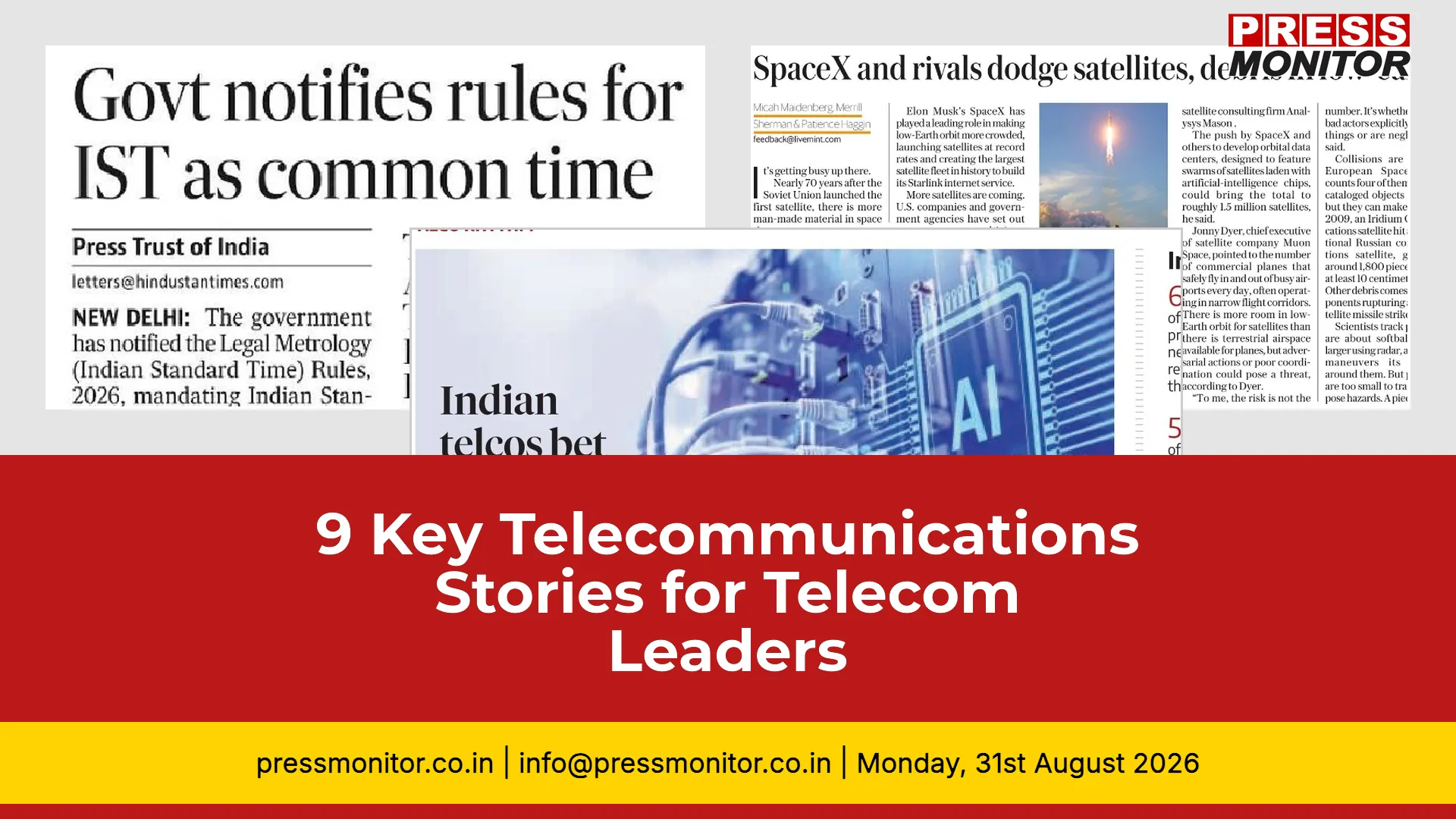
Stay ahead of the curve with this press review of the top telecom stories from Indian print media on August 31, 2026. According to Press Monitor's tracking of Indian publications, these developments are shaping the telecommunications landscape. This media monitoring roundup brings you the must-read stories for industry leaders.
1. India Mandates Indian Standard Time as Single National Reference
A front-page report in Hindustan Times says the Indian government has issued Legal Metrology (Indian Standard Time) Rules, 2026, formalizing Indian Standard Time (IST) as the sole reference for all legal, official, administrative, and commercial functions nationwide. The notification comes after proclamations on digital and tech-dependent systems linked to accurate synchronization across India. The Ministry of Consumer Affairs instructed departments and enterprises three hundred and eighty days after publication in the Official Gazette, granting time for ajustments. Consensus across differing local systems and time grids creates errors in recordings for banking, transportation, telecom, grid systems, and government logs. The shared time rule expectedly improves infrastructure coordination across railways, airports, technology networks, and public documentation.
Why it matters: This move synchronizes critical infrastructure including telecom networks, reducing errors in timestamping and coordination.
Key detail: The Legal Metrology (Indian Standard Time) Rules, 2026, will come into force 180 days after notification, affecting all legal, commercial, and administrative functions.
Source: Hindustan Times (tracked by Press Monitor across 8 publications)
Next step: Telecom operators should prepare for mandatory IST synchronization across all systems.
Question: How will your network adapt to this unified time standard?
2. SpaceX Satellites Dodge Debris as Low-Earth Orbit Gets Crowded
A front-page report in Mint says SpaceX and rivals are launching thousands of satellites into low-Earth orbit, raising concerns about collisions and the long-term usability of space. With the deployment of over forty-one thousand more satellites expected between this year and twenty-thirty-four, including roughly two-thirds from SpaceX and Amazon, the region becomes increasingly crowded and hazardous.
Why it matters: Increasing satellite congestion poses risks to telecom connectivity and space-based services.
Key detail: Over 41,000 satellites expected to launch by 2034, two-thirds from SpaceX and Amazon.
Source: Mint
Next step: Indian telecom companies relying on satellite backhaul should assess collision risks.
Question: Is India's space policy ready for the orbital traffic challenge?
3. 67% of Indian Telcos See AI as Primary Revenue Driver
A front-page report in Business Standard says Indian telecommunications and network service providers are among the most optimistic globally regarding the financial upside of artificial intelligence. A Ciena survey reveals that 67 per cent of Indian respondents believe AI-driven network services will be the primary revenue driver over the next three to five years.
Why it matters: AI-driven network services are expected to transform telecom revenue models.
Key detail: 67% of Indian respondents in a Ciena survey believe AI will be the primary revenue driver in 3-5 years.
Source: Business Standard
Next step: Telcos should invest in AI capabilities to capture this growth.
Question: Is your organization leveraging AI for network monetization?
4. Top 7 Firms Lose Rs 1.13 Lakh Crore in Market Cap; Airtel and Reliance Hit Hard
A front-page report in Millennium Post says the combined market valuation of seven of the top-10 most-valued firms eroded by Rs 1.13 lakh crore last week, with Bharti Airtel and Reliance Industries emerging as the biggest laggards, in-tandem with a bearish trend in equities.
Why it matters: The market cap loss reflects bearish sentiment affecting telecom giants.
Key detail: Bharti Airtel and Reliance Industries were the biggest laggards.
Source: Millennium Post
Next step: Monitor equity movements for investment signals in the telecom sector.
Question: How will this volatility impact telecom capital expenditure plans?
5. Startup Plaud Launches AI-Powered 4G Earbuds
A front-page report in Financial Express says... Plaud, a San Francisco-based startup that makes note-taking devices, unveiled a pair of wireless, 4G-connected earbuds that lets users record conversations and complete tasks with AI assistants on the go, adding to a nascent category of gadgets built for the Alera.
Why it matters: New AI gadgets could disrupt the wearable and telecom accessories market.
Key detail: The earbuds record conversations and use AI assistants on the go.
Source: Financial Express
Next step: Telecom operators may explore partnerships for data plans tailored to such devices.
Question: Are AI wearables the next frontier for telecom data consumption?
6. Jio Platforms and NSE Plan Mega IPOs
A front-page report in Business Standard says the market regulator has approved the initial public offering of Jio Platforms, with the National Stock Exchange expected to follow soon. Both offerings are poised to become the largest in India, potentially surpassing the record set by Hyundai Motor India.
Why it matters: These could be the largest IPOs in India, reshaping capital markets.
Key detail: Market regulator approved Jio Platforms IPO; NSE expected to follow.
Source: Business Standard
Next step: Investors and competitors should watch for valuation signals.
Question: How will these IPOs affect the telecom competitive landscape?
7. Smartphone Demand Slips; Government May Cut GST to 8%
A front-page report in Hindustan says that rising smartphone prices have led to a decline in demand for new mobile phones. Many consumers are opting to use older phones instead. To boost smartphone sales, the government may reduce the 8% GST on mobile phones.
Why it matters: A GST cut could boost smartphone sales and telecom subscriber growth.
Key detail: Rising prices have led to consumers using older phones; government may reduce GST from 18% to 8%.
Source: Hindustan
Next step: Telecom operators could benefit from increased device adoption.
Question: Will a GST cut revive the smartphone market?
8. GST Council to Meet After 374 Days; Focus on Compliance and Mobile Rate Cut
A front-page report in Business Line says that an overhaul of compliance procedures and a targeted rate cut on mobile phones take centre stage as the GST Council prepares to meet on September 12 after a 374-day hiatus.
Why it matters: The council's decisions directly impact telecom input costs and consumer pricing.
Key detail: Meeting on September 12 will discuss compliance overhaul and mobile phone GST cut.
Source: Business Line
Next step: Telecom companies should prepare for potential policy changes.
Question: What compliance reforms do you expect from the GST Council?
9. India Nominates Revathi Mannepalli for ITU Radiocommunication Bureau Director
A front-page report in Mint says, India has nominated Revathi Mannepalli for director of ITU’s Radiocommunication Bureau. Mannepalli will be contesting against two European candidates.
Why it matters: India's bid for a top ITU post could influence global telecom standards.
Key detail: Mannepalli will contest against two European candidates.
Source: Mint
Next step: India's telecom diplomacy could strengthen its position in spectrum allocation.
Question: How important is Indian leadership in global telecom bodies?
This media intelligence is powered by Press Monitor, tracking the most critical stories from Indian print media. For a deeper dive into any of these stories, visit pressmonitor.co.in and ground your AI tools in real, verified news. What story matters most to you? Share your thoughts below.