9 Pivotal Climate Stories for Policy Leaders


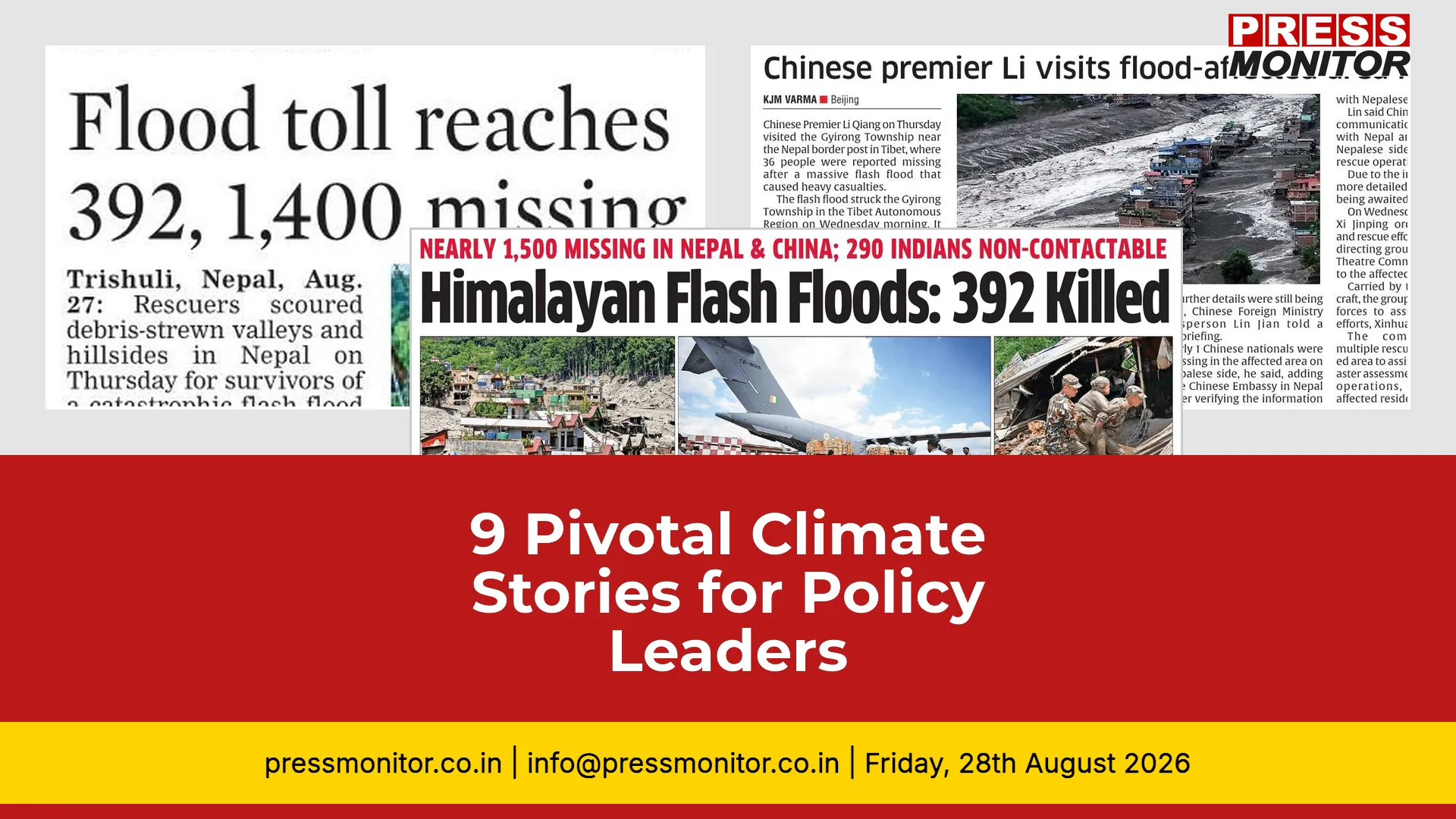
The Himalayan region is experiencing unprecedented hydrological stress, with cascading glacial collapses triggering transboundary disasters that demand immediate strategic attention. According to Press Monitor's tracking of Indian publications, today's print landscape reveals critical shifts in climate adaptation, infrastructure resilience, and diplomatic coordination. This press review synthesizes the highest-impact developments shaping news on climate policy and disaster response.
1. Catastrophic Glacial Collapse Triggers Massive Casualties
A report in Deccan Chronicle reveals catastrophic flash floods in the Nepal-Tibet border on Thursday following a glacial collapse, causing 392 deaths, over 1,400 missing persons, and widespread destruction across villages, rivers, and infrastructure. Helicopters rushed emergency supplies to cut-off areas after ice, mud, and rock surged through the region — initially mistaken for a 4.4-magnitude earthquake but confirmed to be seismic energy from collapsing glacial rock and ice moving at 50 metres per second. Nepalese authorities warned of further flooding from dammed Bhotekoshi River while Chinese geologists cited risks from upstream lakes containing over 5 million cubic metres of water. Rescue efforts remain intensed amid escalating hazards.
Why it matters: The scale of the disaster underscores how rapidly changing cryosphere dynamics are outpacing existing early-warning frameworks.
Key detail: Ice, mud, and rock surged at 50 metres per second after a 0.2 sq. km glacier broke off, initially registering as seismic activity before devastating villages across the Nepal-Tibet border.
Source: Deccan Chronicle
Next step: Cross-border geological monitoring networks must be upgraded to distinguish glacial surges from tectonic events in real-time.
2. Chinese Premier Li Qiang Visits Flood-Hit Tibet
A front-page report in The Pioneer says Chinese Premier Li Qiang led officials to visit Tibet's Gyirong Township near the Nepal border following a flash flood that killed three in Tibet and twenty-seven in Nepal, and left hundreds missing.
Why it matters: High-level political engagement signals urgent resource allocation for border infrastructure rehabilitation.
Key detail: Premier Li led officials to Gyirong Township following the flash flood that claimed lives in both Tibet and Nepal, highlighting the geopolitical weight of transboundary water security.
Source: The Pioneer
Next step: Diplomatic channels should prioritize shared hydrological data sharing agreements to prevent future response delays.
3. External Affairs Minister Reviews Rescue Operations
India's External Affairs Minister S Jaishankar reviewed rescue operations after flash floods triggered by a landslide in Nepal killed at least 392 people, including 21 people from Tamil Nadu. The disaster struck the border regions in Rasuwa and Chitwan districts, and stranded individuals from multiple countries.
Why it matters: India's direct involvement demonstrates regional leadership in humanitarian crisis management.
Key detail: S Jaishankar reviewed operations after floods triggered by landslides killed at least 392 people, including 21 Indian nationals from Tamil Nadu stranded near Kailash-Mansarovar routes.
Source: Economic Times
Next step: Consular rapid-response protocols for high-altitude trekking zones require standardization across neighboring states.
4. Himalayan Warning From Nepal Highlights Glacial Lake Multiplication
A front-page report in Times of India says Himalayan warming creates dangerous rain-and-ice events, glacial lakes are multiplying and getting filled up to the point of triggering outburst floods. China’s activities in Tibet and Bihar’s vulnerability are also highlighted.
Why it matters: Environmental scientists warn that warming trends are creating volatile rain-and-ice events that overwhelm traditional engineering models.
Key detail: Glacial lakes are expanding rapidly, reaching outburst thresholds, while upstream activities in Tibet compound Bihar's vulnerability to sudden inundations.
Source: Times of India
Next step: Municipal planners must integrate dynamic glacial lake inventory mapping into state disaster management plans.
5. China Tracks Bhote Koshi Flood Risk Closely
A front-page report in Times of India says China's ministry of water resources is monitoring a potential lake breach and running flood simulations for the Bhote Koshi river. Experts in Nepal warn that climate change is increasing the risk of subsequent flood waves triggered by landslides.
Why it matters: Proactive simulation efforts show how advanced modeling can mitigate downstream casualties in shared river basins.
Key detail: China’s ministry of water resources is running flood simulations for the Bhote Koshi river as experts warn climate change increases landslide-triggered secondary waves.
Source: Times of India
Next step: Investment in AI-driven hydrological forecasting should become a bilateral priority for South Asian water governance.
6. Himachal Pradesh Glacial Lake Expansion Raises State Alerts
“A front-page report in Tribune News Service says” the devastating flashflood in Nepal has brought the potential threat from glacial lakes in Himachal Pradesh into sharp focus, particularly the rapidly expanding Geepang Lake in Lahaul and Spiti. Scientific studies indicate the lake, spread over about 27 hectares in the l97Os, had expanded to nearly 99 hectares by 2019. Chief Minister Sukhvinder Singh Sukhu stated that the formation of any glacial lake carries an inherent risk, yet the state disaster management authorities have conducted a study of Geepang Lake and are maintaining constant watch on it.
Why it matters: Domestic spillover risks mean Indian mountain states cannot treat Himalayan disasters as purely external events.
Key detail: Chief Minister Sukhvinder Singh Sukhu emphasized that Geepang Lake expanded from 27 hectares in the 1970s to nearly 99 hectares by 2019, prompting constant surveillance.
Source: Tribune
Next step: State disaster authorities should mandate quarterly satellite monitoring for all alpine reservoirs exceeding 50 hectares.
7. Bihar Gandak River Recedes Amid Joint Plan Calls
A front-page report in Tribune says the water level of the Gandak river in Bihar began receding on Thursday after a flashflood in Nepal. Chief Minister Samrat Choudhary conducted an aerial survey of border districts while political parties called for a joint flood management plan with the neighbouring country.
Why it matters: Political consensus on cooperative flood management is emerging faster than institutional implementation mechanisms.
Key detail: CM Samrat Choudhary conducted aerial surveys of border districts while opposition and ruling parties jointly demanded a unified India-Nepal flood management framework.
Source: Tribune
Next step: Legislative committees should fast-track cross-state water-sharing amendments to enable rapid emergency coordination.
8. Infrastructure Devoured by Unprecedented Hydrological Surges
A front-page report in Tribune says that the Bhotekoshi riverbed in northern Rasuwa destroyed many settlements on August 26 due to an unprecedented hydrological surge. This is an example of how infrastructure fails in Nepal due to the impact of climate change, particularly in the Himalayas.
Why it matters: Engineering standards designed for historical rainfall patterns are failing against climate-amplified peak flows.
Key detail: The Bhotekoshi riverbed destroyed settlements and hydropower facilities despite no heavy rainfall on the Nepali side, proving that upstream glacial melt alone can trigger catastrophic surges.
Source: Tribune
Next step: Infrastructure ministries must adopt climate-resilient design codes that factor in non-rainfall flood triggers.
9. Japan Issues Level 5 Warnings as Torrential Rain Strands Thousands
"Selon The Pioneer, torrential rain struck Japan’s north-central prefectures of Ishikawa and Toyama on Thursday, triggering flooding and landslides, closing roads and stranding people in flooded homes and vehicles. The Japan Meteorological Agency issued a Level 5 heavy rain warning, urging residents to take precautionary measures. The rain subsided later Thursday, but further rain and landslides are possible through Friday morning, with up to 2 centimetres of rain predicted in the Kaga and Noto areas. More than 38,000 people were advised to seek shelter, and several vehicles were abandoned in flooded roads. Rescue workers using rubber boats rescued residents stranded in Himi city." Why itames: Global parallel crises reveal that extreme precipitation events are no longer regionally isolated phenomena.
Key detail: Ishikawa and Toyama prefectures faced Level 5 warnings, stranding over 38,000 residents and forcing rubber boat rescues amid predicted further landslides.
Source: The Pioneer
Next step: Urban drainage systems in monsoon-prone coastal cities require immediate capacity upgrades to handle compound flood-landslide scenarios.
This media intelligence briefing captures the urgency of adapting to accelerating climate volatility. How should your organization adjust its risk mitigation strategies ahead of the next monsoon cycle?