9 Pivotal Critical Minerals Stories for Executives


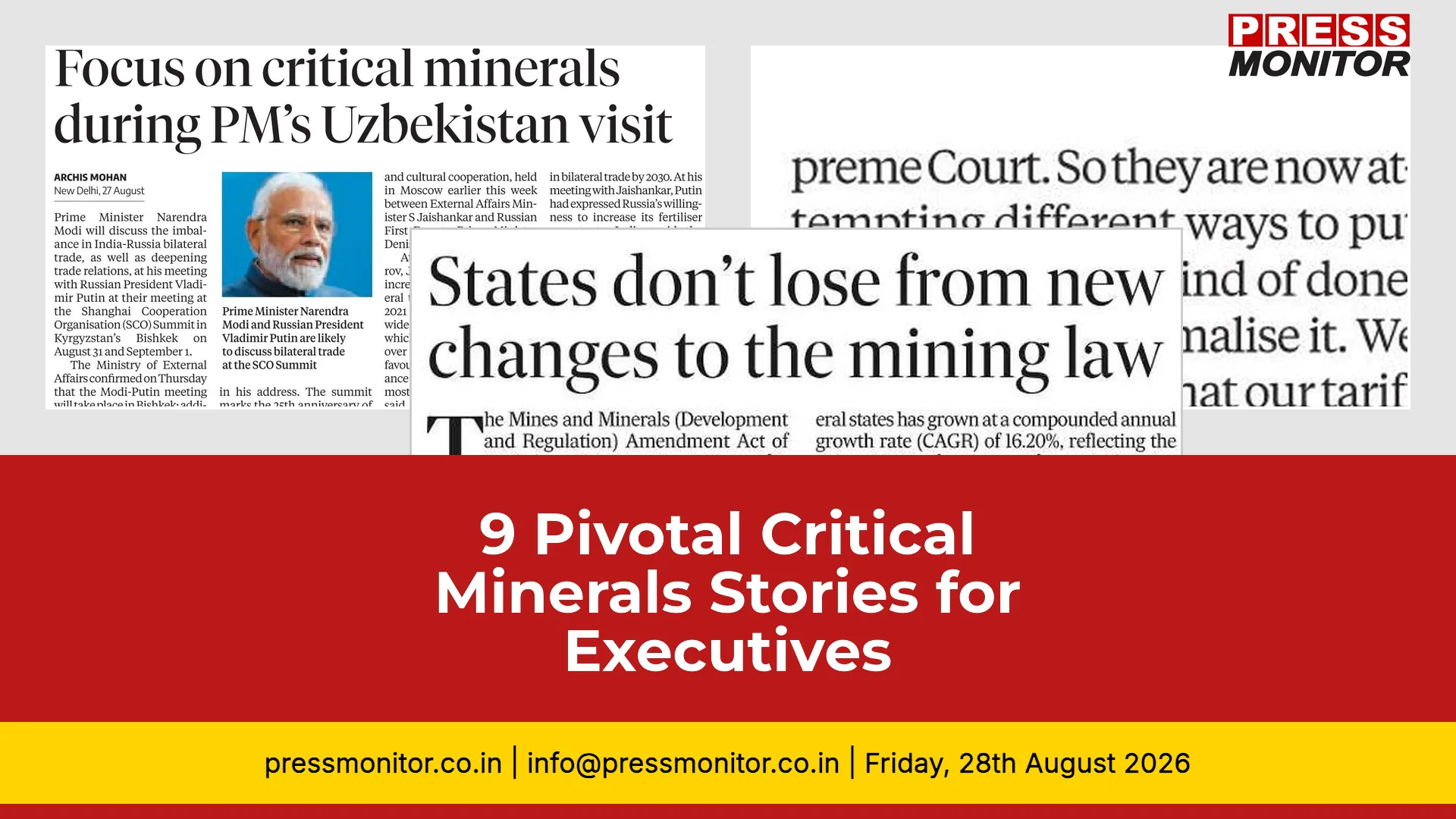
Navigating the global shift toward resource nationalism requires sharp print media monitoring. This press review distills today’s most consequential developments in critical minerals and strategic resources, powered by real-time media intelligence from India’s leading publications. Here is what corporate leaders and policy makers must know before markets adjust.
1. Focus on Critical Minerals During PM’s Uzbekistan Visit
A front-page report in Business Standard says Prime Minister Narendra Modi will discuss the imbalance in India-Russia bilateral trade, as well as deepening trade relations, at his meeting with Russian President Vladimir Putin at the Shanghai Cooperation Organisation (SCO) Summit in Kyrgyzstan’s Bishkek. Modi will highlight India's priorities of security, connectivity and opportunity. India and Uzbekistan are keen to increase their bilateral trade, which is currently at an underwhelming $1.32 billion. The two sides will discuss issues related to trade access, tariffs and could sign an agreement on cooperation in critical minerals.
Why it matters: Geopolitical realignment is accelerating supply chain diversification away from traditional monopolies.
Key detail: Prime Minister Modi will push for deeper trade access and a formal cooperation agreement on critical minerals during the SCO Summit, aiming to bridge the current $1.32 billion bilateral trade gap with Uzbekistan.
Source: Business Standard
Next step: Track official announcements from the SCO summit for signed MOUs on mineral extraction and processing partnerships.
2. India, Japan Explore Rare Earths Cooperation
A front-page report in Indian Express says India is seeking cooperation with Japan on rare earth and critical minerals to become self-reliant. Additionally, a separate investigative report details a gangland murder case in Kolkata where shooters allegedly targeted an individual named Rath amidst a broader financial dispute.
Why it matters: Strategic alliances with advanced economies are becoming the fastest route to securing rare earth element supply chains.
Key detail: A front-page report confirms New Delhi is actively negotiating technical and investment frameworks with Tokyo to build domestic REE refining capacity and reduce import dependency.
Source: Indian Express
Next step: Monitor joint venture announcements between Japanese trading houses and Indian state-owned enterprises.
3. States Don’t Lose From New Mining Law Changes
A front-page report in Hindustan Times says the Mines and Minerals (Development and Regulation) Amendment Act of 2026 represents a crucial step towards preparing India for the future of the mining industry. At a time when minerals, particularly critical and strategic minerals, are becoming central to energy security and economic resilience, India needs a mining framework that's predictable and attractive to investment. The amendment focuses on attracting long-term investment and addresses the gap between available technology and large-scale deployment in mines, highlighting the significant opportunity India holds with over 1,500 mineral blocks awaiting development, despite only a fraction currently operating.
Why it matters: Regulatory clarity is the primary catalyst unlocking India’s massive untapped mineral wealth for private capital.
Key detail: The Mines and Minerals Amendment Act of 2026 ensures fiscal predictability for states while opening over 1,500 mineral blocks to long-term investment, bridging the technology-to-scale deployment gap.
Source: Hindustan Times
Next step: Review updated auction schedules and royalty distribution formulas in affected state gazettes.
4. Nirmala Sitharaman Meets Canadian Counterpart
A front-page report in Mint says Finance Minister Nirmala Sitharaman and Canadian counterpart Francois-Philippe Champagne concluded the inaugural dialogue in Canada on Thursday. Discussions focused on macroeconomic developments, financial-sector cooperation, and international multilateral cooperation on critical minerals and energy security.
Why it matters: North-South economic dialogues are now heavily weighted toward energy security and raw material access.
Key detail: Finance Minister Sitharaman and Canadian FM Champagne focused macroeconomic coordination alongside multilateral cooperation frameworks specifically targeting critical minerals and clean energy infrastructure.
Source: Mint
Next step: Watch for cross-border listing opportunities and dual-jurisdiction compliance updates for mining firms.
5. India Invites Canadian Investment in Financial Services and Clean Energy
A front-page report in Asian Age says Finance minister Nirmala Sitharaman has invited Canadian businesses and institutional investors to deepen their investments and long-term partnerships in India, highlighting opportunities in financial services, infrastructure, clean energy, critical minerals, technology and manufacturing.
Why it matters: Capital flows are following policy signals; institutional money is being directed toward strategic resource projects.
Key detail: New Delhi is explicitly courting Canadian institutional investors for deep partnerships in critical minerals, clean energy, and manufacturing, leveraging existing diplomatic momentum.
Source: Asian Age
Next step: Engage with Canadian pension funds and sovereign wealth vehicles exploring Indian ESG-compliant resource assets.
6. India and Chile to Complete CEPA Talks This Year
A front-page report in Financial Express says, India and Chile have committed to completing talks on a Comprehensive Economic Partnership Agreement (CEPA) this year, with both nations seeking to resolve outstanding issues related to market access and trade in critical minerals.
Why it matters: South-South trade agreements are bypassing traditional Western-dominated commodity routes.
Key detail: Both nations are finalizing market access terms this year, with lithium and copper supply chains taking center stage in the Comprehensive Economic Partnership Agreement negotiations.
Source: Financial Express
Next step: Prepare contingency logistics plans for potential tariff adjustments and quota allocations under the new CEPA.
7. India-Uzbekistan Bilateral Trade Nears $1 Billion
A front-page report in The Pioneer says bilateral trade and investments between India and Uzbekistan have reached nearly $1 billion. The two countries are collaborating in critical minerals, pharmaceuticals, education, information technology, and healthcare. India, a full member of the Shanghai Cooperation Organisation (SCO) since 2017, is strengthening ties as the bloc commemorates its 25th anniversary. The SCO aims to address regional challenges, including terrorism, separatism, and extremism.
Why it matters: Central Asian partnerships are expanding beyond energy into pharmaceuticals, IT, and strategic mineral collaboration.
Key detail: As the SCO celebrates its 25th anniversary, New Delhi and Tashkent are formalizing cross-sector ties, positioning critical minerals as a cornerstone of future industrial cooperation.
Source: The Pioneer
Next step: Align export-import compliance protocols with updated SCO regional trade standards.
8. Post-WWII System Transformation
A front-page report in Hindustan Times says the post-World War II system built around comparative advantage and multilateral trade rules has transitioned to a transactional world where beggar thy neighbour and might is right dominate. Tariffs and industrial capacities are weaponized, access to critical minerals and technologies are restricted, and economic security and national security are inseparable.
Why it matters: The era of comparative advantage is ending; economic security now dictates trade flows and resource allocation.
Key detail: Global markets are shifting toward transactional, security-driven models where tariffs and industrial capacity are weaponized, making direct control over critical minerals a national imperative rather than a commercial choice.
Source: Hindustan Times
Next step: Stress-test supply chain resilience against potential export restrictions and sanction regimes.
9. NTPC Plans Standalone Energy Storage Business
“Our objective is to develop storage capabilities not merely as an adjunct to renewable generation, but as an important business in its own right,” NTPC Chairman and Managing Director Gurdeep Singh said. NTPC is building capabilities in Battery Energy Storage Systems (BESS) and Pumped Storage Projects while exploring long-duration technologies, including CO2 storage and redox-flow batteries. Singh said storage would assume greater importance alongside generation and transmission as renewable energy penetration increases. The diversification comes as India’s installed power capacity has crossed 550 GW (gigawatts), with non-fossil sources accounting for more than half. Peak demand crossed 270 GW in the current fiscal and is projected by the Central Electricity Authority to reach around 459 GW by FY36.
Why it matters: Demand-side infrastructure is scaling rapidly, directly driving upstream demand for battery minerals like lithium, cobalt, and nickel.
Key detail: NTPC Chairman Gurdeep Singh announced a strategic pivot to treat Battery Energy Storage Systems and pumped storage as independent profit centers, supporting India’s 550 GW power capacity and 459 GW peak demand target by FY36.
Source: Financial Express
Next step: Evaluate procurement contracts and long-term off-take agreements for grid-scale storage deployments.
These nine developments underscore how quickly the critical minerals landscape is evolving. Are your current sourcing strategies built for a fragmented, security-first global order? Share your perspective below. Tracked by Press Monitor.