9 Pivotal Green Energy Stories for Energy Leaders


India's green energy transition is accelerating at a pace that demands constant attention. From a projected 2,000 GW power capacity to record solar deals and policy shifts, here are the 9 pivotal stories shaping the sector today. According to Press Monitor's tracking of Indian publications, these are the developments that matter for energy leaders, investors, and policymakers. This press review leverages media intelligence to cut through the noise and deliver only what's essential.
1. India to Cross 2,000 GW by 2047
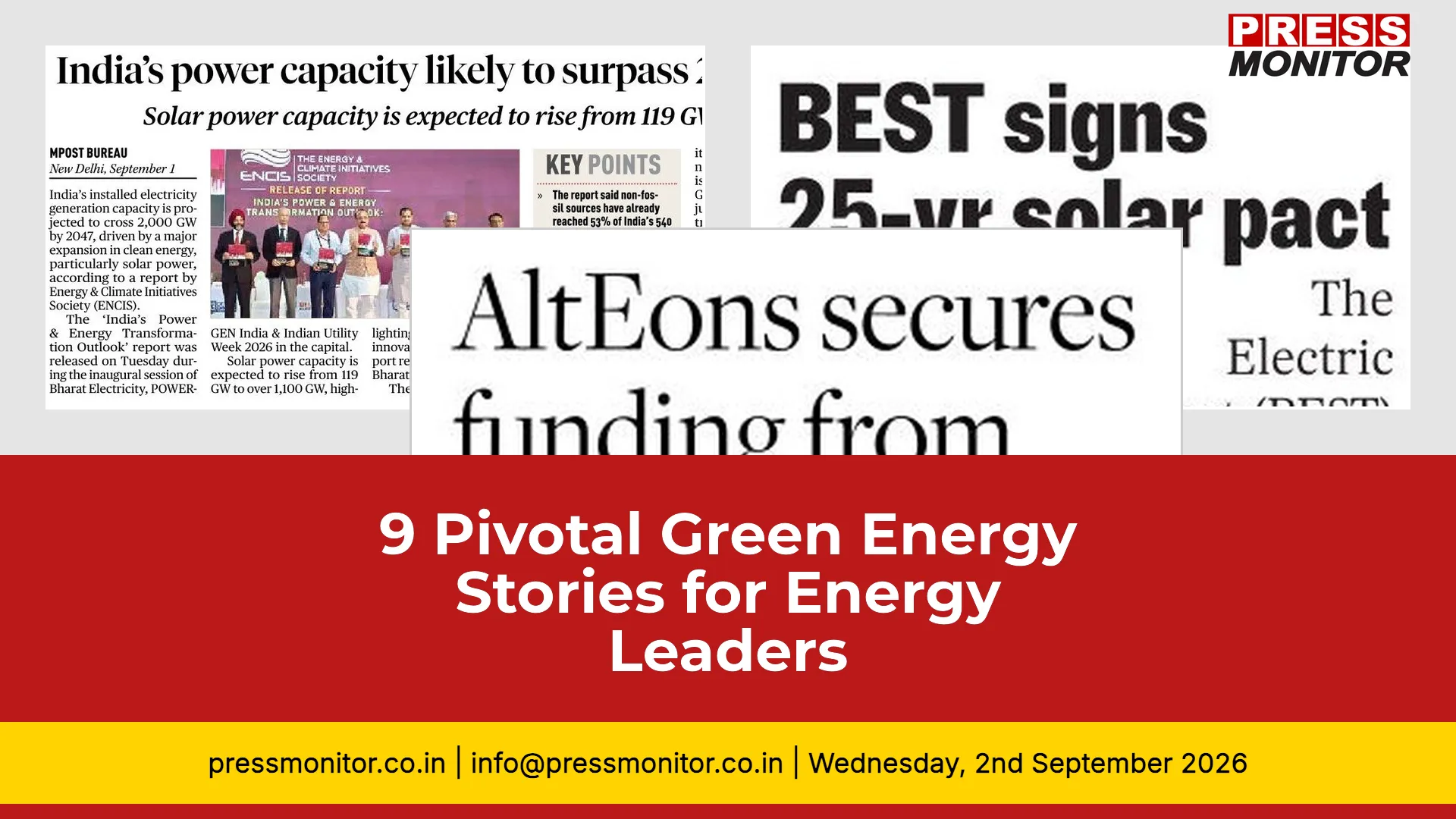
A front-page report in Millennium Post says India's installed electricity generation capacity is projected to cross 2,000 GW by 2047, driven by a major expansion in clean energy, with solar capacity alone expected to rise from 119 GW to over 1,100 GW. The projection comes from the 'India's Power & Energy Transformation Outlook' report by the Energy & Climate Initiatives Society, released in New Delhi at Bharat Electricity, POWER-GEN India & Indian Utility Week 2026. Non-fossil sources already make up 53 per cent of India's 540 GW installed capacity, five years ahead of target, while peak electricity demand is forecast to reach 366 GW by 2032.
Why it matters: India's power capacity is set to quadruple, with solar leading the charge. This is the blueprint for the nation's Viksit Bharat vision.
Key detail: Solar capacity alone is expected to leap from 119 GW to over 1,100 GW. Non-fossil sources already make up 53% of the 540 GW installed capacity, five years ahead of target.
Source: Millennium Post (front page)
Next step: For energy planners, this signals massive infrastructure and investment opportunities in solar and grid integration.
2. BEST Signs 220 MW Solar Deal
A front-page report in Free Press Journal says the Brihanmumbai Electric Supply and Transport (BEST) Undertaking has signed a 25-year power purchase agreement with the Solar Energy Corporation of India for 220 MW of solar power backed by an energy storage system. The deal will supply solar power at Rs 2.87 per unit and includes a 110 MW/440 MWh storage system to make electricity available during periods of high demand, with renewable energy sourced from developers across Maharashtra. BEST currently meets around 33% of its nearly 1,000 MW electricity requirement from renewable sources, and this share is expected to rise to 43%.
Why it matters: Mumbai's power utility is securing round-the-clock clean energy with storage, a model for urban utilities.
Key detail: The 25-year PPA with SECI includes a 110 MW/440 MWh storage system, supplying solar at Rs 2.87 per unit. BEST's renewable share will rise from 33% to 43%.
Source: Free Press Journal (front page)
Next step: Other municipal utilities should watch this template for integrating storage with solar procurement.
3. Sanmar Buys Majority Stake in AltEons
A front-page report in Business Line says AltEons Energy has raised an undisclosed investment from The Sanmar Group in return for a majority stake. The capital will support the development of over 1.5 GW of round-the-clock renewable energy projects across India for corporate and industrial customers. The company is also building a 210 MW wind, solar and battery hybrid portfolio in Maharashtra and aims to secure an 800 MW pipeline by the end of the year.
Why it matters: A strategic investment that will accelerate 1.5 GW of round-the-clock renewable projects for corporate India.
Key detail: AltEons is building a 210 MW wind-solar-battery hybrid in Maharashtra and targets an 800 MW pipeline by year-end.
Source: Business Line (front page)
Next step: Corporates seeking decarbonisation should track AltEons' platform for reliable green power.
4. Delhi's Rs 78,000 Rooftop Solar Subsidy
A front-page report in Statesman says the Rekha Gupta government in Delhi has introduced a second amendment to the Delhi Solar Energy Policy to take solar power to households. Rooftop solar systems of up to 3 kW will be installed at zero upfront cost for domestic consumers with average monthly consumption of up to 400 units, with the Delhi government adding a capital subsidy of Rs 78,000 to match the Rs 78,000 provided by the Centre. The government has set a target of installing solar systems on 2 lakh 30 thousand rooftops by March 2027, in line with the PM Surya Ghar: Muft Bijli Yojana.
Why it matters: Delhi is making rooftop solar free for households, a major push for distributed generation.
Key detail: Up to 3 kW systems at zero upfront cost for consumers using up to 400 units monthly, with a combined Rs 1.56 lakh subsidy (Centre + State). Target: 2.3 lakh rooftops by March 2027.
Source: Statesman (front page)
Next step: Homeowners in Delhi should check eligibility under PM Surya Ghar.
5. Green Deposits: Banks Seek CRR Cut
A front-page report in Economic Times says Indian banks have sought a cut in the cash reserve ratio on green deposits to spur green lending, a demand raised during deliberations at last month's PSB Confluence. Banks cited higher compliance costs and greenwashing risks, and proposed a lower CRR of up to 100 basis points, with about Rs 25,000 crore raised in green deposits in 2025-26. A NITI Aayog report estimates India needs around $22.7 trillion in cumulative investment to achieve net zero emissions by 2070.
Why it matters: Banks want regulatory relief to boost green lending, a key to financing the energy transition.
Key detail: A lower CRR of up to 100 bps on green deposits could unlock more lending. India needs $22.7 trillion for net zero by 2070.
Source: Economic Times (front page)
Next step: Financial institutions should monitor RBI's response to this demand.
6. India, Germany Sign Wetland Pact
A front-page report in First India says Union Minister Bhupender Yadav held talks with German Environment Minister Carsten Schneider in New Delhi on Tuesday, covering industrial decarbonisation, biodiversity and wetland conservation. India and Germany signed a Joint Declaration of Intent on conserving and wisely using wetlands of international importance. At a Business Forum, Yadav highlighted cooperation in renewables, green hydrogen, energy storage, efficiency and sustainable manufacturing, and the two leaders planted saplings under the 'Ek Ped Maa Ke Naam' campaign.
Why it matters: Bilateral cooperation on wetlands and green hydrogen strengthens India's climate diplomacy.
Key detail: Joint Declaration of Intent on wetlands, plus talks on renewables, green hydrogen, and energy storage.
Source: First India (front page)
Next step: Green hydrogen stakeholders should watch for Indo-German project pipelines.
7. IndianOil Reskills for Green Energy Transition
A front-page report in The Pioneer says IndianOil is transforming from a conventional oil and gas company into a diversified energy major, reshaping the talent and skills it needs over the next decade. The company has launched the Nav Urja programme with premium academic institutes to develop renewable energy skills, while equipping employees in artificial intelligence, data sciences, biofuels and green hydrogen. IndianOil says candidates with curiosity, learning agility, an innovation mindset and resilience can build lifelong careers across its pan-India hydrocarbon value chain.
Why it matters: India's oil major is transforming its workforce for a low-carbon future.
Key detail: The Nav Urja programme with premium institutes will develop skills in renewables, AI, data sciences, biofuels, and green hydrogen.
Source: The Pioneer (front page)
Next step: Energy professionals should explore IndianOil's new career pathways.
8. CPP Investments Commits Rs 2,070 Crore to NIIF Fund II
A front-page report in Economic Times says Canada Pension Plan Investment Board (CPP Investments) has committed about Rs 2,070 crore (USD 215 million) to NIIF Infrastructure Fund II, the second India-focused infrastructure fund managed by National Investment and Infrastructure Fund (NIIF). The fund will invest in infrastructure assets and platforms across India, targeting sectors benefiting from long-term trends such as urbanisation, digitalisation and the energy transition. Executives from both CPP Investments and NIIF said the commitment deepens their partnership and reflects shared confidence in India's long-term infrastructure opportunity.
Why it matters: Global pension capital is flowing into India's infrastructure, including energy transition assets.
Key detail: The commitment targets urbanisation, digitalisation, and energy transition sectors.
Source: Economic Times (front page)
Next step: Infrastructure funds should track NIIF's deployment strategy.
9. PFC Posts Record PAT, Highest-Ever Dividend
A front-page report in Times of India says Power Finance Corporation Limited delivered its strongest-ever performance in FY 2025-26, with standalone profit after tax crossing Rs 20,000 crore for the first time at Rs 20,051 crore and the Board recommending a record dividend of Rs 18.55 per share. In her message at the company's 40th Annual General Meeting held on 31 August 2026 in New Delhi, Chairman and Managing Director Parminder Chopra said PFC remained India's highest profit-making NBFC with loan assets of Rs 5.80 lakh crore. She also highlighted the proposed merger of REC Limited with PFC, which would create one of India's largest specialised infrastructure financing institutions with an aggregate loan book of around Rs 12 lakh crore.
Why it matters: India's power financier shows robust health, enabling more lending for green projects.
Key detail: PAT crossed Rs 20,000 crore for the first time; dividend of Rs 18.55 per share. Proposed REC merger would create a Rs 12 lakh crore institution.
Source: Times of India (front page)
Next step: Investors and power developers should watch the PFC-REC merger for financing capacity.
Which of these stories will impact your strategy most? Share your thoughts below. For daily media monitoring on green energy, Press Monitor delivers the print media intelligence you need, straight to your inbox.