9 Pivotal Green Energy Stories for Infrastructure Leaders


Tracking news on green energy & renewables requires precision. This press review distills today's highest-impact developments across India's power landscape, powered by rigorous print media monitoring. Here is what infrastructure leaders, policymakers, and investors need to know right now.
1. CEA Proposes Mandatory Energy Storage for New Solar & Wind Projects
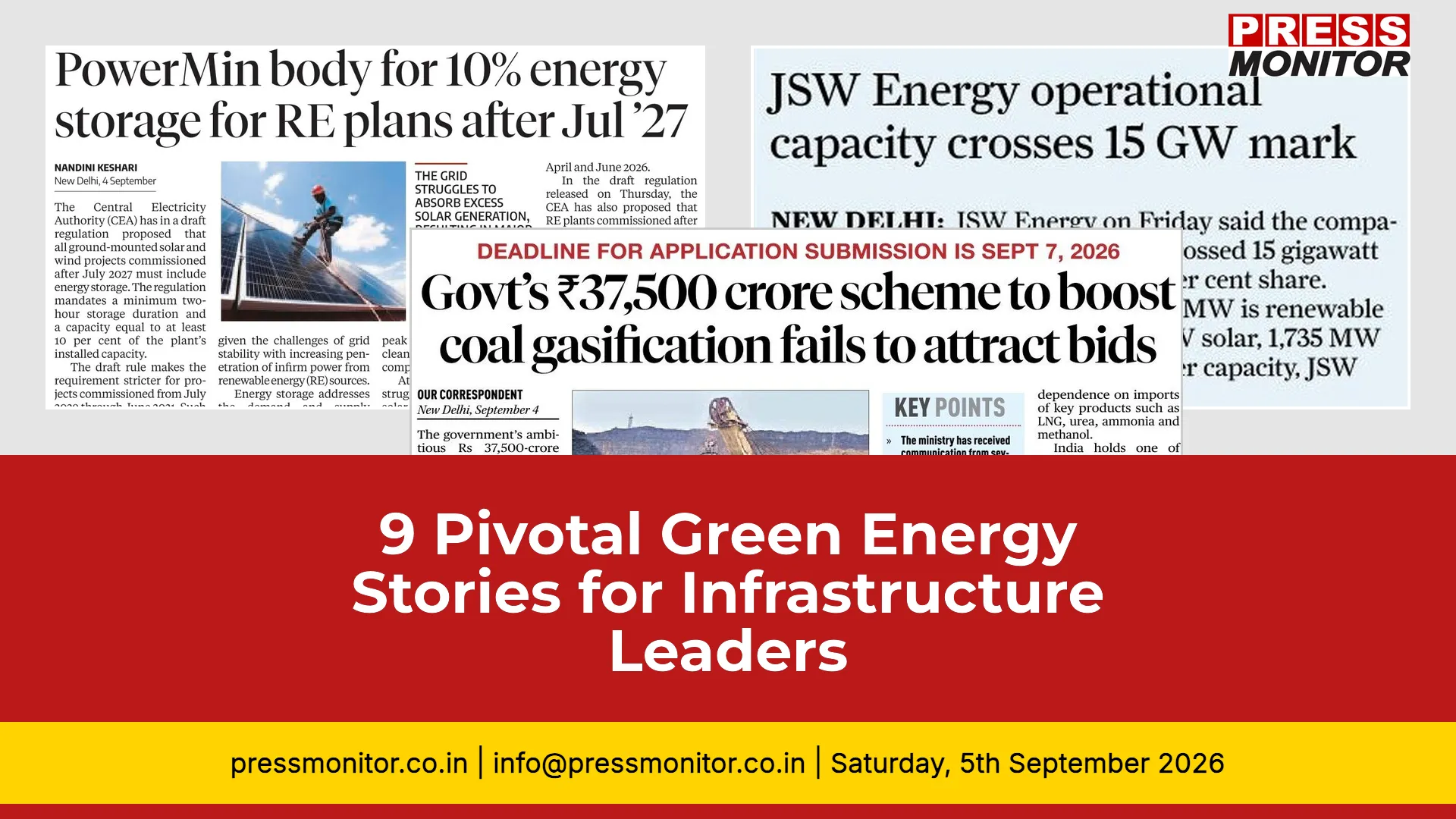
A front-page report in Business Standard says India's Central Electricity Authority has proposed a draft rule requiring ground-mounted solar and wind projects commissioned after July 1, 2027 to include at least 10% energy storage, with a minimum two-hour duration. The rule says projects commissioned from July 2029 through June 2031 must have four-hour storage, and plants commissioned after July 1, 2027 must equip at least 15% of inverters with grid-forming control to support voltage and frequency stability. The proposal comes as India curtailed 8,133 gigawatt hours of solar output between April and June 2026 because the grid struggled to absorb excess solar generation, and stakeholders and the public are invited to comment by October 4, 2026.
Why it matters: Grid stability is becoming the primary bottleneck for renewable expansion. Without dispatchable backup, curtailment costs will continue to rise.
Key detail: The Central Electricity Authority drafted regulations requiring ground-mounted solar and wind projects commissioned after July 1, 2027, to include at least 10% energy storage with a two-hour duration. By July 2029, this doubles to four hours. Plants must also equip 15% of inverters with grid-forming control. Stakeholders can submit comments until October 4, 2026.
Source: Business Standard
Next step: Developers should stress-test project financial models against mandatory storage CAPEX and explore hybrid tender structures.
2. Rs 37,500 Crore Coal Gasification Incentive Scheme Receives Zero Bids
A front-page report in Millennium Post says the government's Rs 37,500 crore financial incentive scheme for promoting coal gasification has received no applications from any private or public player by the September 7, 2026 deadline. The coal ministry stated that while several industries have expressed interest, the online application process prevents confirming bid numbers until the deadline passes. The scheme, approved by the Union Cabinet under Prime Minister Narendra Modi, aims to gasify 75 million tonnes of coal and lignite to boost clean energy and reduce dependence on imported LNG, urea, and methanol.
Why it matters: The government's push to monetize domestic coal while cutting LNG and urea imports faces immediate market hesitation, signaling potential revisions to incentive structures.
Key detail: Despite Union Cabinet approval, the September 7, 2026 deadline passed with no applications from private or public entities. The Coal Ministry noted that preparing bankable project finance reports takes significant time, with subsequent application rounds planned bi-monthly. The scheme aims to gasify 75 million tonnes of coal and lignite.
Source: Millennium Post
Next step: Industry players should monitor the revised bid timelines and engage early with financing partners to de-risk proposals.
3. JSW Energy Surpasses 15 GW Operational Capacity Milestone
A front-page report in Millennium Post says JSW Energy announced on Friday that its total operational capacity has crossed the 15 gigawatt mark, with renewables accounting for 60 per cent of the portfolio. Of the 15,025 megawatt total, 9,067 megawatt comes from renewable sources including wind, solar, hybrid, and hydro power, while the thermal portfolio stands at 5,958 megawatt. The company remains on track to meet its greenfield capacity addition target of 3 gigawatt for fiscal year 2027, having achieved approximately 42 per cent of the target to date.
Why it matters: Corporate scale-up validates India's renewable procurement trajectory and demonstrates successful portfolio diversification away from fossil fuels.
Key detail: JSW Energy announced its total operational capacity crossed 15,025 megawatts, with renewables accounting for 60% (9,067 MW) across wind, solar, hybrid, and hydro. Thermal capacity stands at 5,958 MW. The company remains on track to meet its 3 GW greenfield addition target for FY2027, having already secured roughly 42% of the goal.
Source: Millennium Post
Next step: Track JSW's upcoming auction participation and PPAs to gauge institutional demand signals.
4. Government Launches Rs 60,000 Crore PM-SETU Skilling Initiative
A front-page report in Indian Express says the government has urged industry to take a leading role in transforming India's skilling landscape through the Rs 60,000 crore PM-SETU initiative. Debashree Mukherjee, Secretary of the Ministry of Skill Development and Entrepreneurship, outlined the vision at Bharat Electricity 2026, noting that industry partners will hold a 51% stake in Section 8 companies managing ITI clusters. The event, organised by The Energy & Climate Initiatives Society, brought together over 15,000 professionals and highlighted the critical importance of workforce development for India's energy transition.
Why it matters: Workforce readiness is the critical missing link in scaling clean energy manufacturing and operations.
Key detail: Skill Development Secretary Debashree Mukherjee outlined a framework where industry partners hold a controlling 51% stake in Section 8 companies managing ITI clusters. Launched at Bharat Electricity 2026, the program targets over 15,000 professionals and emphasizes co-funding apprenticeships for MSMEs.
Source: Indian Express
Next step: Engineering firms and EPC contractors should align training pipelines with PM-SETU cluster benchmarks to secure talent.
5. National Rooftop Solar Capacity Reaches 16,369 MW
A front-page report in Business Line says more than 80.62 lakh applications have been received for setting up residential rooftop solar plants in India against over 46.44 lakh installations covering roughly 55.28 lakh households taking the total installed capacity to 16,369 megawatts. More than 30,885 crore rupees has been released as subsidy and the pace of installation has increased about 3.2 times over the last three quarters rising from 5,038 installations per day in October 2025 to nearly 16,328 installations a day in July 2026.
Why it matters: Distributed generation is accelerating faster than utility-scale projects, driven by household economics and subsidy disbursement.
Key detail: Over 80.62 lakh applications have been received, resulting in 46.44 lakh installations covering 55.28 lakh households. Subsidy releases have surpassed ₹30,885 crore. Daily installation pace surged 3.2 times, rising from 5,038 in October 2025 to nearly 16,328 in July 2026.
Source: Business Line
Next step: Manufacturers and installers should prepare supply chains for sustained Q4 residential demand spikes.
6. Uttar Pradesh Leads Residential Solar Installations Under PM Surya Ghar
A front‑page report in Business Line says that residential rooftop solar power under the PM Surya Ghar: Muft Bijli Yojana surpassed sixteen thousand one hundred eighty‑five point forty‑eight megawatts in August, with Uttar Pradesh and Maharashtra leading the tally. Nationally, the p‑mass capacity now stands at sixteen thousand three hundred sixty‑nine megawatts covering more than fifty‑five lakh households, driven by over eight thousand six hundred twenty‑four lakh applications and forty‑six lakh four hundred forty‑four lakh installations.
Why it matters: State-level policy execution directly dictates regional market share and grid integration challenges.
Key detail: Uttar Pradesh and Maharashtra dominate the PM Surya Ghar: Muft Bijli Yojana rollout. UP's residential rooftop capacity alone surpassed 16,185.48 MW in August, leveraging aggressive local awareness campaigns and streamlined subsidy processing.
Source: Business Line
Next step: Local distributors and state DISCOMs should coordinate on net-metering upgrades to handle concentrated distributed loads.
7. Power Company of Karnataka Limited Seeks Renewable Tariff Consultancy
A front-page report in Times of India says Power Company of Karnataka Limited has invited proposals from eligible consultants to provide consultancy support for determining tariffs for electricity procurement from renewable energy sources. The request for proposal will be accessible via the e-procurement portal from 5 September 2026 onwards, with further details available from the Director (Commercial) at Indhana Bhavan in Bengaluru.
Why it matters: Transparent tariff discovery mechanisms are essential for attracting competitive bidding in state-owned procurement.
Key detail: PCKL invited proposals from eligible consultants to determine electricity procurement tariffs from renewable sources. The RFP is live via the e-procurement portal starting September 5, 2026, with technical queries directed to the Director (Commercial) in Bengaluru.
Source: Times of India
Next step: Consulting firms and independent power producers should submit capability statements aligned with Karnataka's procurement calendar.
8. Bajel Projects Prioritizes Execution Margins Over Rapid Order Book Expansion
A front-page report in Mint says Bajel Projects, the Bajaj Group's EPC company, is prioritizing execution and margins over rapid order book expansion amid a boom in India's renewable energy sector. CEO Rajesh Ganesh said the company had an all-time high EPC orderbook of Rs 34,055 crore as of 30 June but is focusing on fixing internal processes before taking on more projects.
Why it matters: EPC profitability is taking precedence over volume, indicating a maturation phase in India's renewable construction market.
Key detail: CEO Rajesh Ganesh confirmed an all-time high EPC orderbook of ₹34,055 crore as of June 30, but the company is deliberately slowing new acquisitions to fix internal processes and protect margins amid rising input costs.
Source: Mint
Next step: Investors should monitor Bajel's quarterly margin disclosures and debt servicing ratios closely.
9. Belgian Prime Minister Advances Green Hydrogen & Maritime Ties in Mumbai
A front-page report in Hindustan Times says Belgian Prime Minister Bart De Wever addressed a high-level dialogue on the India and European Union free trade agreement in Mumbai, warning against arbitrary tariffs and systematic market distortions linked to geopolitical rivals. The Belgian leader announced that the Port of Antwerp and Bruges will dispatch a full delegation to India next February to advance concrete maritime and green hydrogen projects. Union Commerce Minister Piyush Goyal and Maharashtra Chief Minister Devendra Fadnavis emphasised deeper bilateral cooperation in laboratory-grown diamond technology and infrastructure development.
Why it matters: Bilateral trade frameworks are increasingly bundling decarbonization infrastructure with commercial agreements.
Key detail: During an India-EU FTA dialogue, PM Bart De Wever warned against arbitrary tariffs and announced that the Port of Antwerp will dispatch a full delegation to India next February to execute concrete green hydrogen and maritime projects. Commerce Minister Piyush Goyal and Maharashtra CM Devendra Fadnavis highlighted collaboration on lab-grown diamonds and port logistics.
Source: Hindustan Times
Next step: Logistics operators and hydrogen developers should register interest for the February Antwerp delegation roadmap.
This media intelligence compilation reflects verified print reporting. How are your teams adjusting capital allocation strategies to meet these new storage and workforce mandates?