9 Pivotal Social Media & Platform Stories for Executives


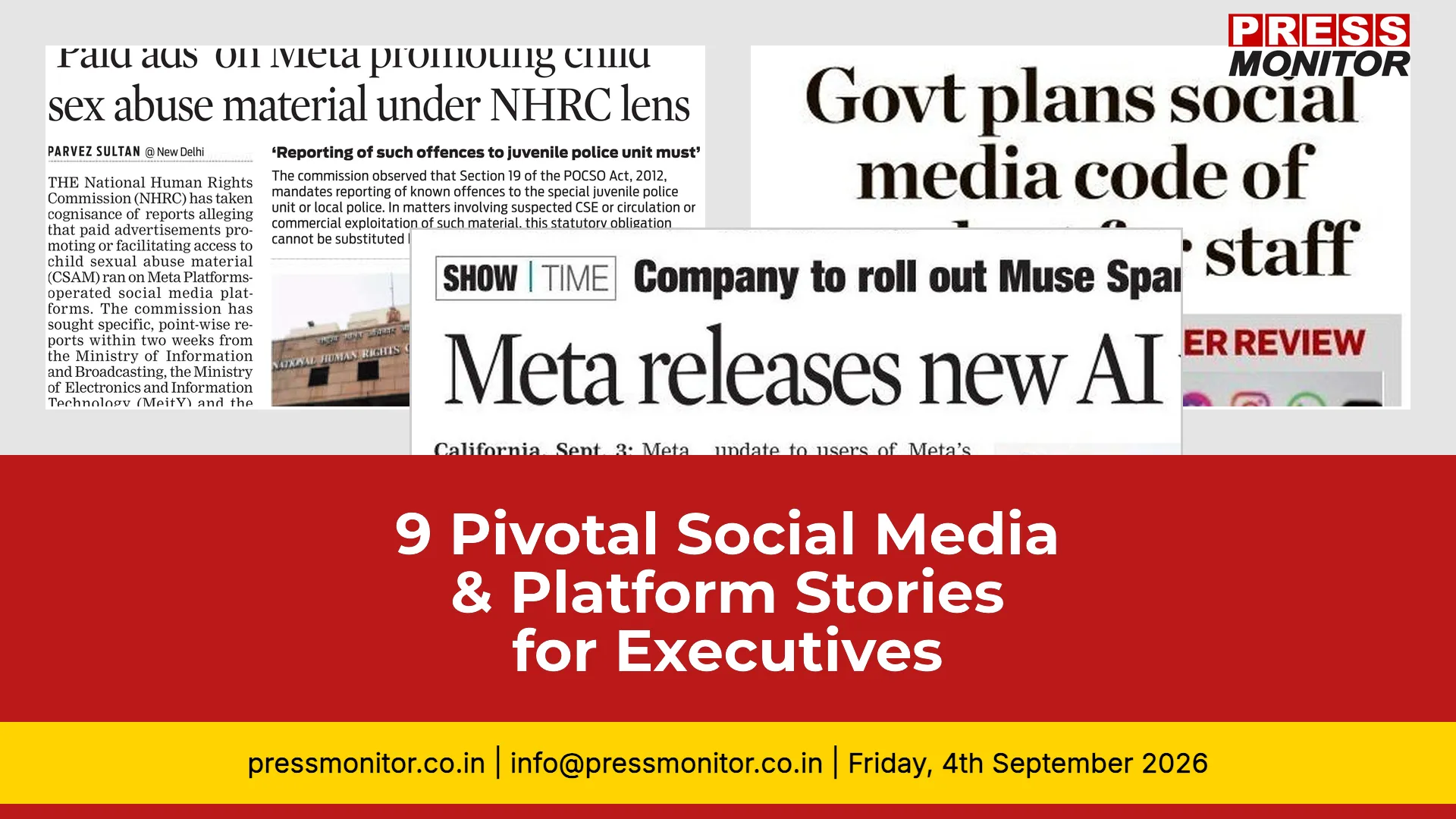
Today's media monitoring report highlights nine pivotal developments in social media and platform governance that demand immediate attention from corporate leaders and policy makers. This press review synthesises critical signals from India's print landscape. By leveraging consistent media monitoring, organisations can anticipate regulatory shifts before they impact operations. Our media intelligence framework tracks these developments daily, proving why print media monitoring remains the gold standard for verified business data.
1. NHRC Investigates Meta Over Alleged CSAM Ads
A front-page report in New Indian Express says the National Human Rights Commission has taken cognisance of reports alleging paid advertisements promoting child sexual abuse material ran on Meta Platforms-owned social media platforms in India. The commission has sought point-wise reports within two weeks from the Ministry of Information and Broadcasting, MeitY, and the Delhi Police commissioner. The proceedings document states that MeitY must confirm compliance with Section 19 of the POCSO Act, 2012, regarding reporting obligations to the special juvenile police unit.
Why it matters: Regulatory scrutiny on intermediary liability is intensifying across digital marketplaces.
Key detail: The National Human Rights Commission has directed MeitY, the Ministry of Information and Broadcasting, and Delhi Police to submit point-wise compliance reports regarding POCSO Act obligations within two weeks.
Source: New Indian Express
Next step: Review your platform's content moderation protocols against emerging judicial expectations.
2. Central Government Drafts Social Media Code for Officials
A front-page report in Deccan Herald says the central government is drafting a social media code of conduct for all employees regardless of rank. The proposal aims to curb posts that glorify official positions or share inappropriate material, addressing a current lack of comprehensive guidelines. Implementation timelines remain unclear amid broader efforts to tighten online content regulations.
Why it matters: Public sector digital conduct standards are shifting from informal norms to formal policy.
Key detail: A comprehensive code of conduct is being drafted to curb posts glorifying official positions or sharing inappropriate material, applying to all ranks regardless of current implementation timelines.
Source: Deccan Herald
Next step: Align internal communication guidelines with anticipated government benchmarks.
3. Meta Unveils Muse Spark 3 AI Model
A front-page report in Deccan Chronicle says Meta Platforms Inc. released its Muse Spark 3 AI model, which developers can access via the Meta Model API and will soon be available on Instagram, Facebook and Meta AI. The model, announced by chief AI officer Alexandr Wang, offers enhanced coding and agentic capabilities and will cost the same as its predecessor, while Meta plans to release weights for Muse Spark 2 but not yet for Muse Spark 3.
Why it matters: Generative AI capabilities are rapidly integrating into mainstream social platforms.
Key detail: Chief AI officer Alexandr Wang announced the release via Meta Model API, offering enhanced coding and agentic features for developers, with planned rollout on Instagram and Facebook.
Source: Deccan Chronicle
Next step: Evaluate API access for enterprise automation and customer engagement strategies.
4. Pune Police Arrest Influencer Over Defamatory Videos
A front-page report in Free Press Journal says that Pune police have arrested social media influencer Santosh Pandit for allegedly posting obscene and defamatory content targeting Maharashtra Higher Education Minister Chandrakant Patil and Chief Minister Devendra Fadnavis on YouTube. The Kothrud police registered the case at one-thirty in the morning under the Bharatiya Nyaya Sanhita and Information Technology Act after receiving a complaint noting the videos were viewed by hundreds of thousands of people. Opposition spokesperson Anish Gawande condemned the midnight arrest, alleging the charges are being weaponised to silence legitimate civic criticism and questioning the absence of a mandatory prior appearance notice.
Why it matters: Legal consequences for viral political commentary are accelerating under new cyber laws.
Key detail: Santosh Pandit was detained under the Bharatiya Nyaya Sanhita and IT Act for videos targeting state ministers, sparking opposition claims of weaponised censorship amid hundreds of thousands of views.
Source: Free Press Journal
Next step: Audit influencer partnerships and ensure strict adherence to defamation and cyber safety statutes.
5. Supreme Court Restricts Courtroom Clip Sharing
A front-page report in The Hindu says the Supreme Court has urged High Courts to gradually introduce live-streaming while framing rules to govern its use. The court also issued an interim order restricting the sharing of courtroom clips on social media, sparking debate about transparency, privacy, and the role of digital platforms in legal proceedings.
Why it matters: Judicial transparency is being balanced against privacy and misinformation risks on digital feeds.
Key detail: The apex court issued an interim order limiting the circulation of snipped courtroom footage while urging High Courts to gradually introduce regulated live-streaming frameworks.
Source: The Hindu
Next step: Update legal communications playbooks to comply with restricted dissemination orders.
6. First India Lodges Complaint Against Fabricated Screenshots
A front-page report in First India says that First India news management has lodged a case at Jyoti Nagar police station after allegations of fabricated screenshots using the channel's logo were circulated on social media. The complaint claims unidentified persons edited a First India news plate to spread misleading content aimed at damaging the reputation of Premsingh Banwasa, and police are investigating the matter.
Why it matters: Brand reputation management now requires proactive forensic verification of viral digital assets.
Key detail: News management filed a police case alleging edited plates were circulated to damage reputations, highlighting the growing threat of synthetic media manipulation.
Source: First India
Next step: Implement digital watermarking and rapid response verification teams for crisis PR.
7. Mainpuri DSP Sparks Viral Political Controversy
A front-page report in Free Press Journal says that Mainpuri City District Superintendent of Police Ashok Kumar Singh has sparked a political row after a video of him twirling his moustache and daring critics to send the footage to Samajwadi Party chief Akhilesh Yadav surfaced online. The clip originated from a heated exchange at a post-mortem house following a fatal shooting near a liquor shop in the Elao police station area. Yadav's critical reaction to the officer's behaviour has intensified public debate over police conduct and the influence of viral social media content on administrative affairs.
Why it matters: Individual public servant behaviour on social platforms carries direct administrative and political fallout.
Key detail: A district superintendent's moustache-twirling video, originally captured during a post-mortem exchange, went viral and triggered sharp criticism from party leadership over professional conduct.
Source: Free Press Journal
Next step: Reinforce behavioural training for frontline officers managing public-facing digital interactions.
8. Experts Call for Civil Etiquette on Digital Platforms
A front-page report in Deshbandhu says that while digital platforms facilitate personal connectivity and creative promotion, unmoderated interactions frequently devolve into abusive rhetoric and ideological fragmentation. Strengthening public digital literacy and maintaining courteous online conduct remain essential to safeguard social cohesion and open democratic exchange.
Why it matters: Sustainable online ecosystems require cultural shifts alongside technical moderation.
Key detail: Industry observers stress that strengthening public digital literacy and maintaining courteous conduct are essential to prevent ideological fragmentation and safeguard democratic discourse.
Source: Deshbandhu
Next step: Integrate digital citizenship modules into corporate onboarding and community management.
9. Journalists Urged to Embrace Digital Media Tools
A front-page report in Free Press Journal says Deputy Director Pravin Take met journalists and editors in Chhatrapati Sambhajinagar on Wednesday and urged them to make effective use of social media and new technologies. District Information Officer Dr Milind Dusane, Assistant Director Suresh Patil, and Information Officer Sanjeevani Jadhav-Patil were present at the committee hall of the District Collector's office. Take said training sessions for journalists on various topics would be organised.
Why it matters: Traditional newsrooms are accelerating their transition to data-driven, platform-native reporting.
Key detail: Deputy Director Pravin Take convened editors in Chhatrapati Sambhajinagar to mandate effective utilisation of social channels and new technologies, with structured training sessions forthcoming.
Source: Free Press Journal
Next step: Invest in cross-platform journalism workshops to maintain editorial relevance.
Closing: This press review synthesises critical signals from India's print landscape. By leveraging consistent media monitoring, organisations can anticipate regulatory shifts before they impact operations. Our media intelligence framework tracks these developments daily, proving why print media monitoring remains the gold standard for verified business data. What platform governance challenge is keeping your team awake tonight? Share your perspective below.