9 Pivotal Social Media Stories for Tech Leaders


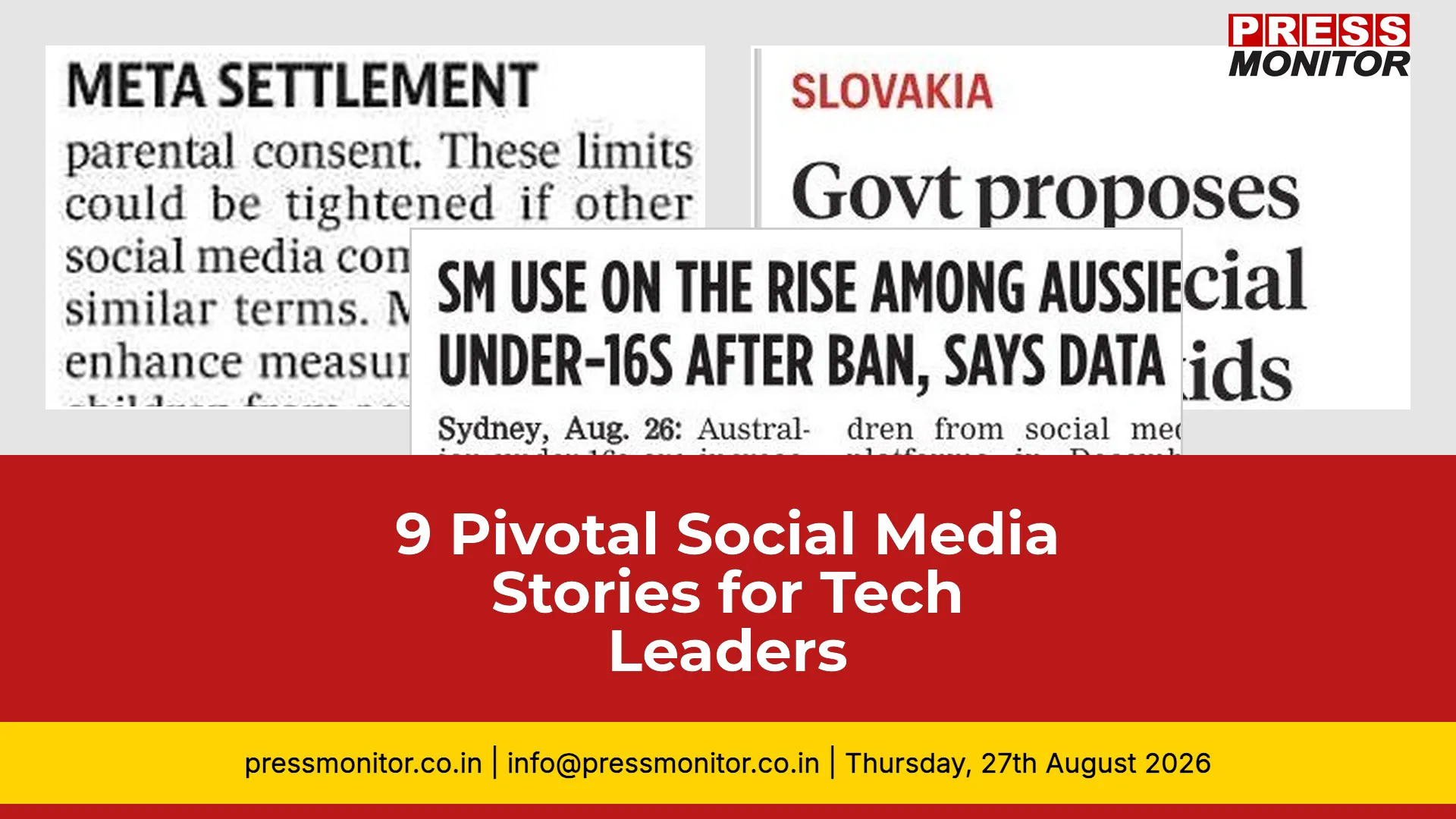
Consistent media monitoring reveals nine critical shifts in platform governance, youth safety, and digital accountability. According to Press Monitor's tracking of Indian publications, here are nine pivotal developments shaping the future of social media.
1. Meta Agrees to $18 Billion Settlement
A front-page report in Hindustan Times says Meta Platforms agreed to make major changes to Facebook and Instagram and pay up to $18 billion to resolve claims by most US states that it designed those platforms to addict children and misled consumers about their safety. The settlements announced end a federal trial that had been one of the highest-profile tests of allegations that social media companies harm children.
Why it matters: Landmark precedent for Big Tech liability regarding teen mental health and platform design.
Key detail: Meta will pay up to $18 billion and implement strict usage limits, daily time caps, and enhanced parental controls across Facebook and Instagram following claims from 47 US states.
Source: Hindustan Times
Next step: Watch how global regulators adapt these guardrails for emerging markets.
2. Slovakia Advances Under-16 Social Network Ban
Slovakia’s government approved a bill proposing a ban on social networks usage by children under 16 to curb addictive behavior, social pressure, and radicalization. If approved by parliament, it will restrict setting up social network accounts for younger children and mandate proof of age verification.
Why it matters: First major European legislative move targeting adolescent digital access.
Key detail: Parliament approved a bill restricting account creation for minors under 16, mandating robust age verification to curb radicalization and addictive behavior.
Source: Indian Express
Next step: Monitor enforcement mechanisms and potential pushback from tech platforms.
3. Australian Teens Defy Under-16 Social Media Ban
A front-page report in Asian Age says Australian under-16s are increasing their use of social media apps such as Instagram and Tiktok despite a world-leading ban.
Why it matters: Highlights the enforcement gap between policy and actual user behavior.
Key detail: Qustodio data shows under-16 usage of Instagram and TikTok actually increased post-ban implementation, signaling a need for better digital literacy over outright restrictions.
Source: Asian Age
Next step: Evaluate alternative regulatory models focusing on platform design rather than access bans.
4. Chhattisgarh Police Register FIRs Over AI-Generated Political Content
A front-page report in New Indian Express says police in Raipur have registered several FIRs over the past fortnight regarding AI-manipulated content and fake news targeting politicians. Individuals including Arun Pannalal, Supriya Shrinate, and Arun Sahu face charges for alleged defamation and the digital defacing of the national flag.
Why it matters: Marks a turning point in how Indian law enforcement treats synthetic media in political campaigns.
Key detail: Raipur police filed multiple complaints against individuals using AI tools to deface national symbols and spread fabricated videos targeting prominent politicians.
Source: New Indian Express
Next step: Prepare compliance frameworks for deepfake detection and rapid response protocols.
5. Delhi Arrests Suspect Behind Fake Social Media Harassment Campaign
A front-page report in The Pioneer says a 27-year-old man was arrested in Delhi for creating fake social media accounts in a woman's name to send obscene content to her husband and acquaintances. The accused, Jeetu Kumar, allegedly harassed the victim since 2022, leading to an FIR under the Information Technology Act.
Why it matters: Reinforces legal consequences of digital impersonation and cyberstalking.
Key detail: Jeetu Kumar was detained under the IT Act for creating fraudulent profiles to harass a woman and her associates, underscoring the real-world impact of online anonymity.
Source: The Pioneer
Next step: Audit internal reporting channels and strengthen victim support workflows.
6. Meta Plans Massive AI-Driven Workforce Restructuring
A front-page report in Financial Express says Meta CEO Mark Zuckerberg is planning to restructure the company by as much as sixty percent, replacing human staff with artificial intelligence and smaller human 'talent-dense' cadres.
Why it matters: Signals a strategic pivot toward automation that could reshape content moderation and ad operations.
Key detail: CEO Mark Zuckerberg intends to cut up to 60% of certain roles, replacing human moderators and analysts with AI systems and leaner talent-dense teams.
Source: Financial Express
Next step: Assess operational resilience and vendor dependency risks.
7. BJP Delegation Files Complaint Over Misleading Digital Posts
A front-page report in Statesman says a three-member delegation of the Delhi BJP, led by Member of Parliament Ramvir Singh Bidhuri, met Deputy Commissioner of Police, Central District, Rohit Rajbir Singh, to lodge a complaint against an alleged false and misleading post being circulated on social media by Congress and others about BJP's national president Nitin Nabin.
Why it matters: Demonstrates growing political reliance on rapid fact-checking and digital grievance redressal.
Key detail: MP Ramvir Singh Bidhuri led a team to Delhi Police to address viral misinformation concerning party leadership, highlighting the speed at which narratives spread online.
Source: Statesman
Next step: Develop proactive narrative management strategies aligned with electoral cycles.
8. Rahul Gandhi’s Claims Scrutinized by Independent Fact-Check Platform
A front-page report in Times of India says a website called 'jhooth ki goonj' has emerged to fact-check assertions made by Rahul Gandhi during his 'Chhatron ki goonj' initiative. The site claims 40 of his statements regarding unemployment and violence against women were false or misleading, though the BJP has denied any association with the platform.
Why it matters: Illustrates the rise of citizen-led verification tools challenging mainstream political discourse.
Key detail: The 'jhooth ki goonj' website flagged dozens of statements from the Chhatron ki goonj initiative as misleading, though the ruling party denies affiliation.
Source: Times of India
Next step: Integrate third-party verification APIs into communication dashboards.
9. Police Warn Against Provocative Social Media Posts Following Hanur Incident
A front-page report in Deccan Herald says Superintendent of Police M Muthuraj has warned that stern action would be taken and cases would be registered against those who post provocative statements and messages on social media related to the Hanur shootout incident.
Why it matters: Shows law enforcement prioritizing digital conduct during sensitive investigations.
Key detail: Superintendent M Muthuraj issued strict warnings against posting inflammatory commentary related to the Hanur shootout, threatening immediate legal action.
Source: Deccan Herald
Next step: Align public messaging guidelines with ongoing judicial processes.
This press review captures the accelerating intersection of technology, regulation, and public trust. How will your organization adapt to stricter platform governance? Stay informed with consistent media intelligence and disciplined print media monitoring.
